Accidents
Most truck accident cases start the same way — with an insurance claim. But a lot of them don't end there.
When the trucking company's insurer refuses to make a fair offer, when the evidence points to something more serious than a simple collision, or when the statute of limitations is closing in, filing a truck accident lawsuit becomes necessary. And when that happens, you're no longer dealing with an adjuster — you're dealing with a defense team that has handled hundreds of cases like yours.
I've seen what happens when victims go into litigation unprepared. I've also seen what happens when they don't. This article walks through the entire truck accident lawsuit process in Maryland, from the decision to file all the way to a jury verdict, so you know exactly what to expect.
Before we get into what a lawsuit looks like, it's worth understanding why so many truck accident cases end up there in the first place.
Commercial trucking companies carry substantial insurance — federal law requires at minimum $750,000 in liability coverage for most interstate carriers, and many large fleets carry $5 million to $10 million or more. That kind of money on the line means the defense side takes these cases very seriously, very early.
Within hours of a serious crash, carriers and their insurers often deploy what are called rapid response teams — an accident reconstructionist, an insurance adjuster, a defense attorney, and sometimes private investigators. Their job is to reach the scene before evidence disappears, secure the truck's data, interview witnesses, and start building a narrative in the carrier's favor. In some cases, they attempt to obtain recorded statements from injured victims while they're still in the hospital, disoriented, or medicated.
I tell every client the same thing: the defense clock starts the moment the crash happens. Yours should too.
Insurers also use several predictable tactics to avoid paying fair value. They make lowball early offers, knowing injured people facing mounting medical bills may feel pressure to accept. They delay, requesting the same documents repeatedly and reassigning adjusters mid-claim to exhaust your patience. They dispute causation through so-called "independent" medical examiners who almost always find in their client's favor. And they monitor social media, looking for a single photo — you carrying groceries, attending a birthday party — that they can weaponize.
When these tactics are in play and negotiations stall, filing a lawsuit is often the only way to force a real resolution.
One of the first strategic decisions in a truck accident lawsuit is where to file.
In Maryland, you can bring a truck accident case in one of two places: Maryland circuit court, or the U.S. District Court for the District of Maryland (federal court). Federal court is available when the parties are from different states and the claim exceeds $75,000 — which is almost always true in serious trucking cases.
Within Maryland's circuit courts, venue selection also matters. Where the accident occurred, where the defendant does business, and where you live are all factors that determine where suit can properly be filed. And where you file has real consequences — jury composition, local legal culture, and average verdicts vary significantly across Maryland's 24 circuit courts. Federal court in Maryland is competent and efficient, but typically viewed as more moderate.
This is one of the decisions where having experienced legal counsel makes a tangible difference. I analyze venue carefully before filing any trucking case.
A critical deadline to know: Maryland's statute of limitations for personal injury is three years from the date of the accident. For wrongful death, it's three years from the date of death. Pre-litigation negotiations do not pause this clock. Miss the deadline and your claim is gone, regardless of how strong it is.
A truck accident complaint in Maryland typically names multiple defendants — not just the truck driver.
Depending on the facts, a lawsuit may include the driver personally, the motor carrier (the trucking company), the freight broker who arranged the load, the shipper or cargo loader if improper loading contributed to the crash, third-party maintenance companies, and the truck manufacturer if a mechanical defect was involved.
Naming every potentially liable party matters strategically. Defense teams use what's called the "empty chair" defense — blaming an absent party who isn't in the room to defend themselves. If you didn't name them in the lawsuit, you can't effectively counter that argument.
The complaint typically asserts several legal theories simultaneously: basic negligence, negligence per se (meaning the defendant violated a federal trucking regulation that was designed to prevent exactly this kind of crash), respondeat superior (holding the trucking company responsible for its driver's actions), negligent hiring, and negligent entrustment. Each theory creates a different path to liability, and in a well-built case, they reinforce each other.
Once the defendants are served, they typically have 30 days to respond if they're located in Maryland, or 60 days if they're out of state. Expect their answer to assert every possible defense — including Maryland's contributory negligence doctrine, which I'll address in a moment.
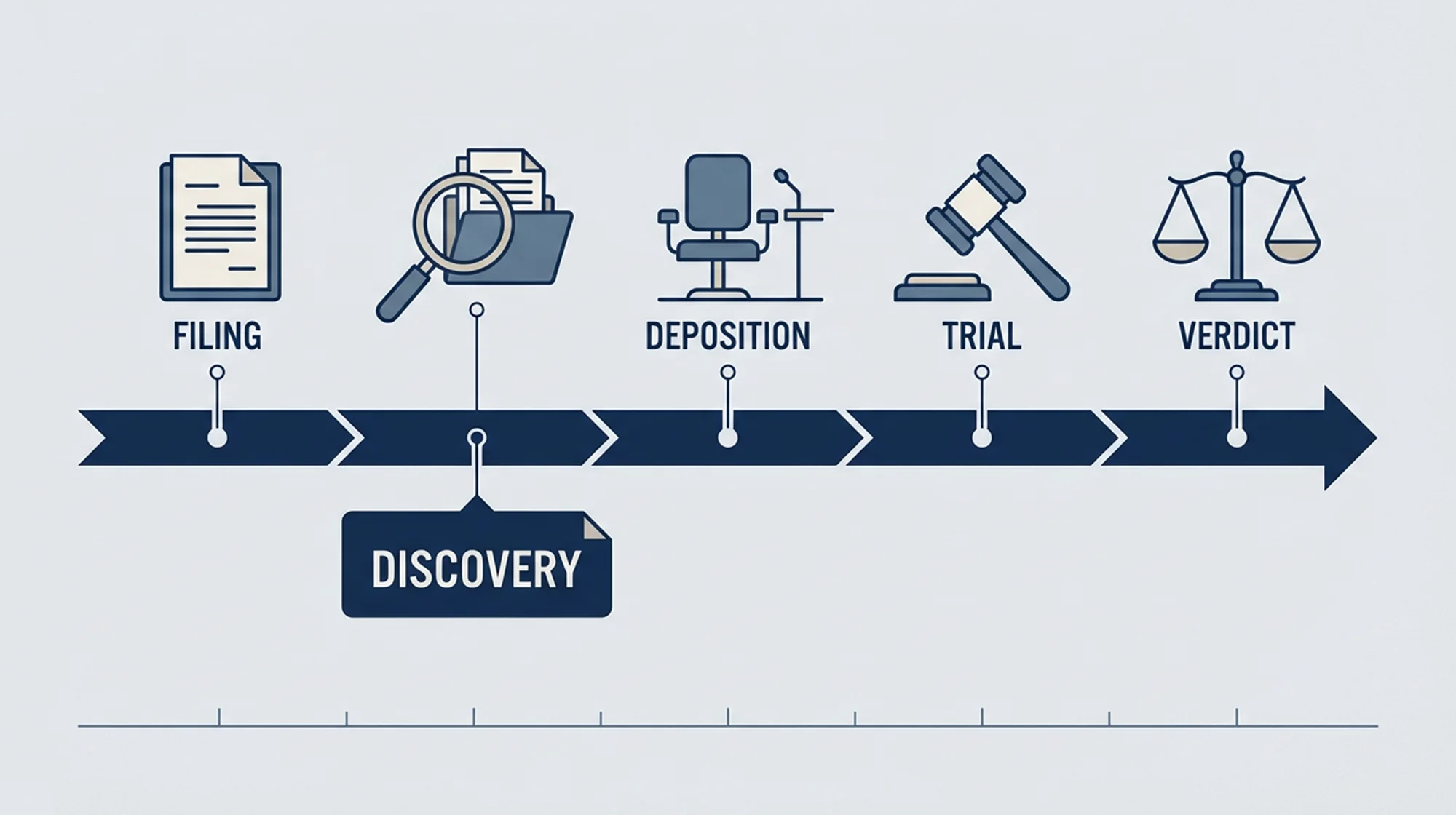
Discovery is the heart of truck accident litigation. It's what makes these cases fundamentally different from ordinary car accident lawsuits — and it's where the most powerful evidence lives.
Federal regulations require trucking companies to generate and maintain extensive records. Through formal discovery, we can demand those records. Here's what we go after:
Driver Qualification Files. Every motor carrier must maintain a qualification file for each driver that includes their 10-year commercial driving history, motor vehicle records from every state, road test certificates, annual driving record reviews, and their medical examiner's certificate. This file is often the single most important category of discovery in a trucking case. It can reveal a history of violations, prior accidents, medical conditions, and inadequate background checks that prove negligent hiring.
Electronic Logging Device (ELD) Data. Federal law requires most commercial truck drivers to use registered electronic logging devices that connect directly to the truck's engine and automatically record driving time, location, engine hours, and vehicle miles. ELD data can prove a driver was violating federal hours-of-service rules — meaning they were too fatigued to be legally behind the wheel. This data is only required to be retained for six months, which is one reason acting quickly matters so much.
The "Black Box" — ECM Data. Commercial trucks have Engine Control Modules that record vehicle speed, brake application, throttle position, cruise control status, hard-braking events, and engine fault codes. When triggered by a crash, this module typically captures 30 seconds to two minutes of pre-event data. It can confirm or destroy the defense's version of what happened. But here's the problem: ECM data can be overwritten by continued vehicle operation after the crash. Without a rapid preservation demand, it can disappear.
Maintenance and Inspection Records. Motor carriers are required to systematically inspect and maintain their vehicles, and document everything. These records can reveal whether the truck had known mechanical problems that were ignored — brake failures, tire issues, lighting defects — before the crash that injured you.
Drug and Alcohol Testing Records. Federal law requires post-accident drug testing within 32 hours and alcohol testing within 8 hours of a qualifying crash. We can demand the results. We can also query the FMCSA Drug & Alcohol Clearinghouse — a federal database operational since 2020 that tracks every positive test, refusal, and violation in the commercial driver's history.
Dashcam and Telematics Data. Many modern commercial trucks have forward-facing cameras, driver-facing cameras, and real-time GPS and telematics systems that record speed, location, and driving behavior continuously. This footage may have captured the crash directly — but it may also be stored on short loops that overwrite automatically. Again, time matters.
Internal Safety Records and CSA Data. The FMCSA's Safety Measurement System ranks carriers across seven safety categories. A carrier with chronic violations in areas like unsafe driving or hours-of-service compliance has a documented history that supports negligent retention and, in egregious cases, punitive damages.
The duty to preserve evidence begins the moment litigation is reasonably foreseeable — which in a serious truck crash means immediately. I send a formal spoliation and preservation letter within 24 to 48 hours of being retained, demanding that the carrier preserve every piece of electronic and documentary evidence.
Maryland courts recognize spoliation sanctions when evidence is deliberately or negligently destroyed. Those sanctions range from an adverse inference instruction — where the jury is told to assume the destroyed evidence would have hurt the defendant — all the way to striking defenses or entering a default judgment. But none of that helps if we don't demand preservation fast enough.
Once written discovery is exchanged, depositions begin. In a trucking case, the depositions I prioritize are:
The truck driver. Their driving history, their actions on the day of the crash, their hours-of-service compliance, their training, and any prior incidents. Everything they say under oath is on the record.
The carrier's safety director. What safety policies existed? How did the company monitor its drivers? What did they know about this driver's record before putting them on the road?
Fleet managers and dispatchers. What pressure was placed on this driver? What were the schedule demands? Were there communications — texts, satellite messages, dispatch software logs — that document that pressure?
Corporate representative depositions. Under Maryland Rule 2-412(d), we can name the corporation itself as a deponent and describe the topics of examination. The company must then designate witnesses who testify on its behalf, and that testimony binds the organization. This is one of the most powerful discovery tools in a trucking case.
I won't bury this. Maryland is one of only four states — along with Alabama, North Carolina, and Virginia — that follows pure contributory negligence as a complete bar to recovery. That means if a jury finds that you bear even 1% of fault for the accident, you recover nothing.
Zero.
This rule makes every aspect of a Maryland truck accident lawsuit more consequential. Defense teams invest heavily in finding evidence of any plaintiff fault — a momentary glance at a phone, a slightly elevated speed, a lane change made a second too late. In a comparative fault state, that might reduce your recovery by 10%. In Maryland, it eliminates it entirely.
The Maryland Supreme Court had the opportunity to change this rule as recently as 2025, when a petition was filed urging the court to adopt comparative negligence. The court declined. As of today, contributory negligence remains the law.
This is why building a clean, well-documented case from the very beginning matters so much. My job in every trucking case is to eliminate any credible argument that my client bears any fault. That requires evidence, experts, and preparation — not assumptions.
Before the trial itself, both sides file motions asking the judge to make rulings on what evidence the jury will and won't hear.
We typically seek admission of the carrier's FMCSA regulatory violations as evidence of negligence per se — meaning the violation itself establishes the breach of duty. Maryland courts recognize this framework: if a federal trucking regulation was designed to protect people in exactly your client's position, and the carrier violated it, that violation establishes both duty and breach. The plaintiff then only has to prove causation and damages.
We also seek to introduce the driver's prior accident history, prior violations, and any employment record showing the carrier knew — or should have known — that this driver was a risk before putting them behind the wheel.
One important development for Maryland litigants: in 2020, the Maryland Supreme Court formally adopted the Daubert standard for expert testimony admissibility, replacing the older Frye-Reed standard.
When a truck accident lawsuit goes to trial, the plaintiff presents their case first. That means calling witnesses — the investigating officer, eyewitnesses, treating physicians, and retained experts — and introducing documentary evidence: ELD data, dashcam footage, maintenance logs, and qualification files.
Expert witnesses play an especially prominent role in trucking cases. A thorough trial typically involves an accident reconstructionist to establish how the crash happened, a trucking safety and FMCSA regulatory expert to explain how the carrier violated federal standards, medical experts to tie the crash to the specific injuries, and often vocational rehabilitation specialists and economists to calculate lost earning capacity and future care needs.
The defense presents its case after the plaintiff rests. Expect an aggressive focus on contributory negligence — any evidence of plaintiff fault, however minor. Expect defense medical examiners who find injuries are pre-existing. Expect biomechanical engineers who argue the crash forces were insufficient to cause the claimed injuries. Expect the empty chair defense if any potentially liable party wasn't named.
A note on damages in Maryland: The jury can award both economic damages (medical bills, lost wages, future care costs) and non-economic damages (pain and suffering, disability, disfigurement). Economic damages are uncapped. Non-economic damages are subject to a statutory cap that adjusts annually — for injuries occurring between October 1, 2025 and September 30, 2026, the cap is $965,000 for a single plaintiff. For wrongful death with two or more beneficiaries, the cap is $1,447,500. Importantly, the jury is not told about the cap — they return a verdict and the judge reduces it if necessary.
Punitive damages are available in Maryland, but the standard is one of the hardest in the country to meet. The plaintiff must prove "actual malice" — conscious, deliberate wrongdoing — by clear and convincing evidence, which is an incredibly difficult burden to meet and I am not aware of any reported Maryland automobile or trucking tort cases where punitive damages were awarded.
A trial verdict isn't always the final word.
In Maryland, post-trial motions must be filed within 10 days of the verdict — notably shorter than the 28-day window in federal court. Missing that deadline is jurisdictional, meaning the court loses the power to consider the motion. If the verdict stands, the losing party has 30 days to file a notice of appeal.
Appeals go first to the Appellate Court of Maryland (formerly the Court of Special Appeals), heard by three-judge panels. Further discretionary review by the Supreme Court of Maryland is available but not guaranteed.
Once the judgment is final, collection may require additional steps if the defendant or insurer doesn't voluntarily satisfy it. Maryland's MCS-90 endorsement — a mandatory attachment to every interstate carrier's liability policy — ensures that at minimum, the federally required insurance limits are available, even if the insurer would otherwise attempt to deny coverage based on a policy exclusion.
I want to be direct about something. I handle both car accident cases and trucking cases, and they are not the same category of litigation.
The federal regulatory framework transforms what's available as evidence. The multiplicity of defendants creates complex, overlapping liability dynamics. The insurance limits attract sophisticated, well-funded defense teams who begin working the case before the victim has left the hospital. And the injury severity — these are 80,000-pound vehicles colliding with 4,000-pound cars — often means catastrophic, life-altering outcomes that require exhaustive damages work to fully capture.
The difference in outcomes between victims who have specialized representation and those who don't is not marginal. It is substantial. Evidence that gets preserved in the first 48 hours might not exist 30 days later. A driver qualification file that reveals a carrier knowingly hired a driver with a pattern of violations is either obtained through discovery or it isn't. A spoliation motion filed after evidence is destroyed is always less powerful than a preservation letter sent before it disappears.
If you or someone you love has been seriously injured in a truck accident in Maryland, the time to act is now — not after you've tried to navigate the insurance process alone.
I represent victims of serious truck accidents throughout Maryland. If your case hasn't settled — or if you're trying to understand whether it should — I'm happy to have a straightforward conversation about where things stand and what your options are.
You can contact me at SG Legal Group here. There's no fee unless we recover for you.
For more on how trucking cases are valued, see How Much Is a Truck Accident Case Worth? For a deeper look at liability and insurance in commercial vehicle crashes, see Truck Accident Liability and Commercial Vehicle Safety Issues. For more information about our truck accident practice, visit our Truck Accidents practice page.
Disclaimer: The information provided in this article is for general informational purposes only and does not constitute legal advice. Laws and regulations are subject to change, and individual circumstances vary. For advice specific to your situation, please consult with a qualified attorney.
Joshua C. Sussex, Esq.
Stay informed with our latest articles and resources.