Accidents
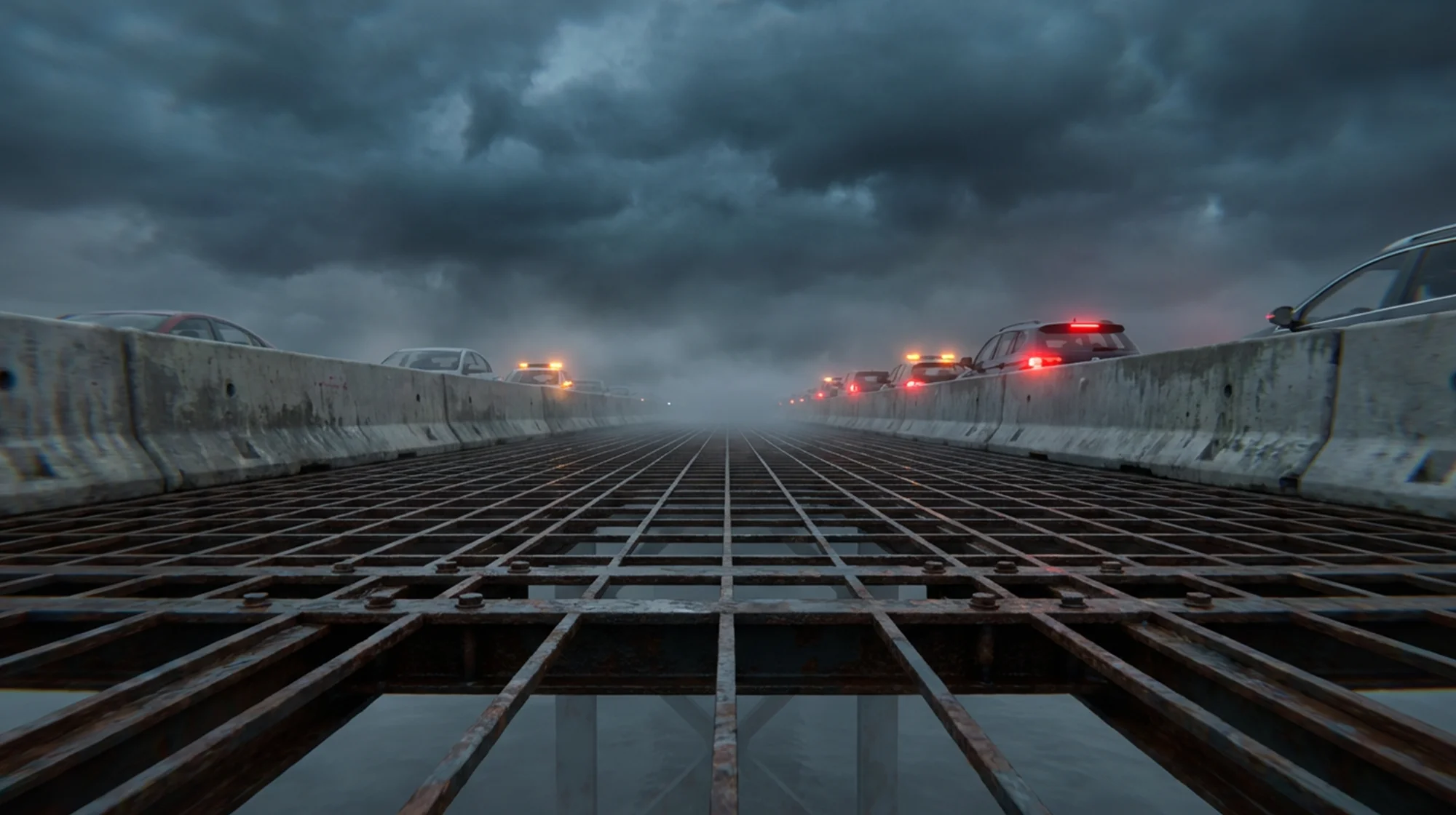
Four miles of open water beneath you. No shoulders. Lanes so narrow your mirrors nearly scrape the Jersey barriers. And when traffic stops — which it does constantly during beach season — the car behind you is closing at highway speed with nowhere to go.
If you've been in an accident on Maryland's Chesapeake Bay Bridge, you already know how terrifying it is. What you probably don't know is that the legal process for recovering compensation after a Bay Bridge crash is fundamentally different from a typical car accident anywhere else in the state. You're not just dealing with another driver and their insurance company. You may be filing a claim against the Maryland Transportation Authority — a state agency — and that triggers an entirely separate set of rules, deadlines, and damage limits that can eliminate your case before it even begins if you don't know what you're up against.
I'm Joshua C. Sussex, a personal injury attorney at SG Legal Group. I want to walk you through exactly how Bay Bridge accident claims work, what makes them so much harder than other Maryland car accident cases, and what you need to do to protect your rights — especially in the first days after a crash.
I want to clear something up because the confusion is everywhere right now. The Francis Scott Key Bridge carried I-695 over the Patapsco River in Baltimore. It collapsed in March 2024 after a container ship struck one of its support piers. That bridge is currently being rebuilt.
The Chesapeake Bay Bridge — formally the William Preston Lane Jr. Memorial Bridge — is a completely different structure in a completely different part of the state. It carries US-50/US-301 from Sandy Point in Anne Arundel County across the Chesapeake Bay to Kent Island in Queen Anne's County. It is the only direct vehicle link between Maryland's Western Shore and the Eastern Shore, and it is fully operational. Both bridges are operated by the Maryland Transportation Authority, which is important for legal purposes, but they are separate facilities with separate histories and separate safety profiles.
This article is about the Bay Bridge — the one you cross to get to Ocean City.
The Bay Bridge handles enormous traffic volumes. Peak summer Saturdays routinely see over 100,000 vehicles crossing the span. Holiday weekends push even higher. The bridge was designed in the 1940s and 1950s for traffic levels that bear no resemblance to what it handles today.
The structural features that make the bridge dangerous are well-documented and have been the subject of federal safety reviews for decades.
Narrow Lanes With No Shoulders
The travel lanes are significantly narrower than modern highway standards. There are no shoulders on the bridge. If your car breaks down, you stop in a travel lane. If you need to avoid a collision, there is no escape route. Every accident on the bridge becomes a blocked-lane situation, which immediately creates the conditions for secondary chain-reaction crashes.
Steel-Grate Decking
The older eastbound span, which opened in 1952, still has sections of open steel-grate deck. In wet conditions, the grating reduces tire traction compared to concrete or asphalt. Drivers unfamiliar with the surface sometimes brake suddenly when they feel their tires lose grip, which contributes to rear-end collisions.
Contraflow Two-Way Traffic Operations
During peak eastbound travel — Friday afternoons and Saturday mornings in summer — MDTA converts the westbound span to carry two-way traffic. This means eastbound vehicles travel on a span that was designed for westbound traffic only, separated from oncoming vehicles by nothing more than traffic cones and temporary signage. The history of fatal crossover collisions during contraflow operations is well-documented.
High Wind Exposure
The bridge sits 186 feet above the Chesapeake Bay at its highest point, fully exposed to wind from every direction. MDTA operates a tiered wind restriction policy: speed reductions begin at 30 mph winds, vehicle-type restrictions kick in at 40 mph, and the bridge closes entirely at sustained winds of 55 mph. High-profile vehicles like empty box trucks and RVs are especially vulnerable to crosswind incidents.
Stop-and-Go Traffic Patterns
During summer weekends and holidays, traffic regularly backs up on the bridge itself. Drivers approaching at highway speed encounter vehicles stopped or crawling with no advance warning beyond variable message signs — which are only useful if they're operational and the driver is paying attention. This is the recipe for the kind of high-speed rear-end collision that turns deadly on a bridge with no shoulders and low guardrails.
The Bay Bridge has been the scene of serious and fatal crashes for decades. A few incidents illustrate the patterns that repeat themselves.
In 2008, an early-morning crossover collision on the eastbound span sent a tractor-trailer through a Jersey barrier and off the bridge into the Bay. The truck driver drowned. Post-crash investigations revealed corrosion in the steel reinforcements inside the barrier walls — a maintenance issue that directly affected the barrier's ability to contain the vehicle.
In 2013, a college student's car was rear-ended by a tractor-trailer in slow-moving traffic on the bridge. The impact pushed her vehicle over the Jersey barrier and off the bridge. She survived by escaping through a broken window and swimming to the riprap at the base of a bridge pier. The incident prompted a federal review of bridge barrier height standards.
In January 2024, dense fog contributed to a 43-vehicle pileup on the westbound span. Thirteen people were injured and the span was shut down for six hours. A driver was later charged with DUI in connection with the initial collision.
These aren't freak occurrences. They are the predictable result of the bridge's design limitations interacting with heavy traffic, weather, and human error. And when the cause of a crash involves the bridge itself — its maintenance, its traffic management, or its safety features — the legal analysis shifts from a simple car accident claim to something much more complex.
Most people think of premises liability as a slip-and-fall at a grocery store. But premises liability is broader than that. It is the legal principle that a property owner or operator owes a duty of care to people who enter the property. When the property is a toll bridge operated by a state agency, the analysis gets complicated — but the core principle still applies.
Maryland follows a traditional classification system for premises liability. The duty a property owner owes depends on the visitor's legal status: invitee, licensee, or trespasser. Each category carries a different level of obligation from the property owner. I've written about how this framework operates in detail in our premises liability and contributory negligence article.
Here's what matters for Bay Bridge cases: you are paying a toll to cross that bridge. The Maryland Transportation Authority is a self-supporting, revenue-bond enterprise. It collects tolls to fund its operations. That makes you a business invitee — the category that receives the highest duty of care under Maryland law. MDTA owes you a duty to use reasonable care to keep the bridge safe and to warn you of unreasonable risks that you wouldn't discover on your own through ordinary care.
That duty doesn't mean MDTA guarantees your safety. It means MDTA must act reasonably — inspect the bridge, maintain it, warn drivers of hazards, and manage traffic in a way that doesn't create unnecessary danger.
When MDTA fails in those duties — a known pothole goes unrepaired, a variable message sign is offline during a fog event, contraflow operations continue during conditions that MDTA's own policy prohibits — you may have a premises liability claim against the State.
Here is where Bay Bridge cases diverge sharply from every other car accident case in Maryland. Because MDTA is a state agency, you cannot simply file a lawsuit the way you would against another driver or a private company. Your claim is governed by the Maryland Tort Claims Act, found at Maryland Code, State Government §§ 12-101 through 12-110.
The MTCA waives the State's sovereign immunity for tort claims, which means you can sue — but only under strict conditions that don't apply to claims against private parties.
The $400,000 Damages Cap
Under the MTCA, the State's liability is capped at $400,000 per individual claimant for injuries arising from a single incident. That cap applies regardless of the severity of your injuries. Whether you suffered whiplash or a spinal cord injury, the State's maximum exposure is the same. This is separate from and much lower than Maryland's general noneconomic damages cap, which applies to private defendants and currently sits near $920,000. Attorney's fees in MTCA cases are also limited — 20% of a settlement, 25% of a judgment.
This cap has enormous practical implications. If you were hit by another driver on the Bay Bridge and your injuries are severe, the other driver's insurance may be your primary path to meaningful compensation — not the State. But if the crash was caused or worsened by a bridge condition rather than another driver, you may be stuck with the MTCA cap as your ceiling.
The One-Year Notice Requirement
This is the deadline that catches people off guard. Before you can file a lawsuit against the State, you must submit a written claim to the Maryland State Treasurer's Insurance Division within one year of the date of your injury. If you miss this deadline, your claim is likely dead — regardless of how strong it is on the merits.
The general statute of limitations for personal injury in Maryland is three years. Most people assume they have that full window. They don't — not when the State is a defendant. The one-year notice runs while you're still recovering, still getting medical treatment, still trying to understand what happened. I cannot overstate how important it is to get legal counsel involved early in any Bay Bridge crash where bridge conditions may have contributed to the accident.
The Discretionary Function Defense
Even when you satisfy every procedural requirement, the State has another powerful defense: discretionary function immunity. Maryland law protects government decisions that involve policy judgment — things like how wide to make the lanes, what type of guardrail to install, or whether to build shoulders. These are considered discretionary choices that courts will not second-guess.
What is not protected is the failure to perform specific, routine maintenance tasks after the agency knows about a problem. If MDTA's own inspections identified a deck defect and the repair wasn't made, that's a ministerial failure — not a discretionary choice. If wind sensors showed conditions that should have triggered bridge restrictions but the restrictions weren't implemented, that's arguably operational negligence. The distinction between discretionary and ministerial acts is where most Bay Bridge premises liability cases are won or lost.
Maryland is one of only four states that still follows pure contributory negligence. Under this doctrine, if you bear any fault at all for the accident — even one percent — you recover nothing. The insurance company or the State's lawyers don't need to prove you were mostly at fault. They just need to show you contributed to what happened.
On the Bay Bridge, the contributory negligence defense is devastating. Were you following too closely in heavy traffic? Did you fail to reduce speed when visibility dropped? Were you driving a high-profile vehicle during posted wind restrictions? Did you look at your phone for three seconds before hitting the car ahead of you? Any of these can be argued as contributory negligence, and any one of them can destroy your claim entirely.
The only meaningful exception is the last clear chance doctrine, which allows recovery if the defendant had a final opportunity to avoid the accident after your own negligence had placed you in danger and failed to take it. It's a narrow doctrine and hard to prove, but it matters in chain-reaction Bay Bridge pileups where following distance is an issue for everyone involved.
I've written extensively about how contributory negligence interacts with premises liability in this article. If you were hurt on the Bay Bridge, understanding this rule is essential.
Many of the most serious Bay Bridge crashes involve commercial trucks. The 2008 plunge, the 2013 rear-end collision — both involved tractor-trailers. Trucks are especially dangerous on the Bay Bridge because of the narrow lanes, the wind exposure, and the stop-and-go traffic patterns that create closing-speed differentials between a loaded truck and a stopped passenger car.
When a commercial truck is involved, the legal landscape opens up considerably. The trucking company, the driver, the cargo loader, and the maintenance provider may all carry separate insurance policies with limits far exceeding the MTCA's $400,000 cap. Federal Motor Carrier Safety Administration regulations create additional standards of care. If the truck driver violated hours-of-service rules, or the carrier had a history of safety violations, those facts strengthen your claim against the private defendants — even if the State's share is capped.
I handle truck accident cases regularly and have written about the liability structure in commercial vehicle crashes and what to expect when filing a semi-truck accident lawsuit. If your Bay Bridge crash involved a commercial vehicle, these resources explain why the case is worth investigating aggressively.
Bay Bridge cases are won or lost on evidence gathered in the first 48 hours. Here is what matters most.
MDTA traffic camera footage. The bridge is monitored by multiple camera systems. This footage can show traffic conditions, weather, the sequence of the collision, and whether variable message signs were active. But it won't be preserved forever — requesting it early is critical.
Wind sensor data. MDTA operates anemometers on the bridge. If wind was a factor, the sensor logs will show whether conditions warranted restrictions and whether those restrictions were actually implemented.
DriveEzMD toll records. Toll timestamps can establish when a vehicle entered the bridge and, in some cases, how fast it was traveling relative to other vehicles.
MDTA Police crash reports. The Maryland Transportation Authority Police have primary jurisdiction on the bridge. Their crash reports contain information about road conditions, weather, contributing factors, and witness statements.
Dashcam and cell phone footage. If you or any other driver had a dashcam running, that footage may be the single most important piece of evidence in the case.
Medical records from the first 72 hours. Prompt medical treatment creates a clear record linking your injuries to the crash. Delays in treatment give the defense ammunition to argue your injuries weren't serious or weren't caused by the accident.
For a step-by-step guide on what to do immediately after any car accident, including evidence preservation, read our post-crash guide.
Two major developments are reshaping the Bay Bridge safety landscape. First, the Bay Crossing Study has advanced a preferred alternative that would replace both existing spans with two new four-lane bridges featuring full shoulders and modern safety features. Construction isn't expected before 2032, and the projected cost is in the range of $7 to $8 billion. Until then, the 1952 and 1973 spans remain in service with all of their existing limitations.
Second, the Key Bridge collapse triggered a reassessment of pier-protection measures on bridges across the country. MDTA has launched a pier-protection design-build project for the Bay Bridge with a budget exceeding $145 million. The agency has also invested over $175 million in bridge safety and security improvements over the past decade.
These investments matter legally. When a government agency identifies a risk and commits resources to address it, that acknowledgment strengthens the argument that the agency had notice of the hazard. A plaintiff injured before the fix is completed has a meaningful notice-based claim — the agency knew, committed to fixing it, and hadn't gotten there yet.
Bay Bridge accident cases are some of the most procedurally complex personal injury claims in Maryland. You're potentially dealing with a state agency defendant, a $400,000 damages cap, a one-year notice deadline that most people don't know about, and a contributory negligence rule that can eliminate your case if the defense finds any fault on your part — no matter how small.
None of that means your case is hopeless. It means your case requires an attorney who understands the specific rules that apply, who knows how to identify and preserve the evidence that matters, and who can move quickly on the statutory deadlines.
If you or someone you care about was injured in a crash on the Chesapeake Bay Bridge, I'm happy to talk through your situation and help you understand where you stand. There's no cost for that conversation. Contact me at SG Legal Group or call 410-618-1277 to get started.

Disclaimer: The information provided in this article is for general informational purposes only and does not constitute legal advice. Laws and regulations are subject to change, and individual circumstances vary. For advice specific to your situation, please consult with a qualified attorney.
Joshua C. Sussex, Esq.
Stay informed with our latest articles and resources.