Accidents
A fully loaded big rig can weigh 80,000 pounds. When one of these trucks causes a crash, the devastation to everyone in its path is almost always catastrophic — broken bones, traumatic brain injuries, crushed vehicles, and too often, death.
But here's what most people don't realize in the aftermath: the driver behind the wheel is rarely the only party responsible for what happened. Big rig accidents are fundamentally different from car accidents because there is almost always a chain of companies, contractors, and decision-makers behind that single truck on the highway. And each one of them may share legal responsibility for your injuries.
In my practice at SG Legal Group, I've handled trucking accident cases where identifying the right defendants meant the difference between a modest settlement from one insurance policy and a substantially larger recovery spread across multiple liable parties. This article explains who those parties are, why they matter, and how finding every one of them can change the outcome of your case.
In a typical car accident, the liability picture is usually straightforward. One driver hits another. You file a claim against that driver's insurance. The case moves forward.
Big rig accidents don't work that way.
The trucking industry operates through a web of relationships — carriers contract with drivers, brokers arrange loads, shippers pack cargo, maintenance companies service equipment, and manufacturers build the components. When a crash happens, the failure that caused it can often be traced back through several of these links.
Federal data tells the story of why this matters. In 2023, 5,375 large trucks were involved in fatal crashes across the United States, and more than 150,000 people were injured in crashes involving large trucks. The occupants of passenger vehicles bear the worst of it — roughly two-thirds of fatalities in large truck crashes are people in the smaller vehicles. These aren't fender benders. The injuries are severe, the medical bills are enormous, and a single insurance policy often isn't enough to cover what victims are owed.
That's why identifying every liable party isn't just a legal strategy — it's a practical necessity.
The driver is the most obvious starting point. Truck driver negligence takes many forms: speeding, distracted driving, driving under the influence, or violating federal Hours of Service regulations that limit how long a driver can be on the road without rest.
The Federal Motor Carrier Safety Administration (FMCSA) requires drivers of commercial motor vehicles to follow strict rules. A property-carrying driver cannot drive more than 11 hours after 10 consecutive hours off duty, and cannot drive beyond 14 hours after coming on duty. Electronic Logging Devices (ELDs) are now mandatory to track these hours, replacing the paper logbooks that were notoriously easy to falsify.
When a driver causes a crash after exceeding these limits — or while impaired, or while texting — that driver is personally liable. But in my experience, the driver is often the least financially significant defendant in a big rig case. Many truckers carry limited personal assets. The real recovery lies with the entities behind the driver.
The motor carrier — the company that operates the truck or employs the driver — is frequently the most important defendant in a big rig crash case.
Under the legal doctrine of respondeat superior, an employer is liable for the negligent acts of its employees when those acts occur within the scope of employment. If a company driver causes a crash while hauling a load for the carrier, the carrier is on the hook.
But carrier liability goes beyond just respondeat superior. Trucking companies have independent duties that, when violated, create their own basis for liability. These include negligent hiring, meaning the carrier failed to properly vet a driver's qualifications, driving record, or criminal history before putting them behind the wheel. They also include negligent supervision, where the carrier knew or should have known that a driver was violating safety rules and did nothing about it. And there's negligent retention — keeping a driver on the road after incidents, violations, or failed drug tests that should have triggered removal.
The FMCSA requires carriers to maintain detailed Driver Qualification Files, including motor vehicle records, medical certificates, road test results, and employment history going back three years. When a carrier cuts corners on these requirements, that's powerful evidence of negligence.
Here's where it gets strategically important: federal law requires interstate carriers hauling general freight to carry a minimum of $750,000 in liability insurance. Carriers hauling hazardous materials must carry between $1 million and $5 million. Many large carriers also carry excess or umbrella policies worth millions more. Identifying the carrier — and all of its insurance layers — is essential to accessing the full pool of available compensation.
Sometimes the truck involved in a crash is owned by one entity and operated by another. This is common in leasing arrangements, where an owner-operator leases a vehicle to a motor carrier or where a leasing company provides trucks to carriers under contract.
When the owner and operator are different entities, both may be liable. The owner may have obligations related to vehicle maintenance, roadworthiness, and insurance. If the owner leased a truck with known mechanical defects — bad brakes, worn tires, faulty lighting — that owner can be held responsible alongside the carrier and driver.
This is one of the most overlooked defendants in trucking litigation, and it's an area I pay close attention to.
Freight brokers are the middlemen of the trucking industry. They connect shippers who need cargo moved with carriers who have trucks available. Brokers don't drive trucks or own them — but they choose which carriers get the load. And that selection process matters enormously.
If a broker assigns a load to a carrier with a poor safety record, a history of violations, an unsatisfactory FMCSA safety rating, or inadequate insurance, that broker may be liable for negligent selection. The broker had a duty to vet the carrier before entrusting it with the shipment, and failing to do so can make the broker a co-defendant in your lawsuit.
Federal courts have increasingly recognized broker liability in trucking accident cases, particularly where the broker knew or should have known about a carrier's safety deficiencies. The FMCSA maintains publicly available safety data — including carrier inspection results, crash history, and safety ratings — that any broker can and should check before booking a load. When they don't, injured victims have a legitimate claim against them.
This matters for your recovery because brokers often carry their own liability insurance, adding another policy to the pool of available compensation.
How cargo is loaded onto a big rig directly affects whether that truck can be controlled safely on the road. Improperly loaded, overweight, or unsecured cargo is a leading factor in rollover accidents, jackknife incidents, and cargo spill crashes.
Federal cargo securement standards (49 CFR Part 393) specify exactly how different types of freight must be tied down, braced, and distributed across a trailer. When a shipper or third-party loading company violates these standards — by overloading one side of the trailer, exceeding federal weight limits of 80,000 pounds gross vehicle weight, or failing to properly secure freight — and that violation contributes to a crash, the loading company is a liable party.
I've seen cases where the driver did nothing wrong operationally, but the trailer was loaded so poorly that the truck became uncontrollable at highway speeds. In those situations, the shipper or loader bears primary responsibility, not the driver.
Big rigs require constant maintenance. Brakes, tires, steering components, lights, coupling devices — all of it must be inspected, serviced, and replaced on strict schedules mandated by federal regulations.
Many carriers outsource this work to third-party maintenance and repair shops. When one of those shops performs defective repairs — or signs off on an inspection without actually doing the work — and a mechanical failure causes a crash, the maintenance company is liable.
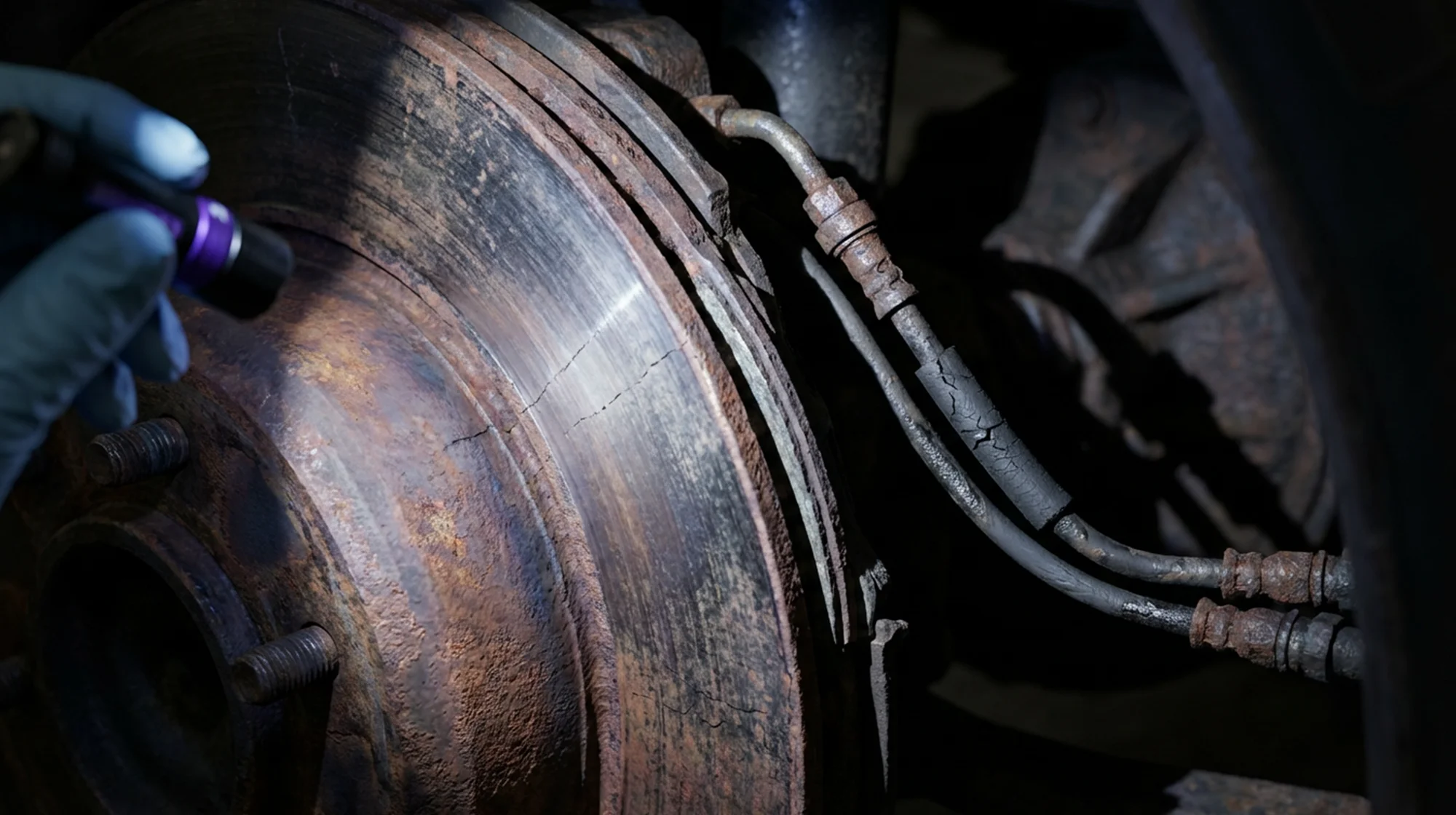
Brake failures are a prime example. The FMCSA has identified brake-related issues as one of the most frequently cited violations during roadside inspections. If a maintenance shop recently serviced a truck's brakes and those brakes failed during the crash, that shop's work records, invoices, and inspection reports become critical evidence.
Carriers are required to maintain systematic inspection, repair, and maintenance records for every vehicle in their fleet. When I take on a trucking case, obtaining these records early is a priority — because they often reveal a pattern of deferred maintenance, skipped inspections, or known defects that were never corrected.
Sometimes the crash isn't caused by human error at all — it's caused by a defective product. A tire that blows out due to a manufacturing defect. A braking system that fails because of a design flaw. A coupling device that separates because it wasn't built to specification.
In these situations, the manufacturer of the truck, trailer, or defective component can be held liable under product liability law. Maryland recognizes product liability claims based on negligence, strict liability, and breach of warranty. Victims don't need to prove that the manufacturer was careless — only that the product was defective and that the defect caused their injuries.
Product liability claims in trucking cases often require expert analysis. Accident reconstruction specialists, mechanical engineers, and metallurgists may need to examine the failed component to determine whether a manufacturing or design defect was present. These claims take time and resources to build, but they can unlock significant additional compensation — particularly when the defect affects an entire product line and the manufacturer has deep pockets and substantial insurance coverage.
In some cases, the condition of the road itself contributes to a big rig crash. Poorly maintained highways, missing guardrails, obscured signage, defective traffic signals, or road design flaws can all be contributing factors.
When a government entity — whether local, state, or federal — is responsible for maintaining the road where the crash occurred, that entity may be a liable party. However, government liability claims come with special rules, including sovereign immunity protections and strict notice requirements. In Maryland, claims against government entities under the Maryland Tort Claims Act require compliance with specific procedural deadlines, and the available damages may be subject to caps.
These claims are complex, but they shouldn't be overlooked — especially in cases where road conditions played a clear role in the crash.
Here's the practical reality: big rig crashes cause catastrophic injuries. Traumatic brain injuries, spinal cord damage, multiple fractures, internal organ damage, and burn injuries are common. The medical bills alone can reach hundreds of thousands or even millions of dollars. Lost wages, lost earning capacity, and the long-term impact on quality of life compound those losses further.
A single insurance policy — even a $750,000 federal minimum — may not come close to covering those damages. But when you identify and pursue claims against the carrier, the broker, the shipper, the maintenance company, and the manufacturer, you're accessing multiple insurance policies and multiple pools of assets. That's how big rig cases reach their full value.
In Maryland, this strategic approach is especially important because of the state's contributory negligence rule. Maryland is one of only a few states where a plaintiff who is even slightly at fault for the accident can be barred from recovering any compensation. Trucking company defense teams know this, and they aggressively look for ways to shift blame onto the victim. Having multiple defendants means having multiple sources of evidence, multiple insurance adjusters to negotiate with, and multiple avenues for recovering what you're owed — even if one defendant tries to play hardball.
Identifying liable parties is only possible when you have the evidence to prove their involvement. In big rig cases, that evidence includes the truck's Electronic Control Module (ECM) — the "black box" — which records speed, braking, throttle position, and other data in the moments before and during a crash. It includes ELD records showing driver hours, dispatch and GPS records showing routes and timing, and the carrier's Driver Qualification File showing whether the driver should have been on the road at all.
Maintenance logs, inspection records, cargo loading documentation, broker-carrier agreements, and safety audit results all play a role. And unlike car accident cases, much of this evidence is in the exclusive possession of the defendants — which means it can be altered, lost, or destroyed if you don't act quickly.
I've written extensively about the importance of evidence preservation in truck accident cases and why early legal intervention is critical. Federal regulations only require carriers to retain certain records for limited periods. Sending a spoliation letter — a formal legal notice demanding that all evidence be preserved — is one of the first things I do when retained on a trucking case. Delay can mean the difference between having the proof you need and watching it disappear.
If you've been hurt in a big rig crash, the most important thing you can do right now is understand that your case is almost certainly more complex — and potentially more valuable — than you think. The driver who hit you may be the face of the accident, but the liability picture behind that driver is often much larger.
An experienced truck accident attorney will know how to investigate the full chain of responsibility, preserve critical evidence before it's lost, and build a case that accounts for every party that contributed to your injuries.
Every trucking accident is different. If what I've described sounds like your situation — or even if you're not sure yet — I'm here to talk it through. Contact me at SG Legal Group for a free consultation. You can call 410-618-1277. I'll listen to what happened, help you understand your options, and if we're the right fit, my team and I will fight to make sure every responsible party is held accountable.

Disclaimer: The information provided in this article is for general informational purposes only and does not constitute legal advice. Laws and regulations are subject to change, and individual circumstances vary. For advice specific to your situation, please consult with a qualified attorney.
Joshua C. Sussex, Esq.
Stay informed with our latest articles and resources.