Immigration Law

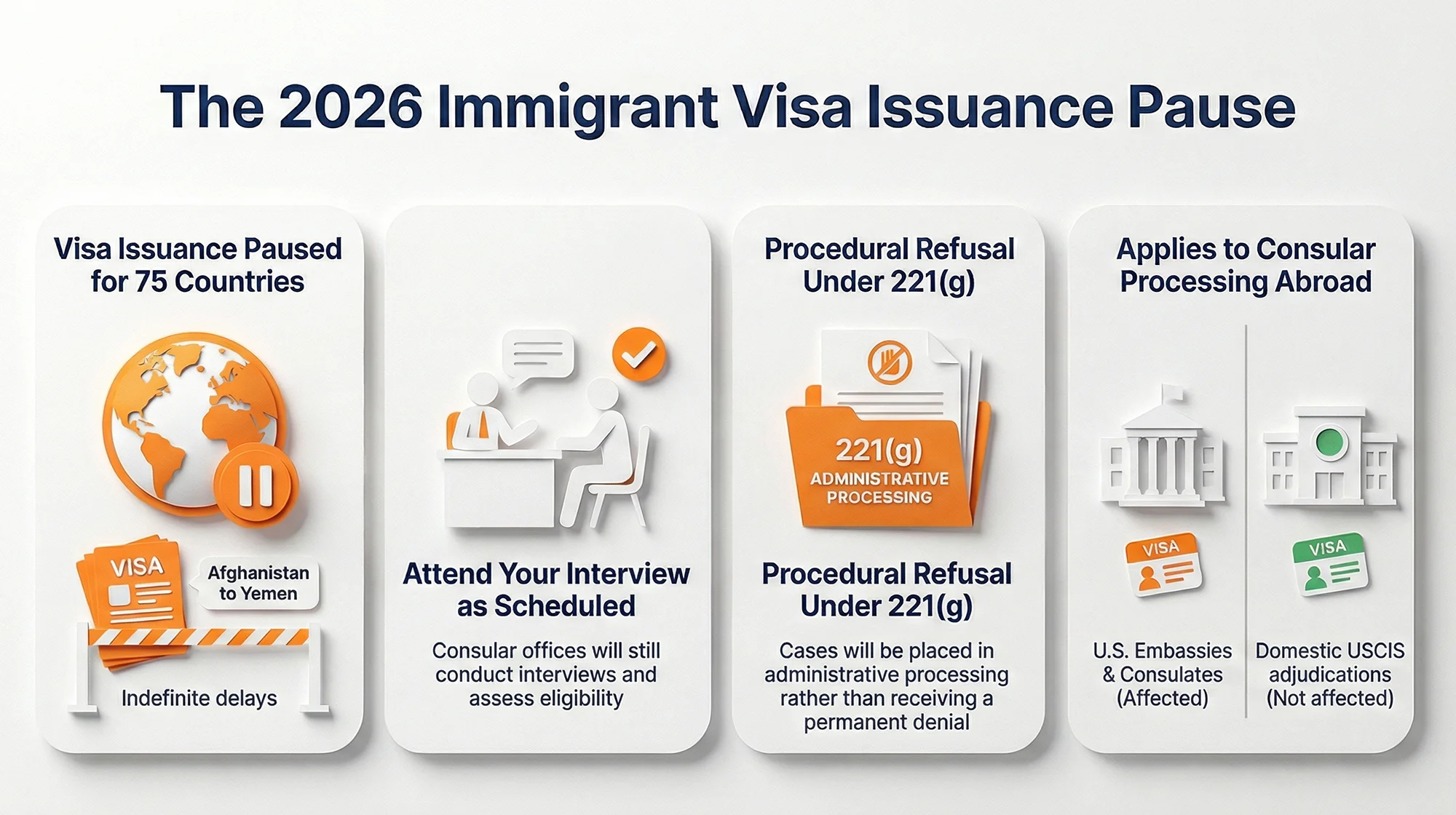
On January 14, 2026, the U.S. Department of State announced a significant change affecting immigrant visa applicants worldwide. Effective January 21, 2026, the Department of State will pause the issuance of immigrant visas for nationals of 75 designated countries.
This pause applies only to immigrant visas processed at U.S. embassies and consulates abroad. It does not apply to nonimmigrant visas, such as tourist, student, or temporary work visas.
Because this policy is being implemented through consular processing—and not by U.S. Citizenship and Immigration Services—it is separate and distinct from the USCIS adjudications pause discussed in our article “USCIS Pauses Immigration Decisions for Travel Ban Countries: What Applicants Need to Know.” Understanding this distinction is critical.
Watch The Video Overview
According to the January 14, 2026 announcement, the Department of State will:
In practical terms, this means that even if an applicant:
The immigrant visa will not be issued while the pause is in effect, unless an exemption applies.
The new policy creates a non-statutory presumption of public charge ineligibility under INA § 212(a)(4) for applicants presenting a passport from one of the affected countries.
Consular officers are instructed to:
This approach allows the Department of State to hold cases while it reviews screening and vetting procedures related to public charge concerns.
For a detailed explanation of how public charge is evaluated in immigrant visa cases, see our related article:
📄 Public Charge and Immigrant Visas – How Self-Sufficiency Is Evaluated.

Nationals of the following countries are subject to the immigrant visa issuance pause:
Afghanistan, Albania, Algeria, Antigua and Barbuda, Armenia, Azerbaijan, Bahamas, Bangladesh, Barbados, Belarus, Belize, Bhutan, Bosnia and Herzegovina, Brazil, Burma, Cambodia, Cameroon, Cape Verde, Colombia, Côte d’Ivoire, Cuba, Democratic Republic of the Congo, Dominica, Egypt, Eritrea, Ethiopia, Fiji, The Gambia, Georgia, Ghana, Grenada, Guatemala, Guinea, Haiti, Iran, Iraq, Jamaica, Jordan, Kazakhstan, Kosovo, Kuwait, Kyrgyz Republic, Laos, Lebanon, Liberia, Libya, Moldova, Mongolia, Montenegro, Morocco, Nepal, Nicaragua, Nigeria, North Macedonia, Pakistan, Republic of the Congo, Russia, Rwanda, Saint Kitts and Nevis, Saint Lucia, Saint Vincent and the Grenadines, Senegal, Sierra Leone, Somalia, South Sudan, Sudan, Syria, Tanzania, Thailand, Togo, Tunisia, Uganda, Uruguay, Uzbekistan, and Yemen.
Notably:
1. Interviews Will Still Take Place
A State Department cable (26 STATE 3740) instructs consular posts to:
Applicants should not assume interviews will be waived or postponed automatically.
2. INA § 221(g) Refusals Are Procedural, Not Final Denials
Cases affected by the pause will typically be refused under INA § 221(g). This is a temporary procedural refusal, not a permanent denial.
Once the pause is lifted, cases may be reopened without requiring a new application—assuming eligibility remains unchanged.
3. Dual Nationals May Be Exempt
Applicants who hold dual nationality may still receive final adjudication if they apply using a passport from a country not on the paused list.
This exemption mirrors prior travel-ban frameworks and must be evaluated carefully on a case-by-case basis.
4. National Interest Exceptions May Apply—Narrowly
As with prior bans, the Department of State appears to allow for national interest exemptions, though these are expected to be granted sparingly and in limited circumstances.
5. No Valid Visas Have Been Revoked
The Department of State has confirmed:
6. There Is No Timeline
At this time, no end date has been provided. The pause is described as remaining in place while the Department of State reviews public-charge-related screening and vetting procedures.
Applicants should prepare for indefinite delays.
This is a strategic, individualized decision.
Some applicants may prefer to:
There is no universal right answer. The decision should be based on the applicant’s circumstances, travel needs, case posture, and tolerance for uncertainty.
It is important not to confuse:
We address the USCIS-specific pause separately in our article:
📄 USCIS Pauses Immigration Decisions for Travel Ban Countries: What Applicants Need to Know.
The Department of State’s immigrant visa pause is policy-driven and temporary, but it has very real consequences for applicants and families.
No amount of preparation can override the pause itself. However, understanding how public charge is evaluated and ensuring your case is otherwise complete and accurate can help prevent additional, avoidable delays once visa issuance resumes.
If you are affected by this policy or are unsure how it applies to your case, experienced legal guidance is essential.
If you need assistance with your immigrant visa case, contact me at SG Legal Group. My team and I help clients worldwide navigate complex immigration policy changes with clarity and realism. Consultations are available in English, Russian, or Romanian. Call 410-618-1288 or visit our Contact page to schedule a consultation.
This article provides general information and is not legal advice. For advice about your specific situation, please contact me directly.
Oleg Gherasimov, Esq.
Stay informed with our latest articles and resources.


