Immigration Law

In early January 2026, U.S. Citizenship and Immigration Services (USCIS) implemented a major policy change that is affecting thousands of immigration applicants across the United States. Under a new policy memorandum, USCIS has placed a hold on final decisions for many immigration benefit applications filed by nationals of certain designated countries.
If you or a family member have a pending immigration case and are from one of the affected countries—or were born in one of those countries—it is critical to understand what this pause means, what it does not mean, and what to expect going forward.
This article explains the current USCIS adjudication pause in clear terms and addresses the most common questions we are hearing from clients.
Watch The Video Overview
On January 1, 2026, USCIS issued Policy Memorandum PM-602-0194, titled Hold and Review of USCIS Benefit Applications Filed by Aliens From Additional High-Risk Countries. This policy expands earlier guidance and implements an adjudicative pause for individuals subject to Presidential Proclamation 10998, issued on December 16, 2025.
Under this policy, USCIS officers are instructed to:
Importantly, USCIS has clarified that a “hold” means the case may continue to move through processing, but no final approval or denial is issued until further guidance is released.
The pause applies broadly to all types of immigration benefit requests, unless a specific exception applies.
This can include, but is not limited to:
In practice, this means applicants may attend interviews, submit biometrics, or receive requests for evidence—but still not receive a final decision.
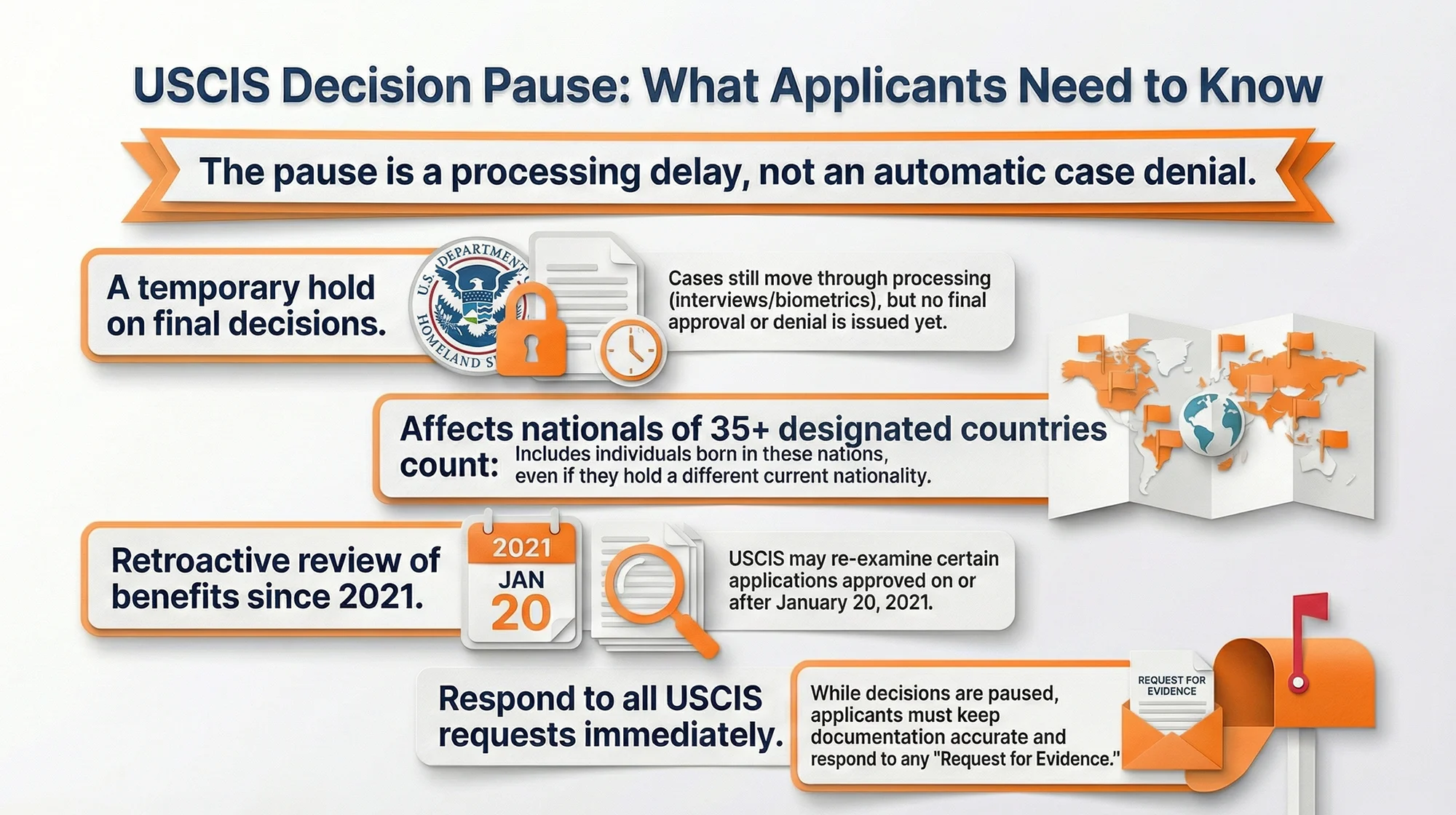
Nationals of the following countries are currently subject to the adjudicative hold and review process:
Afghanistan, Angola, Antigua and Barbuda, Benin, Burkina Faso, Burma (Myanmar), Burundi, Chad, Côte d’Ivoire, Cuba, Dominica, Republic of the Congo, Equatorial Guinea, Eritrea, Gabon, The Gambia, Haiti, Iran, Laos, Libya, Malawi, Mali, Mauritania, Niger, Nigeria, Senegal, Sierra Leone, Somalia, South Sudan, Sudan, Syria, Tanzania, Togo, Tonga, Turkmenistan, Venezuela, Yemen, Zambia, and Zimbabwe.
Important:
The policy may also apply to individuals who:
This means that dual citizenship does not automatically remove someone from the pause, depending on how USCIS applies the guidance.
Does This Mean My Case Is Denied?
No.
A hold under this policy is not a denial.
USCIS has stated that the pause:
Instead, it means USCIS has temporarily paused issuing a final decision while it conducts additional review and develops further operational guidance.
Yes. USCIS has identified limited exceptions, including:
Any request for an exception must be coordinated internally within USCIS and is not automatically granted.
One of the most concerning aspects of this policy is that USCIS has indicated it may re-review certain previously approved immigration benefits, particularly those approved on or after January 20, 2021.
At this time, USCIS guidance contains inconsistencies about whether the re-review applies based on:
USCIS has stated that further operational guidance will be issued, and this is an area we are monitoring closely.
At this time, there is no published end date.
USCIS has indicated that:
This means applicants should be prepared for longer-than-normal processing times, even in cases that appear otherwise ready for decision.
Separately, the U.S. Department of State has announced a pause on immigrant visa issuance at U.S. embassies and consulates abroad for nationals of 75 countries.
Although these are different agencies overseeing different processes, the combined impact can be significant:
Because these agencies operate under separate legal authority, an applicant may be affected by one policy, both policies, or neither, depending on where and how their case is being processed.
For a detailed explanation of the Department of State’s immigrant visa pause—including who is affected, how interviews are handled, and what INA § 221(g) refusals mean—please see our related article:
While applicants cannot force USCIS to issue decisions during a pause, there are still important steps to take:
Most importantly, applicants should ensure their cases are accurate, consistent, and well-documented, so that when adjudications resume, there are no avoidable issues delaying a final decision.
Final Thoughts for Affected Applicants
The USCIS adjudication pause is a policy-driven delay, not a judgment on individual merit. Unfortunately, it does mean uncertainty and longer wait times for many applicants who have already been in the system for years.
If you or a family member are from one of the affected countries and have a pending immigration application, it is essential to understand how this policy applies to your specific case and what risks may exist moving forward.
If you need experienced legal guidance for your immigration matter, contact me at SG Legal Group. My team and I help clients understand complex policy changes and navigate the immigration process with clarity and realism. Consultations are available in English, Russian, or Romanian. Call 410-618-1288 or visit our Contact page to schedule a consultation.
This article provides general information and is not legal advice. For advice about your specific situation, please contact me directly.
Oleg Gherasimov, Esq.
Stay informed with our latest articles and resources.


