Immigration Law
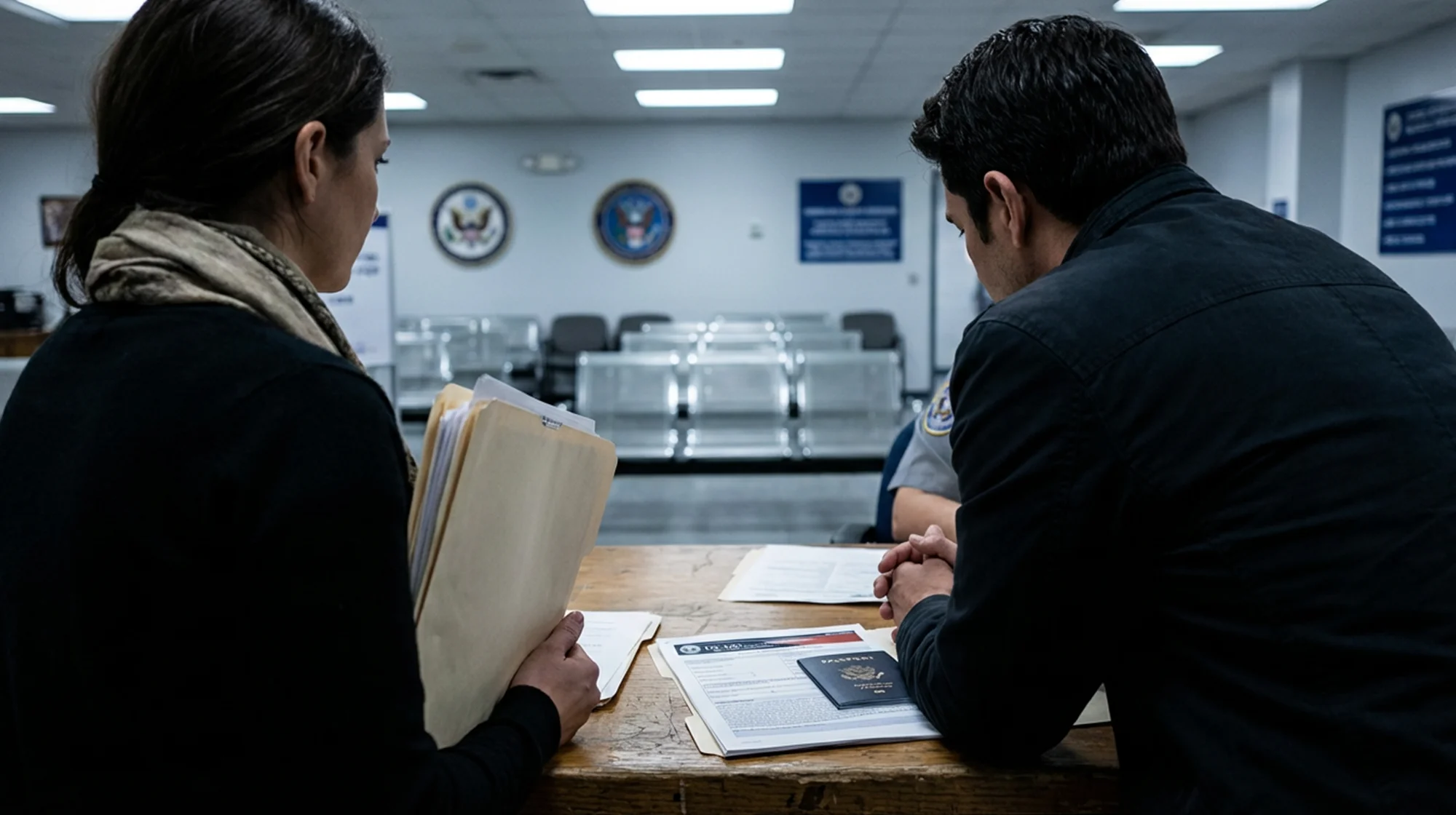
The paperwork looks the same. The form numbers are the same. The 90-day marriage rule hasn't changed. But if you're applying for a K-1 fiancé visa in 2026 using advice you found online two or three years ago, you may be walking into a process that has fundamentally shifted around you — without realizing it.
Since early 2025, the K-1 has been operating inside a completely different enforcement environment. Processing times that were trending down are stalling again. Public charge scrutiny has expanded in ways that catch couples off guard. AI systems are now reviewing your relationship timeline for inconsistencies. And for nationals of dozens of countries, the K-1 is no longer one option among several — it may be the only legal path forward.
This article is a 2026 update for couples who are preparing to file, already in the process, or trying to decide whether the K-1 is still the right move for their situation. I'll cover each major change in plain language, explain what it means practically, and tell you what to do about it.

The statutory requirements for the K-1 haven't changed. You still need a U.S. citizen petitioner (not a green card holder — that's a common mistake), both parties must be legally free to marry, you must have met in person within the two years before filing, and the couple must marry within 90 days of the fiancé(e)'s arrival in the United States.
What has changed is everything around those requirements — how strictly they're interpreted, what evidence satisfies them, how long the process takes, how much it costs, and how many additional filters your case now passes through before a visa is issued.
Think of the statute as the skeleton. In 2026, the muscle, nerves, and skin around that skeleton look very different from 2022 or even 2024.
In early 2025, there was genuinely good news on K-1 processing times. After the pandemic-era peak of nearly 14 months median wait time for Form I-129F in fiscal year 2023, USCIS brought that figure down to roughly 6 months by early 2025 through aggressive backlog-clearing efforts and AI-assisted case sorting.
That progress has since stalled.
As of early 2026, I-129F processing times at the California Service Center — the primary hub for these petitions — have climbed back to 9 to 11 months. The reason is USCIS Policy Memorandum PM-602-0194, which mandates a pause on adjudicating applications for nationals of designated "high-risk" countries until re-vetting is completed. For affected nationals, this hold can add months of invisible waiting time that never shows up cleanly on a USCIS case status page.
Even after USCIS approves the I-129F, the wait continues at the embassy. And the disparities between consular posts are staggering. Internal Department of State data shows that as of late 2024, the estimated interview backlog at the Abu Dhabi embassy exceeded 500 business days. Accra, Ghana was at 450 days. Dhaka, Bangladesh over 400. Meanwhile, Frankfurt, Germany was running at 26 days, and Warsaw, Poland at roughly 2 days — because those posts are processing displaced nationals from elsewhere, not just their local applicant pool.
What does this mean for planning? In 2026, couples should budget at least 12 to 18 months from initial filing to entry into the United States, depending on where the interview will take place. Building a wedding date around a projected visa approval is not a strategy I recommend to any of my clients.
For a detailed breakdown of the processing stages from I-129F through the green card, see my earlier article on K-1 visa processing times in 2025 — the framework is still accurate, though the timelines in this article reflect current 2026 conditions.
Two overlapping policy actions from late 2025 and early 2026 have created significant confusion — and significant consequences — for K-1 applicants depending on their country of origin.
Proclamation 10998, effective January 1, 2026, expanded what is commonly called the "travel ban" to cover 39 countries and the Palestinian Authority. The proclamation operates on two tiers. Countries under full entry suspension — including Afghanistan, Iran, Syria, Burma, Libya, Somalia, and Yemen — are effectively blocked from both immigrant and nonimmigrant visas absent a specific National Interest Waiver. Countries under partial suspension — including Nigeria, Cuba, Venezuela, Senegal, Tanzania, and Angola, among others — face entry restrictions primarily for immigrant visas and B-1/B-2 visitors, while K-1 visas remain technically issuable but subject to what the State Department is calling "extreme vetting."
Separately, on January 21, 2026, the Department of State implemented an indefinite pause on immigrant visa issuances for nationals of 75 countries, citing public charge concerns. This pause covers CR-1 and IR-1 spousal visas — the immigrant pathways for married couples.
Here is the critical legal distinction that I cover in more detail in my article on the immigrant visa pause and the K-1 solution: the K-1 is classified as a nonimmigrant visa. Even though the ultimate goal is permanent residency, the K-1 holder technically enters the U.S. temporarily. Because of this, the K-1 is explicitly exempt from the 75-country immigrant visa pause.
This exemption has made the K-1 the primary — and in many cases only — viable pathway for families in affected countries like Brazil, Nigeria, Colombia, and others to begin the process of reuniting in the United States.
One warning I cannot state strongly enough: do not get married abroad if your fiancé(e) is from one of the paused countries. The moment a legal marriage occurs anywhere in the world, K-1 eligibility ends. You would then need a spousal CR-1 or IR-1 visa — and those are exactly the visa categories currently stuck in the indefinite pause. I have spoken with couples who lost months of progress and their entire strategic advantage by marrying before consulting an attorney on timing. The status of "fiancé" versus "spouse" is not a technicality in 2026. It is the difference between a working pathway and an indefinite hold.
For applicants from countries under full suspension (Afghanistan, Iran, Syria, and others), neither the K-1 nor the CR-1 is a routine option. Those cases require a case-by-case National Interest Waiver analysis and experienced legal representation.
Even for applicants whose interview proceeds and goes well, 221(g) administrative processing — where the visa is technically refused pending additional interagency security checks — has become significantly more common in 2026 for nationals of affected countries. This can add three to six months after a successful interview.
This is the change that surprises my clients most — and the one with the most serious consequences for cases that aren't properly prepared.
Most couples walk into a K-1 consultation believing that if the U.S. citizen petitioner has a qualifying income — above the poverty guideline — the public charge question is answered. That was a reasonable assumption a few years ago. In 2026, it is not accurate.
Under a November 2025 State Department directive, consular officers are now instructed to assess the fiancé(e)'s own demographic and health profile under a "totality of circumstances" framework — regardless of the petitioner's income. The K-1 process uses Form I-134 (Affidavit of Support) at the visa stage, which is a lighter document than the I-864 used for immigrant visas. But the substantive standard applied at the consular interview has moved much closer to the immigrant visa standard.
Specifically, officers are now evaluating these factors as potential negative public charge indicators:
Chronic health conditions. The immigration medical exam (Form I-693 or its consular equivalent) is now reviewed not just for communicable disease grounds but for any chronic condition — including chronic illness, mental health diagnoses, or even obesity — that could be interpreted as creating long-term medical costs in the United States.
Age. Applicants over 65 now face heightened scrutiny. Officers are instructed to consider the probability of future nursing home or long-term care needs. This is a new and explicit factor.
Limited English proficiency. The State Department now explicitly lists limited English as a "negative factor" in the public charge analysis, on the theory that it limits the applicant's ability to achieve financial self-sufficiency in the U.S. labor market.
What should couples do about this? Preparation matters enormously. Clients whose profiles include any of these factors should not arrive at a consular interview armed only with the petitioner's tax returns. I advise bringing — proactively — documentation of private health insurance coverage that will take effect upon arrival, educational transcripts or certifications, and any English-language proficiency evidence available. The goal is to address negative presumptions before the officer raises them.
For a deeper dive on how public charge grounds are applied at the consular level, see my article on public charge visa denial.
If your fiancé(e)'s profile includes chronic health conditions, is older, or has limited English proficiency, I strongly encourage you to consult with me before the interview — not after a 221(g) refusal. The time to build a counter-narrative is before the officer forms an impression, not while trying to overcome one.
USCIS has integrated AI-powered fraud detection systems into K-1 adjudications. These systems automatically cross-reference social media profiles, travel records, prior immigration filings, and the factual narrative you provide in Form I-129F.
In practice, this means your relationship timeline is being compared against verifiable data — and discrepancies get flagged automatically for secondary review.
Several patterns now trigger automatic scrutiny:
The evidentiary standard for the two-year in-person meeting requirement has also increased. Passport stamps alone are no longer reliable proof. Officers increasingly want what the guidelines describe as "shared experiences" documentation: hotel receipts listing both names, restaurant bills, photos with verifiable metadata timestamps, and records of joint activities or family gatherings.
The practical implication is that you should audit your evidence package before filing Form I-129F — not when you're responding to an RFE. Review every date in your narrative. Check that it matches your travel documentation. Make sure photos have metadata or can be corroborated by other records. If you met online first, document the communication history in a way that establishes a clear, date-anchored timeline.
This is also a reason why cases that were routine several years ago now benefit from legal oversight at the petition stage, not just at the interview stage. The AI doesn't understand context. It flags anomalies. An attorney can identify where your case looks anomalous on paper before the system flags it.
The 2024 USCIS Fee Rule, effective April 1, 2024, changed the cost landscape substantially. And in 2026, the cumulative government fees for a K-1 petitioner who intends to obtain a green card through Adjustment of Status now exceed $3,200.
Here's what the fee table looks like:
Before April 2024, the same path cost roughly $1,680. The I-765 and I-131 were included at no additional charge as part of the bundled I-485 filing. That bundling is gone. If your fiancé(e) wants to work or travel internationally while the green card is pending — which most people do — those separate filings are now required.
For context: a spouse entering through the CR-1 immigrant visa route arrives as a lawful permanent resident with immediate work authorization and no separate Adjustment of Status process. The total government fees for the CR-1 path are roughly $1,500 to $1,700 less than the K-1 path. For couples from countries not on the paused list, this cost differential is one of the reasons I discuss both options carefully during consultations.
That said, for couples from the 75 affected countries, the K-1 is currently the more accessible path regardless of cost. The fee comparison matters most when you actually have a choice.
For a full strategic comparison of the two pathways, see my article on K-1 fiancé visa vs. I-130 spousal petition.
One of the most consistent misconceptions I encounter with K-1 clients is the assumption that the hard part ends when the visa is issued. In 2026, that is genuinely not true.
After arrival and marriage, the foreign spouse applies for Adjustment of Status (Form I-485) to become a lawful permanent resident. In field offices like Baltimore, family-based AOS applications are currently taking 10 to 18 months. That's a significant wait on its own. But what has changed in 2026 is the nature of the interview at the end of that wait.
USCIS officers conducting AOS interviews have been trained under new guidance that treats the green card interview as an independent relationship verification — not a rubber stamp of what the consulate already approved. The bona fide relationship questions that your fiancé(e) answered at the embassy will be asked again, in a different setting, by a different officer, with a different lens. Details matter. Consistency matters. And officers in 2026 are asking these questions more aggressively than they were two or three years ago.
Couples who are unprepared for this dynamic — who assumed the green card interview would be brief and procedural — are the ones who struggle. The couples I see succeed at this stage are the ones who prepared for the AOS interview with the same seriousness they brought to the consular interview.
For more on what the adjustment of status process looks like after a K-1 entry, see my earlier guide on the K-1 to green card adjustment process.
Yes — but the answer is more nuanced than it was a few years ago, and it depends heavily on your specific situation.
For couples where the fiancé(e) is from one of the 75 countries under the immigrant visa pause, the K-1 is currently the clearest viable pathway to the United States. The CR-1 spousal route is effectively frozen for those nationalities. If you are in this situation, the K-1 is not just worth it — it may be your only near-term option, and you should move carefully and strategically rather than waiting for the policy environment to improve.
For couples from countries not affected by the pause or travel ban, the comparison between K-1 and CR-1 requires more analysis. The K-1 gets your fiancé(e) here sooner, allows the wedding to happen in the U.S., and is familiar to most couples. But the CR-1 costs significantly less in total government fees, delivers immediate work authorization, and skips the Adjustment of Status process entirely. I regularly advise clients who came in expecting to file K-1 petitions that the CR-1 is actually the better fit once they understand the full picture.
For nationals of the 39 countries under full or partial suspension in Proclamation 10998, the analysis is case-specific. Some of these nationalities can still access the K-1 with extreme vetting; others face near-total bars that require waiver strategies. This is not territory to navigate without experienced legal counsel.
What I can say broadly: the K-1 in 2026 is not a DIY process for most couples. The cost of errors — whether that's a date discrepancy that triggers an AI flag, a missed public charge preparation step, or the catastrophic mistake of marrying abroad before consulting an attorney — has gone up just as much as the filing fees have.
If you're trying to figure out the right strategy for your specific situation — including whether the K-1 is the right path and how to build the strongest possible case under current conditions — I'm happy to help. Schedule a consultation with SG Legal Group. Consultations are available in English, Russian, and Romanian.
Disclaimer: The information provided in this article is for general informational purposes only and does not constitute legal advice. Immigration laws and policies are subject to change, and individual circumstances vary. For advice specific to your situation, please consult with a qualified immigration attorney.
Oleg Gherasimov, Esq.
Stay informed with our latest articles and resources.


