Immigration Law
If you are applying for an immigrant visa to the United States, one issue will affect every case, regardless of country of origin or visa category: whether the government believes you are financially self-sufficient.
Under U.S. immigration law, consular officers must evaluate whether an immigrant visa applicant is likely to become a “public charge” after entering the United States. This analysis applies to all immigrant visa applicants worldwide.
At the same time, some applicants face an additional, separate obstacle: the current pause on immigrant visa issuance for nationals of certain countries announced by the U.S. Department of State in January 2026. For those applicants, it is important to understand that even a perfectly prepared case cannot result in visa issuance while the pause remains in effect.
This article explains:
Watch The Video Overview
The public charge rule is based on INA § 212(a)(4) and implemented through 9 FAM 302.8, which guides consular officers worldwide.
In plain terms, an immigrant visa applicant may be found ineligible if the officer concludes that, after admission to the United States, the applicant is likely to become primarily dependent on the U.S. government for basic living expenses.
This is a forward-looking analysis. Officers are not allowed to deny visas based on speculation or hypothetical future problems. Instead, they must evaluate the applicant’s current circumstances at the time of the visa application.
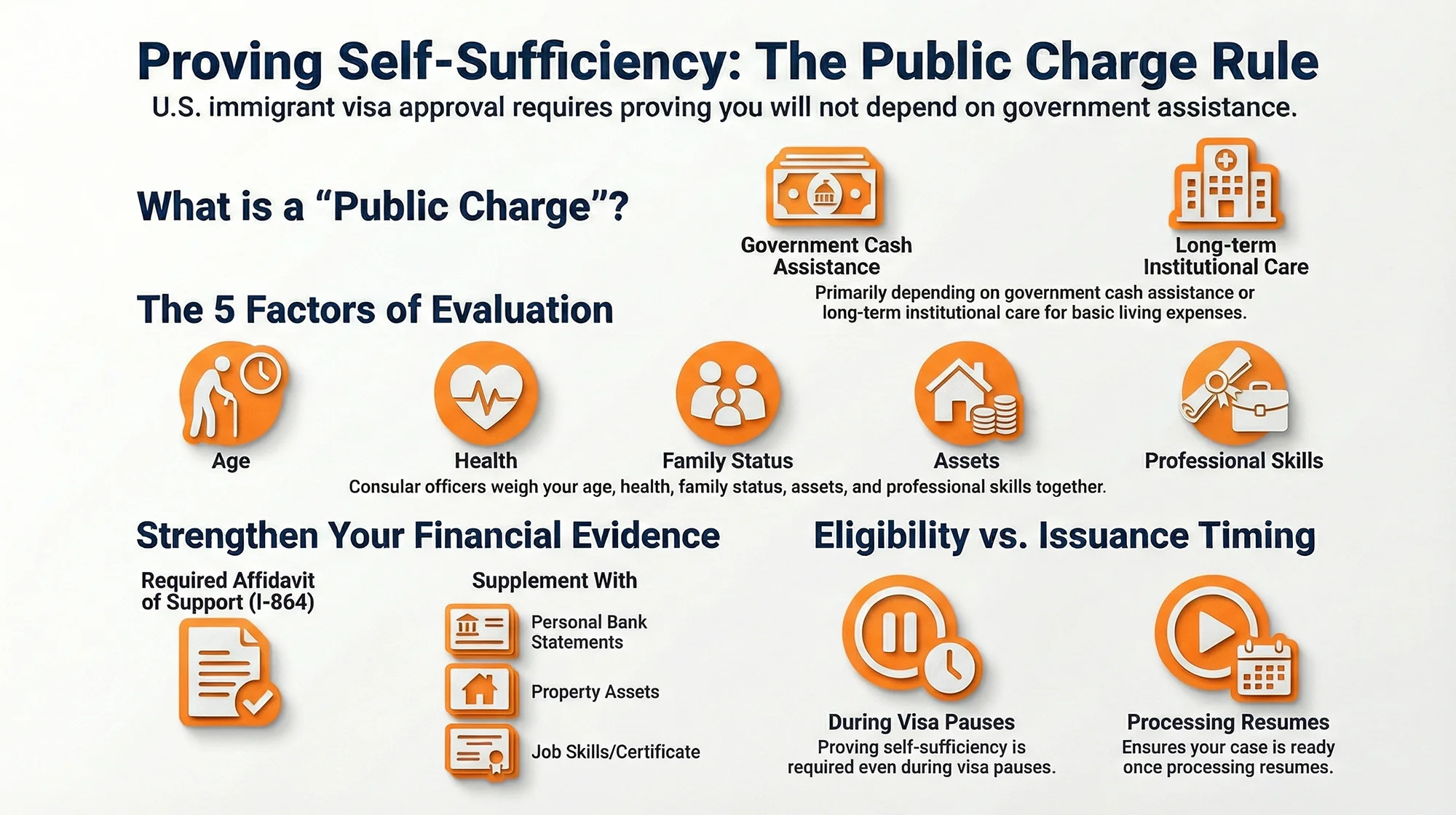
Applicants from countries subject to the current immigrant visa issuance pause should understand the distinction between:
Even if:
An immigrant visa cannot be issued while the pause is in effect.
Preparing strong self-sufficiency evidence does not bypass or shorten the pause. What it does is ensure that your case is properly positioned and not substantively deficient once issuance resumes.
This distinction is critical to managing expectations.
A “public charge” finding is limited in scope. It generally refers to situations where an applicant is expected to rely primarily on:
Many applicants worry unnecessarily about benefits that do not fall within this definition. The public charge analysis is not a general review of every public service or benefit someone might access.
The focus is whether government cash support would become the applicant’s primary means of subsistence.
The “Totality of the Circumstances”
Under 9 FAM 302.8, officers must evaluate the totality of the circumstances, considering at least the following factors:
No single factor automatically decides the case. Instead, officers look for a coherent overall picture showing that the applicant will be financially supported and able to live in the United States without becoming dependent on government assistance.
For most family-based immigrant visas, a Form I-864, Affidavit of Support, is required.
A properly completed and credible I-864 is normally sufficient to satisfy the public charge requirement. However, officers may look more closely when there are factors such as:
For this reason, applicants should not view the I-864 as a “check-the-box” document. It works best when supported by consistent, well-documented financial evidence.
Sponsor Evidence (When an I-864 is Required)
Commonly reviewed documents include:
Applicant’s Own Resources
Even when a sponsor is required, an applicant’s own resources remain relevant, such as:
The goal is to demonstrate financial stability through multiple, credible sources, not reliance on a single fragile factor.
Education, Skills, and Employment Prospects
Consular officers may consider whether an applicant has the education and skills needed to become self-supporting.
Relevant evidence may include:
This is not about optimism. Officers assess whether the applicant’s background realistically supports future self-sufficiency.
Health Considerations in the Public Charge Analysis
Health is relevant only when it suggests:
Applicants with medical conditions can still demonstrate self-sufficiency by showing:
Applicants should understand that:
For applicants affected by the issuance pause, 221(g) may be used as a procedural holding mechanism. This is not the same as a permanent denial.
For applicants from paused countries, preparation serves a different purpose:
For applicants not affected by the pause, proper preparation can reduce the risk of avoidable refusals or prolonged administrative processing.
The public charge rule applies to all immigrant visa applicants, regardless of nationality or current policy conditions.
Demonstrating self-sufficiency does not guarantee a visa, and it does not override government-wide issuance pauses. What it does is ensure that, when a case is ready to move forward, it is not held back by preventable weaknesses.
If you need experienced legal guidance for your immigration case, contact me at SG Legal Group. My team and I will help you understand your options and prepare your case with clarity and realism. Consultations are available in English, Russian, or Romanian. Call 410-618-1288 or visit our Contact page to schedule a consultation.
This article provides general information and is not legal advice. For advice about your specific situation, please contact me directly.
Oleg Gherasimov, Esq.
Stay informed with our latest articles and resources.


