Accidents
A loaded dump truck weighs more than 60,000 pounds. That's roughly 20 times heavier than your car — and it's often operated in some of the most chaotic driving environments on the road: active construction zones with shifting lanes, unclear signage, and workers moving on foot just a few feet from traffic.
I'm Joshua C. Sussex, a personal injury attorney at SG Legal Group, and I've represented clients who were injured in crashes involving construction vehicles on Maryland roads. These cases are some of the most complex in all of personal injury law, and they're consistently misunderstood — by other attorneys and by the people who've been hurt.
The reason is straightforward. A construction truck accident is not just a "bigger car accident." It's not even a standard trucking case. The liability picture is different. The regulations that apply are different. The number of potentially responsible parties can be staggering. And the evidence you need to win can disappear if nobody acts quickly.
Here's what you need to understand if you or someone you love has been hurt in one of these crashes.
Construction vehicles present hazards that simply don't exist with standard 18-wheelers traveling on highways. Understanding those hazards is the first step toward understanding why these cases are so different.
Dump trucks have the largest blind spots among all construction vehicles. The Federal Motor Carrier Safety Administration (FMCSA) has found that roughly one-third of crashes between large trucks and passenger vehicles involve blind spots. Nationally, nearly 840,000 blind spot accidents occur every year, resulting in approximately 300 fatalities.
But the blind spot problem is only part of it. Dump trucks carry loose materials — gravel, sand, dirt, asphalt — and when those loads aren't properly secured, the results can be catastrophic. Under Maryland Transportation Article § 24-106.1, vehicles carrying loose materials must have fully enclosed beds and secured covers. The reality on job sites doesn't always match what the law requires. I've seen cases where tailgates weren't properly latched, loads weren't covered, and debris scattered across active roadways.
Tipping and rollovers are actually the most common type of dump truck accident, often caused by overloading, uneven weight distribution, or unstable road surfaces near construction zones.
Concrete mixer trucks have a rollover rate roughly 10 times higher than passenger cars. The reason is physics: a full drum of liquid concrete creates a high, shifting center of gravity that makes these vehicles inherently unstable — even at low speeds. Research from the National Ready Mixed Concrete Association shows that over 80% of mixer rollovers occur with loaded drums, and more than half happen while the truck is traveling in a straight line, not turning.
There's another factor that most people don't consider. Concrete hardens within 60 to 90 minutes of mixing, which creates intense time pressure on drivers to deliver loads quickly. That pressure encourages speeding, cutting corners on safety checks, and pushing through fatigue — all of which increase accident risk.
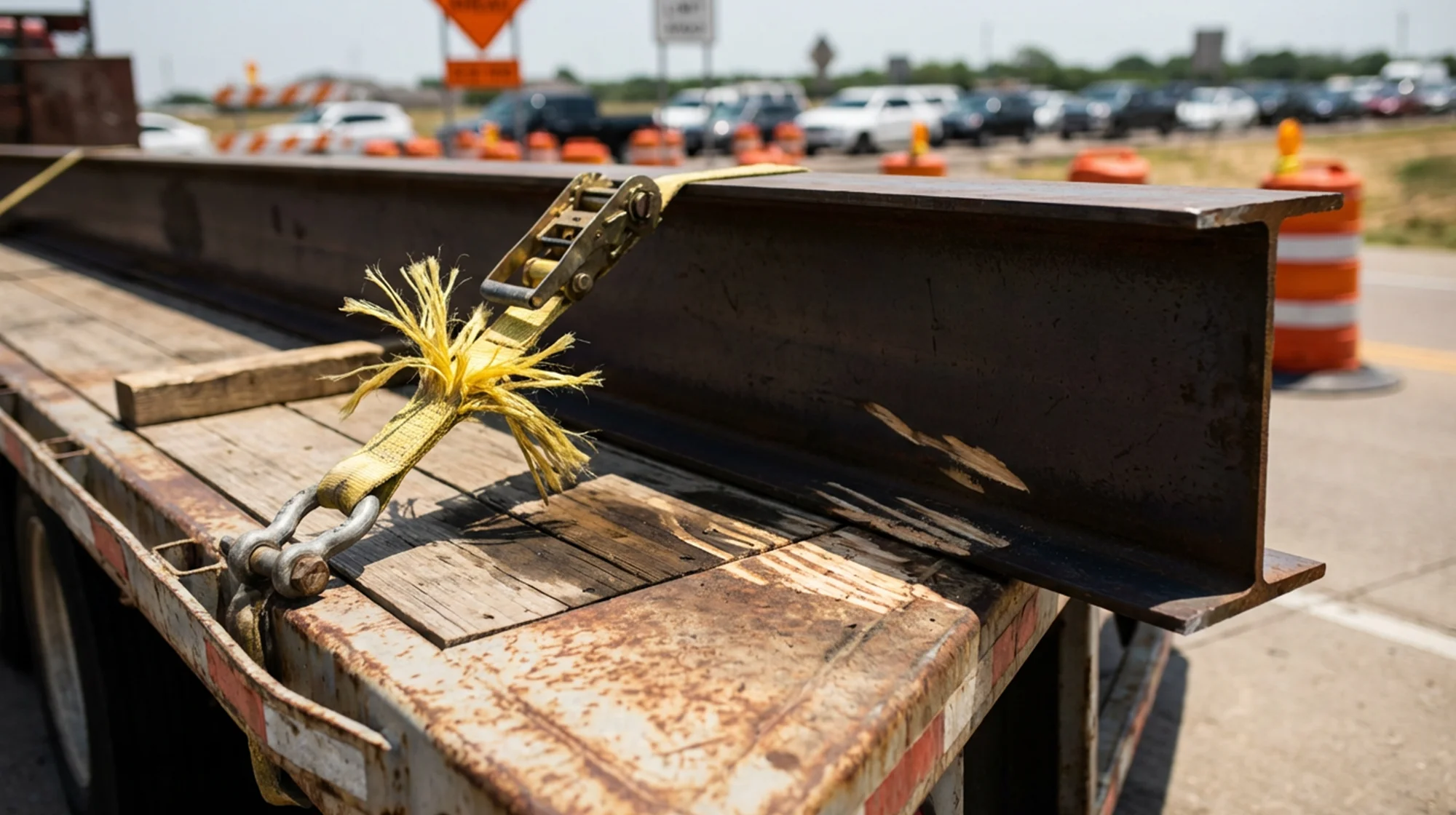
Flatbed trucks hauling excavators, bulldozers, steel beams, and other heavy equipment face unique securing challenges. Under federal cargo securement rules (49 CFR § 392.9 and Part 393), drivers must immobilize cargo and regularly inspect tie-downs during transit. When securing equipment fails, loads can shift during braking or turning, causing the truck to jackknife, overturn, or shed equipment directly into traffic.
In a typical car accident, the liability analysis is usually straightforward: who was driving, and what did they do wrong? In a standard trucking case, you're typically looking at the driver and the trucking company.
Construction truck accidents blow this wide open. In these cases, I regularly identify five, six, or even more potentially liable parties — and each one may carry separate insurance coverage.
The individual behind the wheel can be held personally liable for negligence: speeding, distracted driving, failure to check blind spots, driving while fatigued, operating without a valid CDL, failing to perform required pre-trip inspections under 49 CFR § 396.13, or violating hours-of-service rules. Most dump trucks and concrete mixers require a Class B CDL, and many of the drivers operating these vehicles are subject to FMCSA drug and alcohol testing requirements.
Under the doctrine of respondeat superior, an employer is vicariously liable for the negligent acts of its employees performed within the scope of employment. But construction companies have an additional layer of potential liability: direct negligence. This includes negligent hiring (failing to verify CDL credentials or check driving records), negligent supervision (inadequate training on equipment operation), and negligent maintenance (failing to keep vehicles in safe operating condition as required by 49 CFR § 396.3).
On a construction project, the general contractor typically has overarching responsibility for site safety. When a GC exercises significant control over subcontractor operations — directing how work is performed, setting schedules, controlling site access — they can be held directly liable for accidents that result from unsafe conditions they created or allowed to persist. Maryland courts have recognized this liability, particularly for work that is inherently dangerous, such as heavy equipment operation near active traffic.
Subcontractors who own or operate the construction vehicles bear their own liability, separate from the GC. Their OSHA violations, FMCSA violations, and internal safety failures are all fair game in litigation. In many construction truck accident cases, the driver works for a subcontractor while the general contractor controlled the work zone — creating shared liability between the two.
This is where construction cases get particularly complex. The company operating the dump truck may not own it. Equipment leasing is extremely common in construction. When a leased vehicle causes an accident, the equipment owner can be liable for mechanical defects or maintenance failures, while the lessee is liable for how the equipment was used. Lease agreements contain indemnification clauses, additional insured endorsements, and allocation-of-risk provisions that an experienced attorney must untangle.
When a construction zone is part of a public works project — road resurfacing, bridge repair, highway widening — the government entity that designed and controlled the work zone can be liable for traffic control failures. In the tragic March 2023 I-695 Baltimore Beltway crash that killed six construction workers, the Maryland Occupational Safety and Health unit cited the Maryland Highway Administration for serious violations, including failure to post legible traffic control signs.
However, government liability claims in Maryland are subject to strict limitations. The Maryland Tort Claims Act caps liability at $400,000 per claimant for state entities. The Local Government Tort Claims Act caps liability at $400,000 per person and $800,000 per incident. And critically, written notice must be provided within one year — failure to meet this deadline permanently bars the claim.
Maryland has several legal rules that directly affect what your case is worth and whether you can recover anything at all.
Maryland is one of only five jurisdictions in the country that follows the pure contributory negligence doctrine. If you are found even 1% at fault for the accident — even if the dump truck driver was 99% at fault — you are completely barred from recovering any damages. Zero.
Insurance adjusters in construction truck cases aggressively look for any evidence that you may have contributed to the crash: Were you speeding? Did you miss a posted work zone warning sign? Were you on your phone? A single text message timestamped near the time of the accident can be used to destroy your entire case.
This is why having an attorney who understands how to protect your claim against contributory negligence defenses is absolutely essential in Maryland.
Maryland caps noneconomic damages — pain and suffering, loss of enjoyment of life, emotional distress — at $965,000 for personal injury cases arising after October 1, 2025. For wrongful death cases with two or more claimants, the cap rises to approximately $1,447,500. There is no cap on economic damages, which includes medical bills, lost wages, and future earning capacity.
Because of this cap, building the strongest possible economic damages case is critical. That means obtaining life care plans, vocational rehabilitation assessments, and forensic economic analyses to document every dollar of future financial impact. I discuss the full damages picture in greater detail in my article on understanding truck accident settlement values.
Maryland's general statute of limitations for personal injury is three years under Courts and Judicial Proceedings Article § 5-101. But if a government entity is involved — which is common in public works construction zone accidents — you must provide written notice within one year. Miss that deadline, and your claim is gone forever, regardless of how severe your injuries are.
I handle truck accident cases regularly, and I can tell you that construction truck accidents present challenges that even experienced trucking attorneys don't always anticipate.
The OSHA Layer
Standard 18-wheeler cases are governed primarily by FMCSA regulations. Construction truck accidents add an entirely separate regulatory framework: OSHA's construction standards under 29 CFR Part 1926. Subpart O specifically addresses motor vehicle safety on construction sites, including requirements for audible reverse alarms, cab shields, dump truck locking mechanisms, and vehicle inspections before each shift. Subpart G covers signs, signals, and barricades in work zones.
When a construction truck accident involves violations of both OSHA workplace safety rules and DOT/FMCSA transportation regulations, it creates dual tracks of potential negligence per se — something that doesn't exist in standard trucking cases.
Evidence Disappears Faster
Work zone configurations change constantly. Lane closures shift between day and night shifts. Barriers move. Signage gets relocated. The physical layout of a construction zone at the time of your accident may look completely different within hours.
Construction equipment also gets moved rapidly. Unlike a commercial trucking company that owns its fleet, construction vehicles may be leased, returned to the lessor, transferred to another project site, or repaired in ways that destroy evidence. In one case I'm aware of, attorneys had to send immediate preservation letters to prevent a piece of equipment from being altered, sold, or disposed of before it could be inspected.
Electronic logging devices (ELDs) — which are mandatory for most long-haul trucking — often don't apply to construction vehicles. Many dump truck operations qualify for the short-haul exemption because drivers operate within 150 air miles of their base and return daily. Without ELD data, you lose automated records of driving hours, speed, location, and rest periods. That evidence has to be obtained from other sources — fleet GPS systems, dash cameras, geofencing data — and those records can be overwritten quickly.
This is exactly why I emphasize immediate evidence preservation in every construction truck case. Spoliation letters demanding the preservation of driver qualification files, maintenance records, drug testing results, daily construction logs, work zone traffic control plans, equipment rental agreements, and subcontractor insurance certificates must go out within hours of the accident — not days or weeks. I cover the spoliation and evidence preservation process in detail in a separate article.
A standard car accident involves one insurance policy. A typical trucking case involves two — the driver's and the carrier's. A construction truck accident can involve five, six, or even seven separate policies.
The contractor's commercial general liability (CGL) policy is the first layer, but it often contains automobile exclusions. A separate commercial auto policy covers the vehicle itself. If the truck was leased, the equipment owner carries its own policy. The project owner — often a government entity or real estate developer — may have a project-specific Owner-Controlled Insurance Program that covers everyone on the job site. Umbrella and excess policies stack on top of these primary policies. And if the injured person is also a construction worker, workers' compensation interacts with all of it: accepting workers' comp benefits generally waives the right to sue your employer directly, but third-party claims against other negligent parties remain available.
Sorting through these policies to identify every available source of recovery requires a level of insurance litigation experience that goes well beyond what most personal injury attorneys encounter.
If you or someone you care about has been injured in a construction truck accident, the steps you take in the first 24 to 48 hours can make or break your case.
Get medical attention immediately, even if you feel okay. Injuries from collisions with vehicles weighing 30,000 to 60,000 pounds often don't present symptoms right away — but the absence of an immediate medical evaluation can be used against you later.
Do not give a recorded statement to any insurance company before speaking with an attorney. In a multi-party construction case, you may be dealing with adjusters from several different insurers, each looking for ways to minimize their client's exposure and shift blame — including onto you.
Contact an attorney who has specific experience with construction vehicle and truck accident claims. Not all personal injury lawyers handle these cases, and not all truck accident lawyers understand the construction-specific dimensions — the OSHA regulations, the contractor liability chains, the leased equipment issues, the work zone evidence that vanishes overnight.
I handle these cases throughout Maryland, and every construction truck case I take begins the same way: with an aggressive, immediate evidence preservation effort targeting every party and every document that could be relevant. In these cases, speed matters more than almost anything else.
If you've been injured and you're not sure where to start, reach out to me at SG Legal Group for a free consultation. I'll give you an honest assessment of your situation, walk you through your options, and help you understand what your case may be worth. You pay nothing unless we recover compensation for you.

Disclaimer: The information provided in this article is for general informational purposes only and does not constitute legal advice. Laws and regulations are subject to change, and individual circumstances vary. For advice specific to your situation, please consult with a qualified attorney.
Oleg Gherasimov, Esq.
Stay informed with our latest articles and resources.