Accidents
After a truck accident, the question I hear most often is some version of: "What am I actually entitled to?"
It makes sense. You're dealing with injuries, missed work, mounting bills, and an insurance company that seems more interested in closing your file than making you whole. You want a straight answer about what compensation is on the table — not vague promises, not legal jargon, just a clear picture of what the law allows you to recover.
That's what this article is designed to give you. I'm going to walk through every category of truck accident compensation available under Maryland law — the dollars-and-cents damages, the harder-to-measure losses, and the rare but important category of punitive damages. I'll explain what each one covers, how it's calculated, and what you need to know to make sure nothing gets left behind.
If you've already read our article on how much a truck accident case is worth, this is the companion piece. That article explains the factors that drive settlement value. This one answers the more fundamental question: what categories of harm does the law actually recognize?
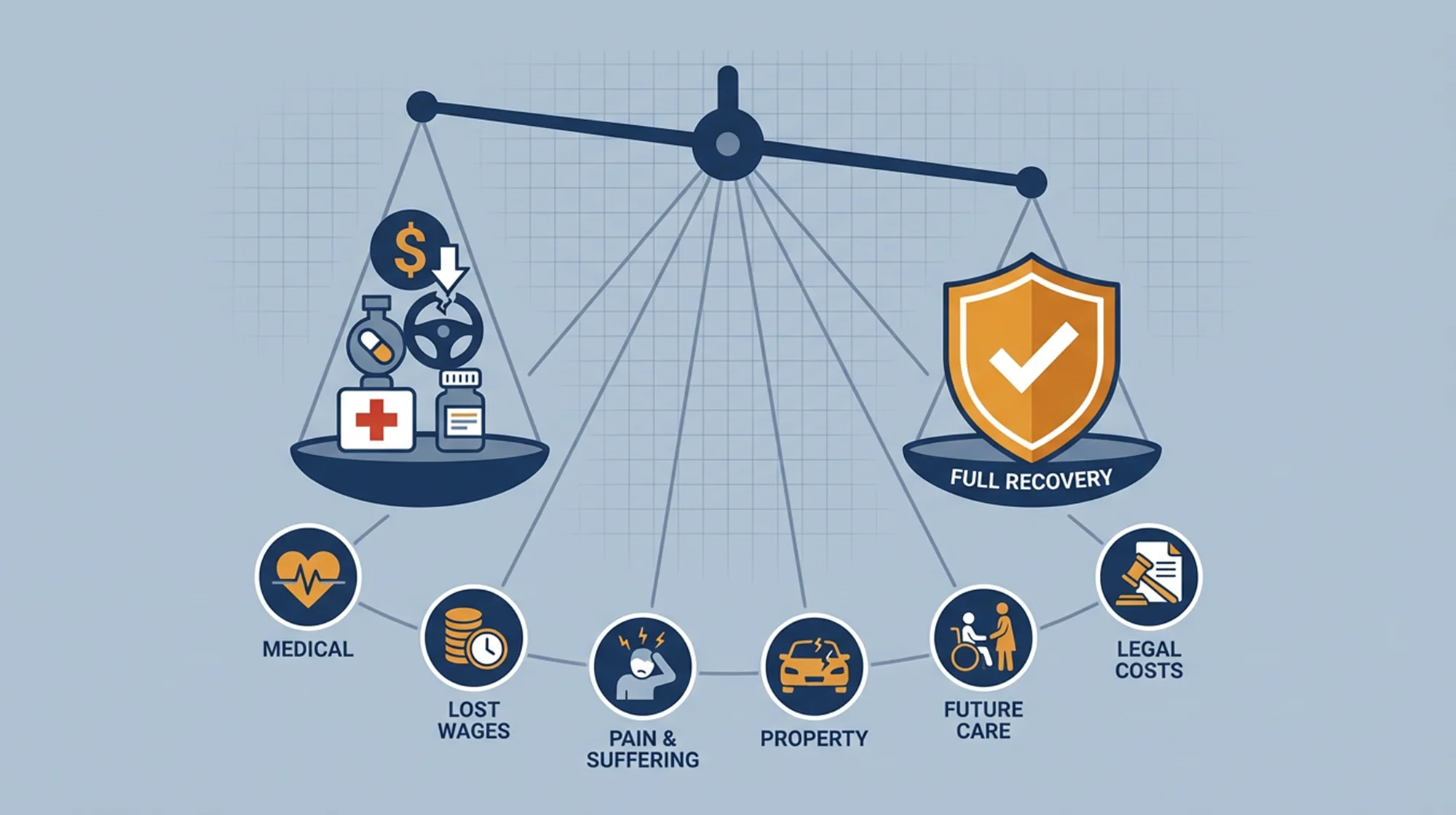
Economic damages cover every measurable financial loss caused by the truck accident. This is the foundation of any compensation claim, and here's the good news — Maryland places no cap on economic damages. Every provable dollar of financial harm is recoverable.
That matters enormously in truck accident cases, where the injuries tend to be more severe and the financial impact tends to be significantly greater than in a typical car crash. An 80,000-pound tractor-trailer hitting a passenger vehicle at highway speed creates forces that often result in catastrophic injuries — and catastrophic expenses to match.
Here are the specific categories of economic damages I pursue in truck accident cases:
Medical Expenses — Past, Present, and Future
This is usually the largest single category of economic damages. It covers everything from your initial emergency room visit and ambulance ride to surgeries, hospital stays, prescription medications, diagnostic imaging, and follow-up appointments.
But the medical expenses that matter most are often the ones that haven't happened yet. If your injuries require ongoing treatment — physical therapy, additional surgeries, long-term pain management, psychological counseling for PTSD — those future costs are also recoverable. In serious truck accident cases, I work with medical experts and life care planners who project the full scope of future treatment needs based on your specific injuries, your age, and your prognosis.
This is where truck accident cases differ sharply from fender benders. A spinal cord injury or traumatic brain injury doesn't just generate a one-time medical bill. It creates a lifetime of medical needs. Getting that projection right — and making it credible enough to withstand defense challenges — is one of the most important things an attorney does in a serious trucking case.
Lost Wages and Lost Earning Capacity
If your injuries kept you from working, you're entitled to recover the income you lost during your recovery. That includes your base pay, bonuses, commissions, overtime, and the value of any employment benefits you missed.
Lost earning capacity is a separate — and often larger — category. This applies when your injuries permanently change what you're able to earn going forward. Maybe you were a construction worker who can no longer do physical labor. Maybe you were on a career trajectory that your injuries interrupted. The law compensates you for the difference between what you would have earned and what you can realistically earn now, projected across your remaining working life.
I typically bring in forensic economists to calculate this figure. They look at your work history, education, occupation, age, and the specific limitations your injuries have created. This is not guesswork — it's evidence-based projection, and it needs to be bulletproof because the defense will challenge every assumption.
Property Damage
Your vehicle is the most obvious property damage, but it's not the only item. You can recover the fair market value of a totaled vehicle or the cost of repairs if it's fixable. You may also be entitled to compensation for diminished value — the fact that even a repaired vehicle is worth less than one that was never in a crash.
Beyond the vehicle itself, you can recover for personal property destroyed in the collision: laptops, phones, child car seats, eyeglasses, clothing, cargo, or anything else that was damaged or destroyed.
Rehabilitation and Long-Term Care
Severe truck accident injuries often require extensive rehabilitation. Physical therapy, occupational therapy, cognitive rehabilitation for traumatic brain injury, and vocational rehabilitation to retrain for a new career are all recoverable costs. So are assistive devices — wheelchairs, prosthetics, communication aids.
For the most serious injuries, the cost of in-home care or long-term residential care must also be calculated. Spinal cord injuries alone can generate lifetime care costs exceeding $1 million. The law entitles you to recover those costs — but only if they're properly documented and supported by expert testimony.
Out-of-Pocket Expenses
These are the costs that often fall through the cracks if you're not paying attention: transportation to and from medical appointments, home modifications like wheelchair ramps or accessible bathrooms, hiring help for household tasks you can no longer perform, childcare expenses during your recovery. Individually they may seem small, but collectively they add up — and they're fully recoverable.
I always tell my clients to keep every receipt and document every expense from day one. The more thorough the record, the stronger the claim.
Not every harm caused by a truck accident shows up on a bill. Non-economic damages compensate for the subjective, deeply personal losses that affect your quality of life. These damages are real, they're significant, and Maryland law recognizes them — but they are subject to a statutory cap.
What Non-Economic Damages Cover
Pain and suffering is the most well-known category. This compensates you for the physical pain you experienced from the initial injury and any chronic or ongoing pain. It's separate from the cost of the medical treatment itself — you can recover for both the treatment and the pain.
Emotional distress includes anxiety, depression, PTSD, nightmares, insomnia, and fear. Truck accidents are violent events, and the psychological impact is often just as debilitating as the physical injuries. If you're receiving treatment for mental health conditions caused by the crash, that supports this claim.
Loss of enjoyment of life compensates for the activities and experiences you can no longer participate in. If you were an avid runner, a weekend golfer, someone who played with your kids every evening — and your injuries took that away — the law recognizes that loss.
Disfigurement and scarring covers permanent physical changes to your body: visible scars, burns, amputation-related changes, or facial injuries. The value of this claim depends on the location, size, and visibility of the disfigurement, as well as its impact on your daily life and self-image.
Loss of consortium is a claim your spouse can bring for the loss of companionship, affection, and support within your marriage caused by your injuries.
Maryland's Non-Economic Damages Cap
Here's something every truck accident victim in Maryland needs to understand: non-economic damages are capped by statute. Under Maryland Code, Courts & Judicial Proceedings § 11-108, there's a maximum amount you can recover for all non-economic damages combined, regardless of how severe your injuries are.
The cap increases by $15,000 each year. For injuries occurring between October 1, 2025, and September 30, 2026, the cap is $965,000. In wrongful death cases with two or more beneficiaries, the cap is 150% of the base amount — $1,447,500 — and if both a wrongful death action and a survival action are pursued, the caps stack, creating a potential combined non-economic recovery of up to $2,412,500.
One critical detail: the cap applies based on when the injury occurred, not when you file your lawsuit. And juries are never told about the cap — they award whatever they believe is fair, and the judge reduces the verdict afterward if it exceeds the statutory limit.
This cap is one of the reasons I focus so heavily on documenting economic damages thoroughly. Economic damages have no cap in Maryland. Every dollar of medical expenses, lost wages, lost earning capacity, and care costs is recoverable without limit. In serious truck accident cases, maximizing the economic damages component of your claim is often the most effective strategy for ensuring full and fair compensation.
Punitive damages are not about compensating you for your losses. They're about punishing the defendant for conduct so egregious that the law says a message needs to be sent.
In Maryland, punitive damages require proof of actual malice by clear and convincing evidence. That's a high standard. It means the defendant acted with evil motive, intent to injure, ill will, or fraud. Regular negligence — even gross negligence — is not enough under Maryland law. The Maryland Court of Appeals established this standard in Owens-Illinois, Inc. v. Zenobia (1992), and it has been applied consistently since.
There is no statutory cap on punitive damages in Maryland, though federal constitutional limits do apply.
When a truck accident results in death, Maryland law provides a separate framework for compensation through wrongful death and survival actions under Courts & Judicial Proceedings § 3-904.
A wrongful death action compensates the surviving family members — spouse, parents, and children — for their own losses. These include mental anguish and emotional suffering, loss of companionship and comfort, loss of parental or marital care, lost financial support, and funeral and burial expenses.
A survival action compensates the deceased person's estate for the pain, suffering, and losses the victim experienced before death.
These are two separate claims, and each has its own non-economic damages cap. In wrongful death cases with two or more beneficiaries, that means the caps stack — creating significantly higher potential recovery than in a personal injury case alone. For more on how these cases work, see our wrongful death overview.
The statute of limitations for a wrongful death action is three years from the date of death, which is independent of when the negligent act occurred. This deadline is firm, and missing it means losing the right to pursue a claim entirely.
Truck accident cases tend to result in higher compensation than car accident cases, and it's not just because the injuries are worse — though they usually are. Several structural factors work in the victim's favor.
Higher insurance coverage. Federal law requires commercial trucking companies to carry a minimum of $750,000 in liability coverage for general freight, $1 million for oil transport, and $5 million for hazardous materials. Many large carriers carry policies of $5 million to $10 million or more, plus umbrella and excess coverage. Compare that to the $30,000 minimum in a typical Maryland car accident case.
Multiple liable parties. A truck accident may involve the driver, the trucking company, the vehicle owner, the maintenance provider, the cargo loader, the freight broker, and even the truck or parts manufacturer. Each of these parties may carry their own insurance policies, creating multiple potential sources of recovery. I covered this in detail in our article on identifying all liable parties in a truck accident.
Federal regulatory violations. The FMCSA regulates hours of service, driver qualifications, vehicle maintenance, and drug testing. When a trucking company violates these regulations and that violation contributes to your accident, it can trigger the negligence per se doctrine — meaning the violation automatically establishes a breach of duty. You only need to prove the violation caused the accident and resulted in your damages. This significantly strengthens liability and often increases settlement value.
Joint and several liability. In Maryland, each defendant found liable can be held responsible for the entire damages award, regardless of their individual share of fault. If one defendant can't pay, you can recover the full amount from any other liable party. This is a powerful protection in multi-defendant trucking cases.
I need to address this directly because it's the single most important thing any truck accident victim in Maryland should understand: contributory negligence.
Maryland is one of only four states (plus Washington, D.C.) that follows the pure contributory negligence rule. If you are found even 1% at fault for the accident, you are completely barred from recovering any compensation — not reduced compensation, zero compensation.
Insurance companies in trucking cases use this rule aggressively. They look for any evidence that you were distracted, speeding, failed to signal, or did anything that could be characterized as contributing to the crash. Even a minor fault finding can destroy an otherwise strong case worth hundreds of thousands or millions of dollars.
This is why I tell every client: do not give a recorded statement to the trucking company's insurance adjuster without speaking to an attorney first. There is no legal obligation to provide one, and the leading questions adjusters ask are specifically designed to elicit admissions that can be used against you under Maryland's all-or-nothing negligence rule.
There is one important exception — the last clear chance doctrine, a narrow exception, but in the right circumstances, it can save a case.
The biggest mistake I see truck accident victims make is not understanding the full scope of what they're entitled to. Insurance companies count on this. They offer a settlement that covers your current medical bills and maybe some lost wages, and they hope you'll sign before you realize that your future medical costs, your lost earning capacity, your pain and suffering, and your spouse's loss of consortium claim were never part of the offer.
Truck accident compensation in Maryland encompasses far more than most people realize. Documenting every category thoroughly — and fighting for each one — is how I approach these cases.
If you've been injured in a truck accident and you're not sure what your claim is actually worth, I'm happy to walk through your specific situation. Contact me at SG Legal Group for a free consultation. No obligation, no pressure — just an honest assessment of what your case involves and what compensation may be available to you.

Disclaimer: The information provided in this article is for general informational purposes only and does not constitute legal advice. Laws and regulations are subject to change, and individual circumstances vary. For advice specific to your situation, please consult with a qualified attorney.
Joshua C. Sussex, Esq.
Stay informed with our latest articles and resources.