Immigration Law
The notice arrives. Your regional center has been terminated by USCIS.
For most EB-5 investors, that sentence triggers immediate panic. You have put $800,000 or more into this investment. You have been waiting years for your green card. And now the organization that sponsored your entire petition no longer exists in the eyes of the U.S. government.
Before you assume the worst, stop. The legal landscape for EB-5 investors in this situation changed significantly in 2022 — and for good-faith investors who did nothing wrong, the path forward is not necessarily closed. But it is narrow, it is time-sensitive, and it requires a clear understanding of exactly where you stand.
In this article, I want to walk you through what a regional center termination actually means, how the EB-5 Reform and Integrity Act of 2022 changed the rules, and what you should be doing right now depending on when you filed your petition. This is not a situation where reading a general overview and hoping for the best is a sound strategy. But knowledge is a powerful first step.

To understand the implications, it helps to understand the structure of the EB-5 program itself.
The EB-5 Immigrant Investor Program allows foreign nationals to obtain a U.S. green card by making a qualifying investment that creates American jobs. The majority of EB-5 investors do this through a USCIS-designated regional center — a government-approved entity that pools investor capital into specific commercial projects, such as real estate developments, hotels, or infrastructure projects.
Regional centers serve as the administrative backbone of most EB-5 investments. They sponsor the petition, manage the job-creation documentation, and maintain their own standing with USCIS. When a regional center loses that standing — through termination — it creates a legal problem for every investor associated with it.
Under the rules that existed before 2022, a regional center termination was essentially fatal to any pending investor petition. USCIS treated it as a "material change" — meaning your underlying petition no longer met the eligibility requirements. Pending I-526 petitions would be denied. Immigrant visa applications in process could be stopped. It was, in the bluntest terms, a serious and often unrecoverable setback.
Why do regional centers get terminated? The most common reasons include failure to pay the annual EB-5 Integrity Fund fee — a requirement introduced by the 2022 reform law — as well as fraud, misrepresentation, failure to maintain a viable investment project, or other compliance failures. The reason for termination, as you will see, matters enormously for what happens next.
In March 2022, Congress passed the EB-5 Reform and Integrity Act (RIA) as part of a broader federal spending package. The RIA overhauled the EB-5 program in sweeping ways — new minimum investment amounts, new job-creation rules, new filing forms, and a dramatically expanded set of compliance requirements for regional centers.
But for investors caught up in a regional center termination, the most consequential change in the RIA is found in Section M: the good-faith investor protections under INA section 203(b)(5)(M).
Before the RIA, investors were largely at the mercy of their regional center's conduct. If the regional center failed, investors failed with it — even if they had done absolutely nothing wrong. The RIA changed that. For the first time, Congress explicitly recognized that innocent investors should not automatically lose their immigration benefits because of someone else's misconduct or administrative failure.
Section M creates a framework that allows good-faith investors to potentially retain their eligibility — or amend their petitions to restore it — even after a regional center termination. USCIS has confirmed that these protections apply to both pre-RIA investors (those who filed Form I-526 before the RIA's enactment) and post-RIA investors (those who filed Form I-526E after April 2022), though the specific rules differ significantly for each group.
Understanding which category you fall into is the single most important first step after receiving a termination notice.
If you filed your Form I-526 petition before the RIA was enacted in March 2022, you are a pre-RIA investor. This distinction matters because USCIS has extended the Section M good-faith protections to you while also applying them through the eligibility framework that existed when you originally filed.
The most favorable scenario: termination for non-payment of the Integrity Fund fee.
When a regional center is terminated solely because it failed to pay the annual EB-5 Integrity Fund fee — a new administrative requirement that did not exist when you filed your original petition — USCIS has indicated that officers may generally determine, on a case-by-case basis, that a pre-RIA investor continues to be eligible for classification as an immigrant investor. In this scenario, USCIS will generally not treat the termination as a material change that affects your continued eligibility.
What does that mean practically? It means you may be able to continue processing your I-526 petition approval, your immigrant visa or adjustment of status application, and ultimately your I-829 petition to remove conditions — all without needing to reassociate with a new regional center or make a fresh investment. Your case moves forward on the basis of the underlying investment and the job creation of the original project.
This is a significant protection. For many pre-RIA investors, a fee-nonpayment termination — as frustrating and disruptive as it is — does not necessarily derail the green card process.
When pre-RIA investors still face real eligibility risk.
The picture changes when the regional center termination is tied to something more substantive than a missed fee payment. If the termination reflects underlying problems with the project — fraud, misrepresentation, failure to create the requisite number of jobs, or collapse of the investment project itself — pre-RIA investors may not be insulated from the consequences.
USCIS guidance is clear on this: if the underlying capital investment project has failed, or if it will only create fewer jobs than required, investors generally will not remain eligible based on the termination alone. In those situations, pre-RIA investors may need to exercise Section M protections by amending their petitions — either by reassociating with a new approved regional center or by making a qualifying investment in a new commercial enterprise.
Timelines and response options.
Once USCIS provides formal notification of termination, pre-RIA investors generally have 183 days to respond (194 days if abroad). The notice will typically present options: notify USCIS that your petition continues to meet eligibility requirements as-is, or file an amended petition demonstrating that you have reassociated with a new regional center or made a new qualifying investment.
If you fail to respond within the deadline, USCIS will proceed with adjudication under Option 1 — treating your petition as continuing to meet eligibility requirements — which may or may not benefit you depending on the specifics of your case.
A legal vulnerability worth flagging.
There is an important nuance here that I want to raise directly. USCIS has limited Section M protections to regional center terminations that occurred after the RIA's passage in March 2022. If your regional center was terminated before March 2022, USCIS has indicated you cannot rely on Section M.
The stated justification is that applying Section M prospectively avoids retroactivity concerns. However, legal analysts have noted that this reasoning may be vulnerable to challenge. A true retroactivity analysis generally hinges on whether applying a law backward would harm someone or strip them of a vested right. Extending new protections to investors would not harm them — it would benefit them. If your regional center was terminated before March 2022, this is an issue worth discussing with a qualified EB-5 attorney, because the USCIS position on this point has not been tested in immigration court or federal court.
If you filed Form I-526E after the RIA's enactment, you are a post-RIA investor. The good news is that you have access to the full Section M framework. The more demanding news is that the path to retaining eligibility after a regional center termination is more prescriptive.
Post-RIA investors are subject to a requirement that pre-RIA investors are not: you must remain associated with an approved project application under INA 203(b)(5)(F) — filed using Form I-956F. This means that when your regional center is terminated, your petition does not simply carry on as before. You need to take affirmative steps to reestablish the required association.
Two paths to retain eligibility.
USCIS has outlined two ways for post-RIA investors to preserve their EB-5 case after a regional center termination.
The first option is for the new commercial enterprise (NCE) — the project entity your funds were invested in — to reassociate with another approved regional center. Importantly, the new regional center does not have to operate in the same geographic area as the original one. Once the NCE reassociates and a new approved I-956F is in place, the investor's petition can continue to move forward.
The second option applies when the NCE itself cannot or does not reassociate. In that case, the investor may make a qualifying investment in a different new commercial enterprise entirely. This path involves more complexity but preserves the EB-5 route to permanent residence.
In either case, the investor must file an amended I-526E petition to notify USCIS of the changes and establish continued eligibility.
The 180-day clock.
After USCIS sends formal notification of the termination, post-RIA investors generally have 180 days to amend their petition. This is a hard deadline, and missing it can have serious consequences for eligibility.
Plan for the amendment process to involve real costs. Based on the current USCIS fee schedule, an amended I-526E petition will likely require a new filing fee of approximately $3,750 plus the $1,000 Integrity Fund fee — roughly $4,750 in government fees alone, before attorney fees.
The "knowing participant" rule.
One critical limitation applies to both pre- and post-RIA investors: if you were a knowing participant in the conduct that led to the regional center's termination — for example, if you knew your regional center was committing fraud and failed to report it — you will not receive Section M protections. USCIS will notify you of that determination, deny or revoke your petition, and you will not receive EB-5 immigration benefits.
For the vast majority of investors, who had no knowledge of or involvement in any misconduct, this is not a concern. But it is worth knowing.
This is one of the questions I hear most often from investors in distress, and the answer is genuinely reassuring.
Section M explicitly provides that for petitions approved following an amendment filed under its provisions, USCIS shall retain the immigrant visa priority date related to the original petition. In plain language: even if you have to file an amended petition, restart with a new regional center, or make a new qualifying investment, you do not go to the back of the line. Your original priority date is preserved.
For investors from countries with long visa backlogs — particularly India and China, where EB-5 wait times can stretch for years — this protection is enormously valuable. Losing a priority date could mean starting a multi-year waiting period all over again. Section M prevents that.
Additionally, Section M provides age-out protection for derivative beneficiaries — meaning your children who are included on your petition will not age out of eligibility due to the delays caused by the termination and amendment process. Given that some EB-5 cases can take many years to resolve, this protection can be the difference between a child qualifying for a green card as a dependent or having to pursue an entirely separate immigration pathway as an adult.
USCIS also has the authority to hold your petition in abeyance — essentially pausing the clock on adjudication deadlines — while the amendment process plays out. This gives investors additional breathing room, though it should not be treated as an indefinite extension.
Here is something many investors do not realize: when USCIS determines that a regional center has violated its obligations, the termination does not happen overnight. There is a structured administrative process, and it matters for how you manage your response.
The process begins when USCIS issues a Notice of Intent to Sanction to the affected regional center. That notice includes a summary of the alleged violations and a description of the proposed sanction and its terms. The regional center typically has 30 days to respond, though USCIS retains discretion to consider responses received after that window.
If USCIS determines, after reviewing any response, that termination is warranted, it issues a final notice of sanction. Critically, the termination is not considered final until the period to appeal has expired — or, if the regional center files an appeal, until that appeal is decided. This means USCIS will generally continue to adjudicate Form I-526E petitions filed by investors associated with the regional center throughout the entire administrative process.
For investors, this is important information. Your petition does not automatically freeze the moment a termination notice hits the news or reaches your inbox. The process has stages, and during those stages, your case continues to be processed. Staying informed about where your regional center is in the sanctions process — and responding appropriately at each stage — is essential.
If your petition requires an amendment and USCIS needs to evaluate the new eligibility basis, it may issue a Request for Evidence (RFE) or a Notice of Intent to Deny (NOID) to give you the opportunity to establish continued eligibility. These are not final decisions — they are opportunities to respond, and a well-prepared response can make all the difference.
If you have received notice that your EB-5 regional center has been terminated — or if you have heard that your regional center is facing sanctions and you are concerned about what comes next — here is the most important guidance I can offer.
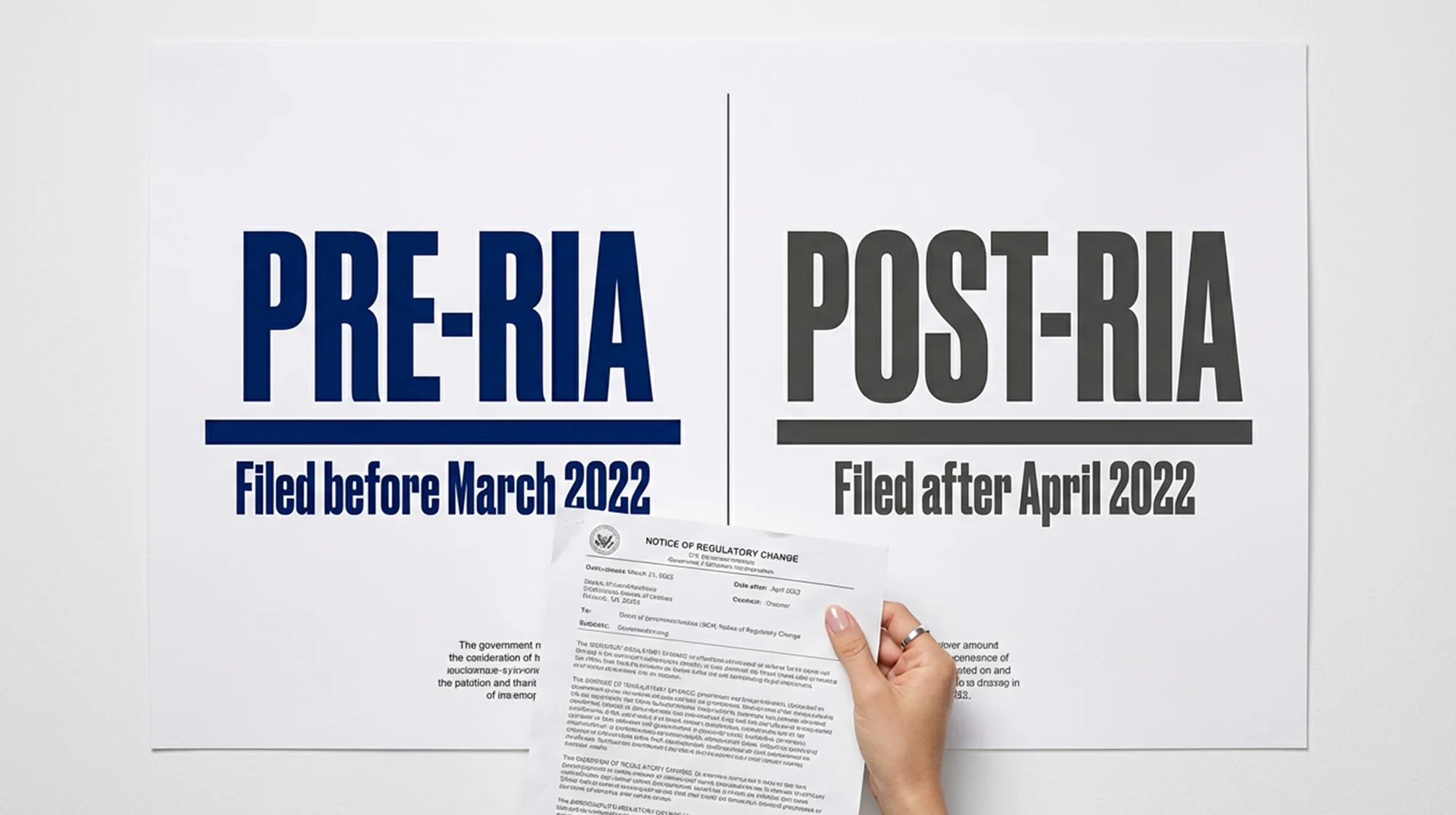
Determine whether you are a pre-RIA or post-RIA investor. This single distinction governs which rules apply to your case, what your options are, and how quickly you need to move. Check your filing date. If you filed Form I-526 before March 2022, you are pre-RIA. If you filed Form I-526E after April 2022, you are post-RIA.
Understand why your regional center was terminated. The reason matters enormously. A fee-nonpayment termination is treated far more leniently — especially for pre-RIA investors — than a termination based on fraud, project failure, or material misrepresentation. Contact your regional center and request full information about the basis for the termination action.
Check the status of your underlying project. Even if your regional center was terminated for administrative reasons, the health of the investment project itself is what ultimately determines your eligibility. Has the project created the requisite number of jobs? Is the capital still invested and at risk? Is the project commercially viable? These questions need real answers, not reassurances from a regional center with obvious interests in keeping you calm.
Watch the clock. The 180-day window (183 days for pre-RIA investors, 194 if abroad) runs from the date USCIS provides formal notification — not from the date you first hear about it informally. Filing an amended petition late can forfeit the very protections Congress intended you to have.
Do not assume you are automatically protected. Section M's good-faith investor protections are real and meaningful — but they are not self-executing. They require you to demonstrate continued eligibility, respond to USCIS within prescribed deadlines, and in many cases file amended petitions with supporting documentation. Investors who assume they are fine and take no action may find USCIS proceeding with adjudication in a way that does not favor them.
This is not a situation where a wait-and-see approach serves your interests. The stakes — your investment, your green card, your family's future in the United States — are too significant for passivity.
If you are navigating this situation and want to understand exactly where you stand, I'm here to help. Contact SG Legal Group to discuss your case and explore your options.
Do I lose my EB-5 investment money if my regional center is terminated?
Regional center termination is an immigration event — it affects your petition status, not directly the commercial investment itself. Whether you recover your invested capital depends on the financial condition of the underlying project, not on USCIS's termination decision. However, in cases where the regional center was terminated because the project failed or funds were misappropriated, investors may face both immigration and financial losses simultaneously. These are two separate issues that often need to be addressed in parallel, and the immigration remedies available under Section M do not resolve questions about the return of invested capital.
Can I keep my original priority date if I have to file an amended EB-5 petition?
Yes. Under Section M of the INA, as established by the RIA, investors who file an amended petition following a regional center termination retain the priority date from their original I-526 or I-526E petition. This is one of the most significant protections in the law and is especially valuable for investors from high-demand countries facing long visa backlogs. Your place in line is preserved even if the road to get there has changed.
Do I have to make an entirely new EB-5 investment if my regional center is terminated?
Not necessarily. For pre-RIA investors whose regional center was terminated only for failure to pay the Integrity Fund fee, USCIS may allow your petition to proceed on the basis of your original investment without any requirement to reinvest. For post-RIA investors, the answer depends on whether the new commercial enterprise can reassociate with a different approved regional center. If it can, no new investment is typically required. A new investment is necessary only if the NCE cannot reassociate and the investor must move to an entirely different commercial enterprise.
What if I do not respond to the termination notice within the deadline?
For pre-RIA investors, USCIS will proceed with adjudication under Option 1 — treating your petition as continuing to meet eligibility requirements. This may or may not be beneficial depending on your circumstances. For post-RIA investors, failing to respond or amend within the 180-day window creates serious eligibility risk. In either case, allowing the deadline to pass without taking deliberate, informed action is not advisable. The safer course is always to engage an experienced EB-5 attorney before the deadline, not after.
Regional center termination is not automatically the end of your EB-5 journey. The 2022 Reform and Integrity Act created real, meaningful protections for good-faith investors — and if you act promptly and strategically, many investors in this situation can preserve their green card path, their priority date, and their children's derivative benefits.
But "act promptly and strategically" is the operative phrase. The deadlines are firm. The distinctions between pre-RIA and post-RIA treatment are consequential. And the difference between a well-prepared amended petition and a poorly handled response can determine whether your years of waiting and hundreds of thousands of dollars in investment continue to move you toward permanent residence — or not.
The EB-5 program has always rewarded preparation and penalized passivity. That is doubly true when your regional center is in trouble.
If your regional center has been terminated, or you have reason to believe sanctions may be coming, the right time to consult with an experienced EB-5 attorney is now — not after the deadline has passed. If you are also exploring alternative investor pathways, it may be worth reviewing the E-2 Treaty Investor visa or employment-based green card options as part of a broader strategy.
Reach out to SG Legal Group today to discuss your situation. Every EB-5 case is different, and there is no substitute for advice tailored to your specific circumstances.
Disclaimer: The information provided in this article is for general informational purposes only and does not constitute legal advice. Immigration laws and policies are subject to change, and individual circumstances vary. For advice specific to your situation, please consult with a qualified immigration attorney.
Oleg Gherasimov, Esq.
Stay informed with our latest articles and resources.


