Immigration Law
Not long ago, a client came to me convinced she would not be able to return to the United States for ten years. She had overstayed her visa and assumed the damage was already done.
It wasn't.
The real risk was what she was about to do next — leave.
Here is what most people in overstay situations don't know: the 3-year and 10-year bars to reentry don't activate while you're still in the United States. They activate the moment you leave. Immigration attorneys call this the "departure trap," and it is the single most important concept in this entire area of law.
Someone who has lived without status in the U.S. for eight months may be able to fix their situation entirely from inside the country. But the moment they board a plane — thinking they'll resolve it at a consulate abroad — that same eight-month overstay can lock the door for three years.
So when clients ask me, "I overstayed my visa in the USA — can I return?", my first answer is always a question back: Where are you right now, and how long has it been?
The answer to those two questions determines which legal tools are available, how serious the consequences are, and what the right next move looks like. This article walks through the full framework — for people still inside the U.S. and for those already outside facing a bar.

The short answer is: sometimes yes, sometimes no — and it almost always depends on a specific combination of factors.
You likely have options if:
Return becomes significantly harder if:
What the outcome depends on:
No online article — including this one — can give you a definitive answer for your specific situation. But understanding the framework below will tell you which category you fall into and what legal tools may be available to you.
Before getting into bars and waivers, I want to address the single most common misunderstanding I encounter in overstay consultations. It leads people to believe they're fine when they're not — and it's the reason many end up in a far worse position than necessary.
Your visa and your authorized period of stay are two completely different legal instruments.
A nonimmigrant visa — the document stamped in your passport — is an entry document. It tells Customs and Border Protection (CBP) that a consular officer abroad determined you were eligible to present yourself at a U.S. port of entry. The expiration date on the visa means only that you must use it to enter before that date. It says nothing about how long you may remain.
Your actual permission to stay is recorded on your Form I-94, the electronic Arrival/Departure Record generated by the CBP officer at the time of your admission. The date on your I-94 — not the date on your visa — is your legal deadline.
This distinction has real consequences. Someone admitted in August 2024 on a 10-year B-2 visa with an I-94 expiring in February 2025 who is still in the United States in April 2025 has overstayed by two months — even though their visa technically remains valid for another nine years. The visa means nothing here. The I-94 date is the only metric that matters.
The overstay begins the day after the I-94 expires. As of that first day, the current visa is automatically voided by operation of law under INA § 222(g) — no government notice, no cancellation stamp required. Under § 222(g)(2), future nonimmigrant visa applications must generally be filed at the applicant's home country consulate. The option to apply at a third-country embassy is restricted unless extraordinary circumstances can be demonstrated.
A note on students and exchange visitors: F-1 and J-1 visa holders are admitted for "Duration of Status" (D/S) rather than a specific date. For them, unlawful presence doesn't begin to accrue from a calendar date — it begins the day after a formal finding by USCIS or an immigration judge that a status violation occurred. This is meaningful protection, but it doesn't make D/S holders immune. Visa voidance under § 222(g) still applies if they remain past the end of their program, and the consequences of a formal violation finding are serious.
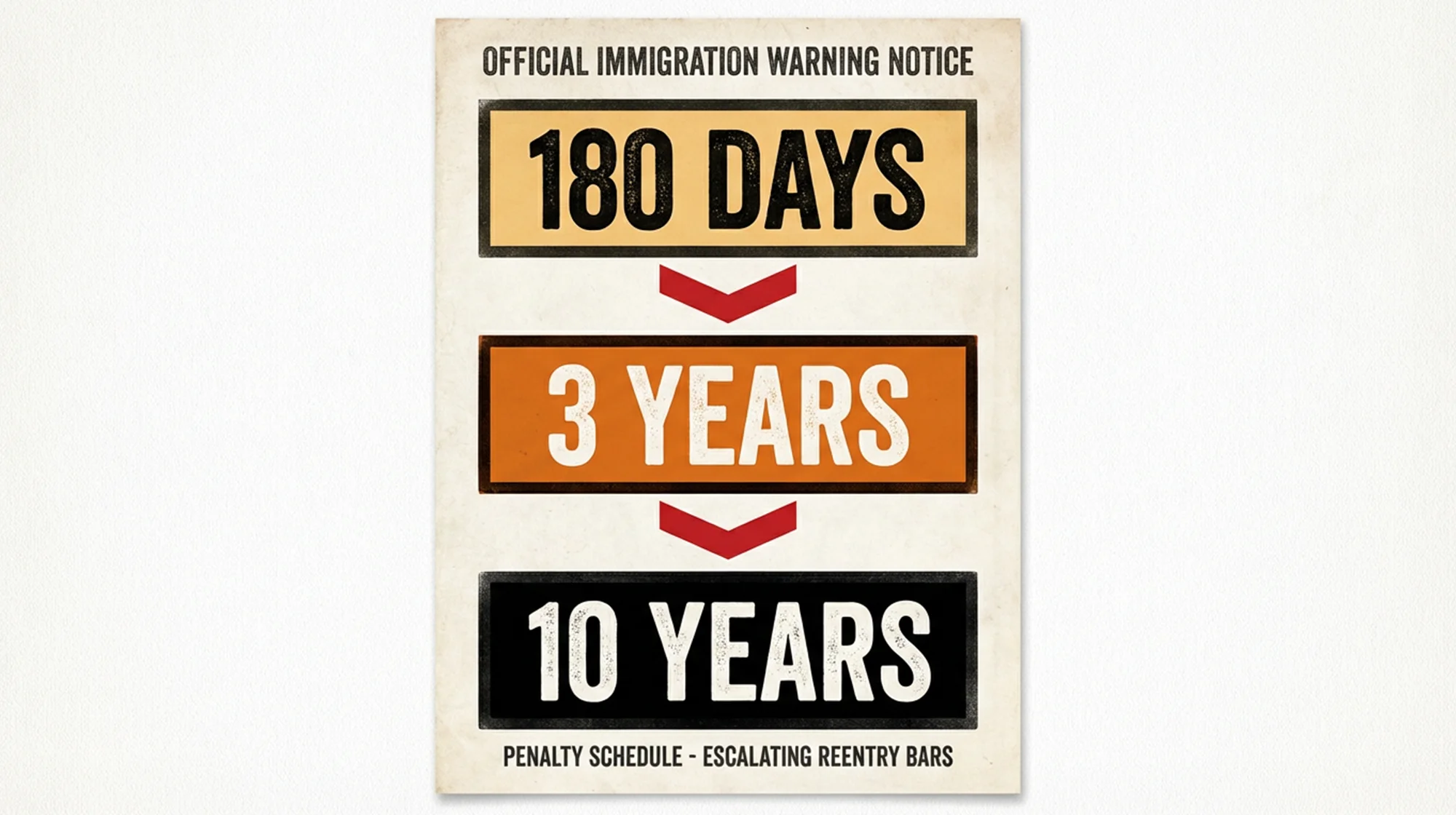
U.S. immigration law imposes three tiers of reentry bars based on how long someone has been unlawfully present. Understanding what triggers each bar — and when — is the foundation of any strategy in this area.
In my practice, I often see individuals trigger a 3-year or 10-year bar not because they had no options, but because they left the United States before anyone reviewed what those options were.
Under 180 Days — No Statutory Bar, But Real Consequences
If an overstay lasts fewer than 180 days, no formal reentry bar is triggered upon departure. But "no statutory bar" does not mean "no consequences." The visa is voided. The overstay becomes a permanent part of the immigration record.
At every future visa interview, the consular officer will see it. Under INA § 214(b), every nonimmigrant visa applicant is presumed to be an intending immigrant. Overcoming that presumption requires demonstrating strong ties to the home country — employment, family, property, financial roots. A prior overstay is perhaps the single most powerful piece of evidence a consular officer can use against an applicant. Even a 60-day overstay can and does result in discretionary visa denials for years afterward.
180 Days to Under 1 Year — The 3-Year Bar
Under INA § 212(a)(9)(B)(i)(I), someone who accrues more than 180 days but less than one year of unlawful presence and then voluntarily departs before removal proceedings are initiated is barred from reentry for three years from the date of departure.
Two nuances matter enormously here. First, this bar is triggered by voluntary departure before proceedings begin. If removal proceedings have already commenced before the person departs, the 3-year bar under this provision does not apply — though other consequences may. Second, the three-year clock starts on the day of departure, not the day the overstay began.
1 Year or More — The 10-Year Bar
Anyone who accrues one continuous year or more of unlawful presence and then departs — voluntarily or otherwise — is barred from reentry for ten years under INA § 212(a)(9)(B)(i)(II). Unlike the 3-year bar, this one applies regardless of whether the departure was voluntary or the result of a removal order.
A decade is a long time. It separates spouses, keeps parents from their children, and derails careers. And in my experience, it is frequently triggered not through deliberate defiance of the law, but through confusion, inaction, or bad advice received at a critical moment.
The Permanent Bar — The Most Severe Penalty
INA § 212(a)(9)(C) establishes the "permanent bar." It is triggered when someone accrues an aggregate period of more than one year of unlawful presence across multiple stays and then enters or attempts to reenter without inspection — or when someone with any prior removal order attempts unauthorized reentry.
Those subject to the permanent bar cannot even apply for permission to reapply for admission until they have remained continuously outside the United States for at least ten years from the date of their last departure. The pathway back is extraordinarily narrow, requiring Form I-212 filed only after that decade has elapsed.
Unlawful Presence and Reentry Bars Overview
If You're Still Inside the United States: More Options Than You Might Think
For someone who has overstayed and remains in the U.S., this is the most important section of this article. The departure trap works in both directions — while leaving can trigger bars, staying gives you access to remedies that disappear the moment you leave.
The single most important provision in this area of law is the immediate relative exception to Adjustment of Status under INA § 245(a). Spouses, unmarried children under 21, and parents of U.S. citizens who are at least 21 years old are classified as "immediate relatives" — and for them, an overstay does not bar adjustment of status inside the United States.
Provided the person was inspected and admitted or paroled when they originally entered — even if they have overstayed for years since then — they may file Form I-485 to obtain a green card without departing. The overstay is not held against them in the same way it would be for other categories. This is one of the most meaningful protections in family-based immigration, and it is why, for an immediate relative of a U.S. citizen, staying in the country while pursuing adjustment is often the legally correct strategy.
This exception does not extend to spouses of lawful permanent residents. LPR spouses fall under the F2A preference category and generally cannot adjust status while in overstay.
INA § 245(i): The Grandfather Clause
Those who are not immediate relatives may still be eligible to adjust status if a qualifying labor certification or immigrant visa petition was filed on their behalf on or before April 30, 2001. This provision grandfathers certain individuals into adjustment of status eligibility despite periods of unlawful presence or unauthorized entry. Whether a particular petition qualifies requires careful review of the original filing date and the underlying petition.
INA § 245(k): Employment-Based Relief
Certain employment-based applicants who are otherwise inadmissible due to status violations or unauthorized employment may adjust status if their aggregate period of violations does not exceed 180 days. This is a narrow but meaningful exception for applicants in the EB-1, EB-2, or EB-3 categories who have maintained substantially continuous employment-based status.
Extraordinary Circumstances: The Nunc Pro Tunc Option
If an overstay was caused by circumstances genuinely beyond the applicant's control — a medical emergency, a government processing delay, or ineffective assistance of prior counsel — USCIS has the discretionary authority under 8 CFR § 214.1(c)(4) to excuse a late-filed extension or change of status. If approved, the extension is granted nunc pro tunc, meaning retroactively, effectively erasing the overstay period for status purposes. These approvals are not common and the evidentiary burden is real, but in the right case they are worth pursuing.
F-1 Students: The Reinstatement Window
Because F-1 students are admitted for Duration of Status, their unlawful presence doesn't accrue from a missed calendar date but from a formal finding of a violation. A student who has fallen out of F-1 status may seek reinstatement within five months of the violation — provided they have not been out of status for more than five months, did not cause the violation willfully, are not in removal proceedings, and meet other criteria. Reinstatement, if granted, restores lawful status.
If you or a family member are in any of these situations, feel free to reach out. I handle these cases regularly and can assess whether adjustment or another remedy applies to your specific circumstances. Schedule a consultation here.
For those who have departed and triggered a 3-year or 10-year bar, the pathway back runs through the waiver process. There is no shortcut and no way to simply wait it out at a consulate. A waiver must be obtained.
The I-601 Waiver: Extreme Hardship to a Qualifying Relative
The primary unlawful presence waiver for immigrant visa applicants is filed on Form I-601 under INA § 212(a)(9)(B)(v). The applicant must demonstrate that denial of admission would result in "extreme hardship" to a qualifying relative — specifically, a U.S. citizen or LPR spouse or parent.
This is a demanding standard. The hardship must be unusual — beyond what would normally be expected when a family member is separated. The Board of Immigration Appeals in Matter of Cervantes-Gonzalez identified the relevant factors: family ties in the U.S. and abroad, conditions in the country of return, the financial impact, health conditions of the qualifying relative, and the duration of U.S. residence. Critically, it is the hardship to the qualifying relative that controls — not the hardship to the applicant.
I regularly see waiver cases fail not because hardship doesn't exist, but because it is not properly documented or framed. The strongest I-601 cases layer multiple factors that, taken together, paint a picture no single element could create alone. A qualifying relative with serious health needs that cannot be met abroad, combined with dependent U.S. citizen children and deep financial roots in the United States — these layered arguments are far more persuasive than a single hardship claim standing on its own.
The I-601A Provisional Waiver: Apply Before You Leave
For applicants in the immigrant visa pipeline — typically those with an approved I-130 petition preparing for a consular interview — the I-601A provisional unlawful presence waiver is one of the most strategically important tools available.
The I-601A allows the applicant to submit the waiver while still in the United States, before departing for their consular interview. If approved, they travel abroad knowing the waiver has been conditionally granted — dramatically reducing the period of family separation and eliminating the uncertainty of waiting abroad for an unknown period while a waiver is adjudicated overseas.
There is a critical limitation: the I-601A only waives unlawful presence. If the consular officer finds a separate ground of inadmissibility — fraud, criminal history, a prior removal order — the provisional waiver is revoked and those additional grounds must be addressed separately. This is why a thorough pre-departure review of the complete immigration record is essential before anyone files or travels.
The INA § 212(d)(3) Nonimmigrant Waiver: For Temporary Return
For those seeking to return temporarily — as a visitor, student, or in another nonimmigrant capacity — a separate waiver under INA § 212(d)(3) is available. Unlike the I-601, it does not require a qualifying relative or extreme hardship. It is purely discretionary, evaluated using the "Hranka factors": the risk of harm to U.S. society, the seriousness of the prior violation, and the applicant's reasons for seeking admission.
The 212(d)(3) is a more flexible tool, but it must be re-requested with each new nonimmigrant visa application. It provides no permanent resolution.
In my practice working with clients across different consular posts, I have seen significant variation in how strictly unlawful presence — and waiver requests — are evaluated. Some posts apply considerably more aggressive scrutiny, particularly where prior overstays are involved. That variability is itself a reason why preparation and legal strategy matter so much before any consular interview.
Visa Waiver Program Travelers
Citizens of VWP countries — the UK, Germany, Japan, and dozens of others — can enter the U.S. for 90 days without a visa. But even a single day past that 90-day period results in a lifetime ban from using the VWP. All future travel requires a B-1/B-2 visa application, which will be heavily scrutinized. I covered VWP overstay and the adjustment of status options available to ESTA travelers in a dedicated article here.
K-1 Fiancé Visa Holders
K-1 holders are admitted for exactly 90 days and must marry their U.S. citizen petitioner during that window. If the marriage does not occur and the holder overstays — or remains past 90 days for any reason — they cannot change to any other nonimmigrant status and cannot adjust through any other means. Departure is required, and if the overstay exceeded 180 days, a 3-year bar travels out the door with them.
TPS and DACA Recipients
Temporary Protected Status confers lawful presence but not a lawful admission. Under the Supreme Court's decision in Sanchez v. Mayorkas (2021), TPS holders who originally entered without inspection cannot use TPS as the basis for adjusting status inside the U.S., because TPS does not constitute a lawful admission. Any prior unlawful presence still matters in their cases.
DACA recipients are protected from accruing unlawful presence while DACA is active. However, any time spent without status after age 18 and before DACA was granted — or after a DACA lapse — still counts toward the unlawful presence calculation if a departure triggers a bar.
Advance Parole and Matter of Arrabally
For those with a pending Adjustment of Status application who need to travel and have prior unlawful presence in their history, the BIA's decision in Matter of Arrabally and Yerrabelly is a critical protection. The Board held that departure on a grant of advance parole does not constitute a "departure" for purposes of triggering the 3/10-year bars. I covered the advance parole rules in detail in a dedicated article here.
Beginning August 20, 2025, the Department of State launched a 12-month Visa Bond Pilot Program targeting B-1/B-2 applicants from countries with historically high overstay rates. Affected applicants may be required to post a refundable bond of $5,000, $10,000, or $15,000 through the U.S. Treasury's Pay.gov portal before their visa is issued. CBP is also instructed to limit admission for bond participants to 30 days.
This is not a waiver of inadmissibility — it is a financial compliance mechanism designed to incentivize timely departure. The program runs through August 5, 2026. If you are a national of a flagged country and planning to apply for a visitor visa, confirm current requirements with your consulate or with counsel before proceeding.
Most of the serious, long-term consequences I see in overstay cases are not inevitable. They are the result of decisions made without complete information — often under stress, often with the best intentions. The most common mistakes include:
Leaving the U.S. without first getting legal advice. This is the departure trap in action. Booking that flight before understanding the consequences is how people walk into bars that could have been avoided or managed.
Assuming the reentry bar has already started. Many people believe the 3 or 10-year clock began when their I-94 expired. It hasn't — it begins on the day of departure. Every day still inside the U.S. is a day the clock has not started.
Believing a valid visa means no overstay. As discussed above, the visa date and the I-94 date are different instruments. A valid visa offers no protection against an expired I-94.
Not analyzing Duration of Status carefully. F-1 and J-1 holders in particular often don't realize that their unlawful presence clock works differently. A formal finding — not a calendar date — is what triggers accrual. This distinction can significantly affect the calculation.
Underestimating consular scrutiny after even a short overstay. Even a 45-day overstay, well under the 180-day statutory bar threshold, can and does result in visa denials. Consular officers have broad discretion under INA § 214(b), and they use it.
Filing a waiver without properly building the hardship record. The I-601 and I-601A require more than a declaration of hardship. They require documentation, structure, and a legal argument. Submitting an underdeveloped waiver can result in denial — and a longer road back.
A question that comes up in nearly every consultation involving a past overstay: could it be that it's not "in the system"? Perhaps it was so long ago it has been forgotten. Perhaps a different passport would help.
It won't.
U.S. immigration authorities maintain a layered network of databases that cross-reference every documented entry and exit. The Consular Lookout and Support System (CLASS) stores visa refusals and prior violations. The Arrival and Departure Information System (ADIS) tracks entry and exit data. The Treasury Enforcement Communications System (TECS) allows CBP officers to access a consolidated record the moment a passport is scanned — at any port of entry, anywhere in the world.
The complete immigration history is visible to any reviewing officer from the moment a passport is presented. Attempting to conceal a prior overstay in a visa application is an independent ground of inadmissibility for fraud or misrepresentation under INA § 212(a)(6)(C) — a far more serious and harder-to-overcome problem than the overstay itself.
Transparency, proper legal disclosure, and a well-constructed strategy are the only approaches that work.
The answer is rarely a flat yes or no. It is a calculation — and the inputs are your current location, the length of the overstay, whether any removal order exists, whether qualifying family relationships are in play, and whether adjustment of status from inside the U.S. remains available.
Many people in overstay situations have more options than they realize. Many others have fewer than they hope. The difference between those two groups often comes down to whether they got legal counsel before making the move that triggered consequences that could have been avoided.
If you have overstayed your visa in the USA, the most important decision is often what you do next — not what has already happened.
If you need experienced legal guidance, contact me at SG Legal Group. My team and I will help you navigate your situation with clarity and confidence. Consultations are available in English, Russian, and Romanian. Call 410-618-1288 or visit our contact page to schedule a consultation.
Disclaimer: The information provided in this article is for general informational purposes only and does not constitute legal advice. Immigration laws and policies are subject to change, and individual circumstances vary. For advice specific to your situation, please consult with a qualified immigration attorney.
Oleg Gherasimov, Esq.
Stay informed with our latest articles and resources.