Immigration Law
You filed a complete package. Every form was filled out. Every document was included. You waited months without hearing a word — and then a Request for Evidence arrived, citing inconsistencies you didn't recognize.
If that scenario sounds familiar, here's something worth understanding: USCIS is already using AI in parts of its adjudicative workflow. DHS's public AI inventory confirms active USCIS tools for evidence classification, document translation, verification matching, and fraud-related analysis. These systems do not make final legal decisions — but they can influence how information is organized, compared, and surfaced for officer review. AI systems may now classify, translate, match, or flag aspects of your filing before a human officer fully evaluates the substance of your case.
Most of the public conversation about artificial intelligence in immigration focuses on one direction — applicants using AI tools to draft cover letters, fill out forms, or self-file petitions. I've written about the serious risks of that approach. But there's an equally important story happening on the other side of the desk, inside USCIS itself, that almost nobody is talking about.
The Department of Homeland Security publishes a document called the AI Use Case Inventory. It lists every artificial intelligence and machine learning system deployed across DHS agencies. The January 28, 2026 update includes roughly 29 USCIS AI use cases — and DHS has stated it will continue updating the inventory throughout 2026. Most immigration applicants have never heard of it. Most don't know it exists.
That's a problem, because these systems are already embedded in how your case is processed.

When people hear "AI in immigration," they usually imagine something speculative — a futuristic system that might one day review applications automatically. That framing is years out of date.
USCIS artificial intelligence is operational today. The systems described in the DHS inventory are not in testing. They are deployed and embedded into the workflows adjudicators use every day.
To be clear about what "roughly 29 use cases" actually means: a use case is not an individual instance of AI being used. It is a distinct operational system. A single use case may run across hundreds of thousands or even millions of applications, often without direct human interaction at that stage. When you upload evidence into USCIS's electronic filing system, an AI system classifies it. When your identity is verified through E-Verify or the SAVE program, a machine learning model is doing the matching. When a fraud detection workflow runs on your petition, it is cross-referencing your submitted information against data from other systems.
DHS is consistent and emphatic on one point: human adjudicators retain final decision-making authority. AI systems do not grant or deny immigration benefits. That is true, and it matters. But "final authority" and "sole influence" are not the same thing. These systems can shape which issues get highlighted, which files get prioritized, and which applications arrive at an officer's desk already flagged for closer review. That is not a trivial function.
The DHS inventory covers a range of tools. These are the ones most directly relevant to the cases I handle — and most likely to affect yours.
ELIS Evidence Classifier
This machine learning system automatically sorts and classifies the evidence documents you upload into USCIS's electronic filing system. According to DHS disclosures, it has significantly improved processing efficiency — reportedly contributing to a doubling of the share of applications processed within 30 days.
What this means practically: the organization and categorization of your documents may influence how your file is structured before any human review begins. A complete, clearly organized submission works with this system. A disorganized or incomplete one may not.
Verification Match Model — E-Verify and SAVE
This system uses machine learning to match names, dates of birth, and other identifiers across multiple government databases. It supports both the Employment Verification Program (E-Verify) and the Systematic Alien Verification for Entitlements (SAVE) program. DHS materials confirm that machine learning is involved in automating E-Verify case processing and improving data matching accuracy.
What this means practically: the kinds of discrepancies that automated matching systems are designed to surface include name variations across documents, date inconsistencies, and identity data that doesn't align cleanly across records. These are illustrations of the system's logic, not a verbatim description of disclosed model specifications — but they are the kinds of mismatches that create downstream problems.
Document Translation Service
USCIS officers can upload a foreign-language evidence document and receive an AI-generated English translation almost instantly, displayed side-by-side with the original. The service uses Microsoft Azure AI Translator and is intended to reduce preparation burden before and during interviews.
What this means practically: an AI translation of your documents may be influencing how an officer understands your evidence. Whether that translation is preserved in your administrative record, and in what form, is an open question — one that matters most in proceedings where credibility may hinge on precise wording. This is a traceability concern worth monitoring as USCIS expands its use of this tool.
Fraud Detection — FDNS and Related Systems
This is the category most likely to affect your case directly. USCIS fraud detection AI — including tools associated with the Fraud Detection and National Security Directorate — is designed to surface inconsistencies in applications for officer review.
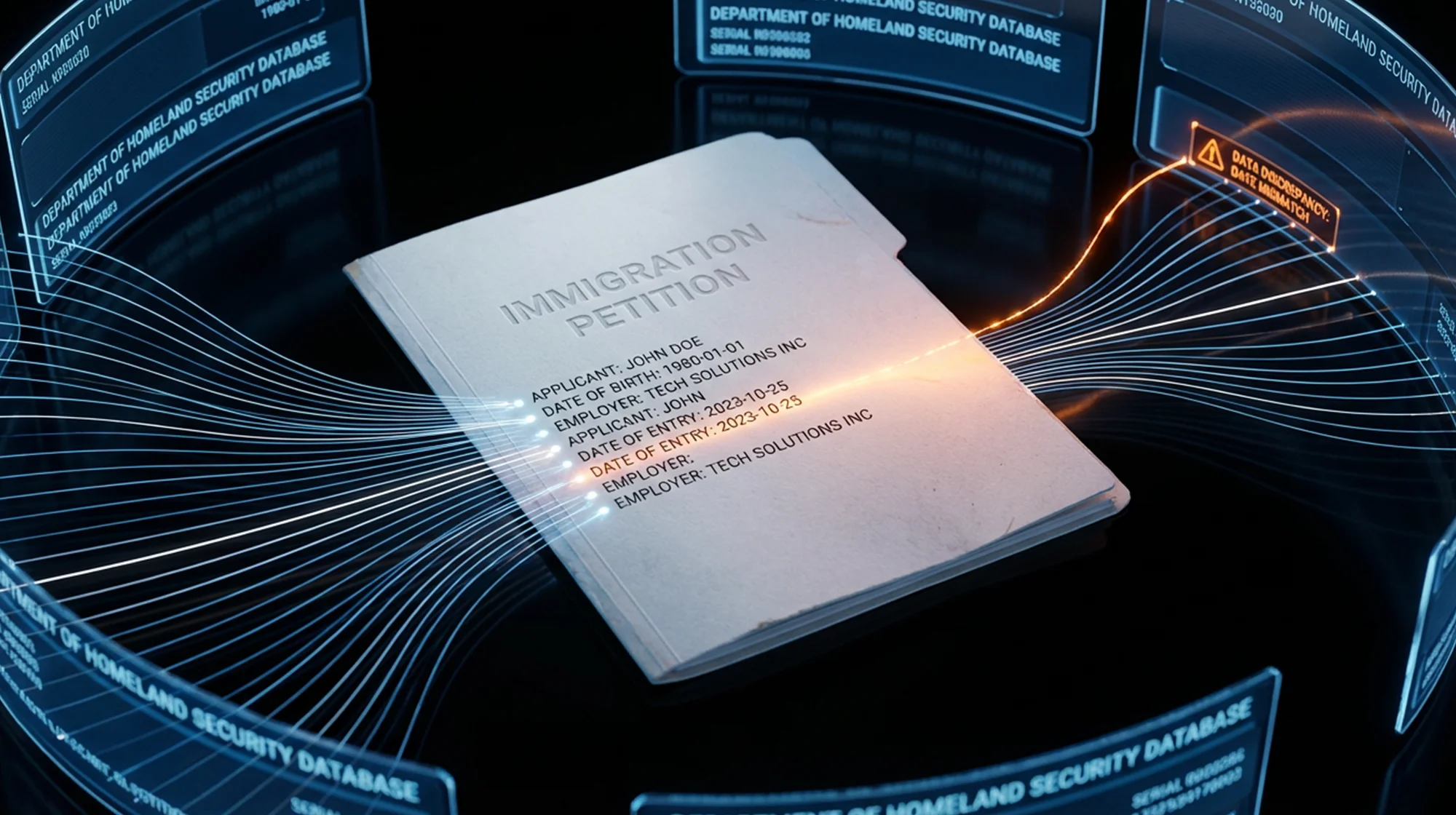
What this means practically: if there are discrepancies between what you've stated in your petition and what appears in other records, a fraud detection system may surface that for officer attention before your file is fully read. Whether the inconsistency has a reasonable explanation is irrelevant at the flagging stage. The flag happens first. The explanation, if it gets made at all, comes later — usually in an RFE response.
I want to be honest about the limits of what I can establish here. USCIS does not publish documentation disclosing when an AI system flagged a specific case. There is no indicator on a case status page, no notation in an RFE, and no official mechanism for an applicant or attorney to confirm it. What I can tell you is that certain patterns are becoming increasingly recognizable to practitioners.
I worked with a client whose petition contained a discrepancy that was entirely explainable — a minor inconsistency between a date stated on the application and a date that appeared in a supporting document, the result of a transliteration difference across two countries' official records. The case was otherwise strong. The documentation was thorough.
The RFE that arrived cited inconsistencies in the record and requested additional documentation and explanation on precisely that point. There was no other logical basis in the file for that specific flag. The pattern was consistent with automated cross-referencing — a system comparing data points across document sets that, in a purely manual review environment, may not have been directly compared at all.
We resolved it, but the delay cost the client months and required preparation that wouldn't have been necessary if the inconsistency had been identified and addressed before filing.
That is the real-world cost of not understanding what these systems are looking for.
The AI tools embedded in USCIS workflows are built around one core function: identifying deviations from expected patterns. Understanding what those systems are designed to catch tells you what to address before you file.
Inconsistencies between your narrative and verifiable records. Every date, location, and fact you state in a petition can potentially be compared against travel records, prior filings, and government database entries. If your I-129F says you first met your fiancé in June 2022 and a travel record shows your passport wasn't stamped in that country until August 2022, that kind of discrepancy is exactly what data-matching tools are built to surface.
What's publicly visible that contradicts your filing. This is the point I emphasize most consistently with my clients. Before filing, verify what you are telling USCIS against what is publicly visible — including social media. If your LinkedIn profile states you have been employed at a company since 2020 and your petition states 2021, that is a discrepancy. Anything publicly visible that contradicts your filing can create risk, whether identified through routine officer review, investigative follow-up, or technology-assisted screening. An attorney can help you identify those conflicts before they become problems.
Identity data mismatches across government databases. The Verification Match Model runs automatically for E-Verify and SAVE queries. Name variations, transliterations, date of birth discrepancies, and address history inconsistencies across official records are the inputs automated matching is designed to catch. For employer clients, this means that data entry accuracy is not an administrative nicety — it is a compliance issue.
Document quality and completeness. The ELIS Evidence Classifier analyzes uploaded documents. Incomplete translations, poor-quality scans, and documents that don't conform to expected formats create noise in the classification process. A missing certification on a translated document is not just a procedural gap — it is a data quality issue that may affect how your evidence is categorized and reviewed.
This is the most important thing I can tell you about USCIS artificial intelligence.
These systems identify deviations from expected patterns. They do not evaluate your explanation. They do not know that your name appears differently across documents because transliteration standards vary between countries. They do not know that a gap in your employment record reflects authorized leave, not unauthorized work. They do not know that a date discrepancy in your relationship narrative comes from how two countries format dates on official documents.
An experienced attorney can often identify where a filing is likely to look inconsistent, incomplete, or atypical before submission — not because anything is wrong, but because these systems don't understand context. Addressing those issues proactively, before a petition is submitted, is now a core part of what competent immigration counsel provides.
If your case involves date discrepancies across documents, name variations across records, employment histories spanning multiple countries, or a social media presence that contradicts anything in your petition, legal review before filing makes a meaningful difference. Schedule a consultation with my office to discuss your case before it reaches a USCIS inbox.
None of what follows substitutes for legal counsel — and that distinction matters more today than it did five years ago. But here is the practical framework I walk my own clients through.
Audit your social media before you file, not after. Review your public-facing profiles — LinkedIn, Facebook, Instagram, and any platform where you've posted dates, locations, employers, or relationship information. Compare what those profiles show against what your petition will state. Inconsistencies are not automatically disqualifying, but unexplained ones create risk.
Verify every date, name, and employer reference against official records. Do not rely on memory. Pull your actual travel records, employment verification letters, and prior immigration filings. Cross-reference them against what you plan to submit. If a date is off by a month, address it before filing. If a name is spelled differently across two documents, include a legal name explanation rather than assuming an officer will overlook it.
Take document translation seriously. Every foreign-language document submitted to USCIS requires a complete, certified English translation. Partial translations, uncertified machine-generated translations, and documents that omit sections of the original are all sources of downstream problems. Given that officers now have access to AI-assisted translation of your original documents, any meaningful divergence between the certified translation on file and a real-time AI rendering of the same document can raise questions you don't want to answer in an RFE.
For employers: treat E-Verify data entry as a legal function, not an HR task. The Verification Match Model runs automatically. A name entered inconsistently with what appears on a foreign national employee's immigration documents, or a date of birth that varies by a digit between an I-9 and a government database entry, can trigger a tentative nonconfirmation and create compliance exposure. These are preventable errors.
Consistency has always mattered in immigration law. What has changed is that inconsistencies are now caught systematically — not only when an officer happens to notice them during manual review. The margin for error has narrowed.
USCIS artificial intelligence will not go away. The institutional pressure to process an 11-million-case backlog will drive continued automation. That is not a reason for alarm — it is a reason to file smarter.
The applicants who experience the most friction are the ones who file with inconsistencies they didn't know existed. The ones who move through the system cleanly are usually the ones whose files were built with the kind of care and consistency that automated processing rewards.
If you are preparing an immigration petition — family-based, employment-based, naturalization, or nonimmigrant — and you want to make sure your file is as clean and consistent as possible before it enters this system, I'm here to help.
Schedule a consultation with SG Legal Group to discuss your case. Consultations are available in English, Russian, and Romanian.
You can also learn more about the family-based and employment-based immigration services my office handles at sglegalgroup.com.
Disclaimer: The information provided in this article is for general informational purposes only and does not constitute legal advice. Immigration laws and policies are subject to change, and individual circumstances vary. For advice specific to your situation, please consult with a qualified immigration attorney.
Oleg Gherasimov, Esq.
Stay informed with our latest articles and resources.