Accidents
A broken arm heals in six weeks. A torn ACL might sideline you for a season. But some injuries don't follow that trajectory — they rewrite your entire life in a single moment.
I'm talking about traumatic brain injuries that steal your ability to think clearly, spinal cord damage that takes away your ability to walk, amputations that fundamentally change how you move through the world. These are catastrophic injuries, and if you or someone you love is facing one, I want you to understand something right away: the legal process for these cases is nothing like a standard personal injury claim. The stakes are higher, the timeline is longer, the evidence is more complex, and the insurance company's playbook is completely different.
As a personal injury attorney at SG Legal Group, I've represented clients across the full spectrum of accident injuries here in Maryland. And the single biggest mistake I see families make after a catastrophic injury is treating the legal side of things the same way they would after a fender-bender or a simple slip-and-fall. It's not the same. Not even close.
Let me walk you through what makes a catastrophic injury case different — and what that means for you.
There's no single Maryland statute that draws a bright line and says, "This injury is catastrophic and that one isn't." But in the legal and medical communities, a catastrophic injury is generally understood as one that results in permanent, life-altering consequences — an injury so severe that you cannot return to the life you had before.
The types of injuries that consistently fall into this category include:
Traumatic brain injuries (TBI). These range from severe concussions with lasting cognitive effects to penetrating head wounds that cause permanent brain damage. A TBI can affect memory, speech, emotional regulation, personality, and the ability to work — sometimes all at once.
Spinal cord injuries and paralysis. Whether it's paraplegia (loss of function in the lower body) or quadriplegia (loss of function in all four limbs), spinal cord damage is among the most devastating outcomes of any accident. Many of my clients who suffer spinal injuries need round-the-clock care for the rest of their lives.
Amputations and limb loss. Losing a hand, arm, foot, or leg changes everything — from how you get dressed in the morning to whether you can continue in your career. The prosthetics, rehabilitation, and adaptive equipment costs alone can reach into the hundreds of thousands of dollars.
Severe burn injuries. Third- and fourth-degree burns often require multiple surgeries, skin grafts, and years of reconstructive procedures. Beyond the physical pain, burn survivors frequently deal with lasting psychological trauma and visible disfigurement.
Loss of sight or hearing. Permanent sensory loss fundamentally changes a person's independence, career options, and quality of life.
Multiple fractures and crush injuries. When an accident causes fractures to multiple bones — particularly weight-bearing bones or the pelvis — the combination of surgeries, hardware, infections, and rehabilitation can create a cascade of complications that persists for years.
Internal organ damage. Severe damage to the kidneys, liver, spleen, or lungs can create lifelong medical dependencies, including the need for dialysis, transplant candidacy, or reduced respiratory function.
The common thread here isn't any one diagnosis. It's permanence. If the injury fundamentally and permanently alters your physical ability, your cognitive function, your independence, or your capacity to earn a living, it falls into catastrophic territory.
Here's what most people don't realize: a catastrophic injury case isn't just a bigger version of a regular personal injury case. It's a fundamentally different type of litigation. The approach, the experts, the evidence, and the negotiation strategy all change.
The Damages Are Measured in Decades, Not Months
In a typical car accident case, we're calculating medical bills and lost wages over a defined recovery period — maybe six months, maybe a year or two. But when someone suffers a catastrophic injury, we're projecting costs across an entire lifetime.
Think about what that means in practical terms. A 35-year-old who becomes a paraplegic after a truck accident may need 40 or 50 years of wheelchair equipment, home modifications, attendant care, medical monitoring, prescription medications, and adaptive technology. The lifetime cost of care for a spinal cord injury can exceed several million dollars. A traumatic brain injury requiring ongoing cognitive therapy, behavioral support, and supervised living can cost just as much.
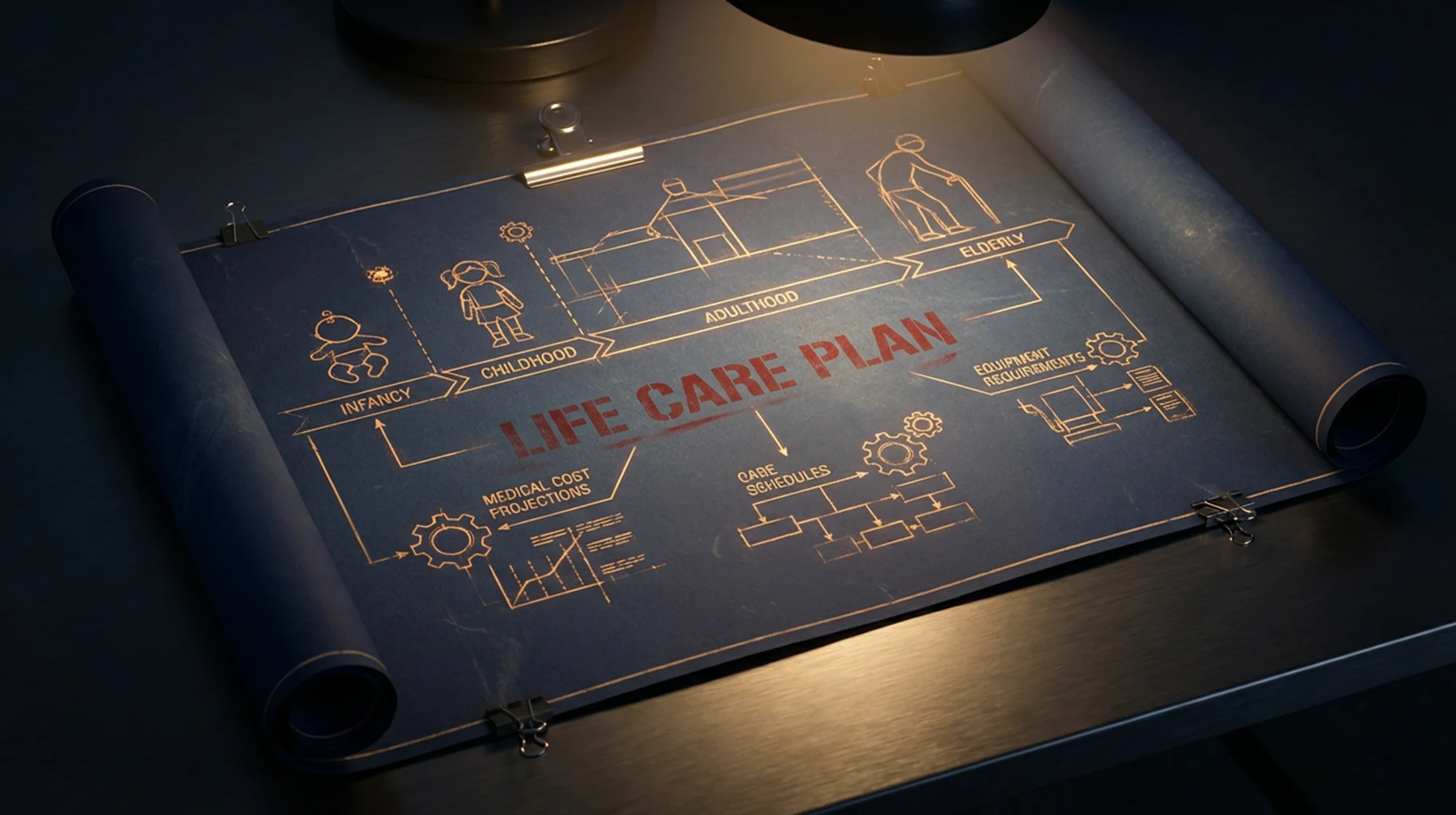
This is where a legal concept called the "life care plan" becomes critical. A life care plan is a comprehensive document — usually prepared by a medical professional who specializes in rehabilitation — that maps out every anticipated medical need, cost, and service the injured person will require for the rest of their life. It's the backbone of a catastrophic injury claim, and without one, you're essentially guessing at what the future will cost.
I work with life care planners, economists, and medical specialists to build these projections on a case-by-case basis. It's painstaking work, but it's the difference between a settlement that runs out in five years and one that actually covers your needs.
You Need Expert Witnesses — and Not Just One
A standard personal injury case might involve your treating physician providing a note about your diagnosis and recovery timeline. In a catastrophic injury case, the expert witness list grows significantly.
You'll typically need medical experts who can testify about the severity of the injury and the long-term prognosis. You'll need an economist who can calculate lost earning capacity over a lifetime — not just the wages you're missing now, but the raises, promotions, and career trajectory you've lost. You may need a vocational rehabilitation expert to assess whether you can work at all, and if so, in what capacity. You may need a neuropsychologist if cognitive deficits are involved, or a mental health professional to address the psychological impact of the injury.
Each of these experts costs money and takes time to retain and prepare. But in a catastrophic case, cutting corners on expert testimony can cost you far more than what those experts charge. Insurance companies know this, and they come to the table with their own team of experts ready to minimize your injuries and your future needs. You need to match that firepower.
Insurance Companies Play a Different Game
I want to be direct about this because I've seen it happen too many times. When an insurance company is facing a claim for a broken wrist or a herniated disc, they have a playbook: delay, lowball, settle. It's frustrating, but it's predictable.
When they're facing a catastrophic injury claim worth potentially millions of dollars, the playbook changes entirely. They assign senior adjusters and defense attorneys. They hire their own medical experts to conduct "independent" medical examinations designed to downplay your injuries. They scrutinize your entire medical history looking for pre-existing conditions they can blame. They deploy surveillance to catch you on camera doing anything that contradicts your claimed limitations.
In short, they fight harder because the stakes are higher — for them. Which means you need an attorney who understands these tactics and is prepared to counter every single one of them.
This is something every catastrophic injury victim in Maryland needs to understand. Maryland imposes a cap on noneconomic damages — that's the legal term for compensation covering pain, suffering, loss of enjoyment of life, and other intangible losses.
For causes of action arising in the current period, the noneconomic damages cap for personal injury cases is $965,000 for an individual claim. In wrongful death cases with two or more beneficiaries, the cap increases to 150% of the base amount — approximately $1,447,500. When both a wrongful death claim and a survival action are viable, the combined ceiling can reach approximately $2,412,500.
Here's why this matters so much in catastrophic cases: a jury might hear the evidence about how a spinal cord injury destroyed a young person's ability to walk, work, raise their children, or live independently, and that jury might decide $3 million or $5 million in pain and suffering is the right number. But the judge is required by law to reduce that award to the statutory cap. The jury is never even told the cap exists.
I wrote about this issue in detail in a recent post about Maryland's noneconomic damages cap debate, and it's a topic I feel strongly about. The cap disproportionately affects the most seriously injured people — the exact individuals who need the most compensation.
The practical takeaway? In catastrophic injury cases, maximizing your economic damages — medical costs, lost wages, future care needs, and other quantifiable losses — becomes absolutely essential because those categories are not capped. That's another reason why a thorough life care plan and strong economic expert testimony are so critical. Every dollar of future care that gets documented and proven is a dollar the cap can't touch.
Maryland gives you three years from the date of injury to file a personal injury lawsuit. That's the general rule under Maryland Courts and Judicial Proceedings Code § 5-101. Three years might sound like a long time, but for a catastrophic injury case, it can feel incredibly short.
Why? Because catastrophic injury victims are often in the hospital for weeks or months after the accident. They're focused on survival, then stabilization, then rehabilitation. Legal action is understandably the last thing on their mind. Meanwhile, the clock is running.
There are also practical reasons to get an attorney involved early. Evidence disappears. Witnesses forget details. Trucking companies overwrite electronic logging data. Surveillance footage gets deleted. The sooner we can start preserving evidence and building your case, the stronger that case will be.
If you're a family member of someone who suffered a catastrophic injury, this is one of the most important things you can do to help: make the call to an attorney early, even if the injured person isn't ready to think about legal matters yet. A consultation doesn't commit you to anything — it just protects the timeline.
Catastrophic injuries can happen in any accident, but certain types of incidents are more likely to produce life-altering outcomes:
Commercial truck accidents. The sheer size and weight difference between a tractor-trailer and a passenger vehicle means that truck accidents disproportionately produce catastrophic injuries. When an 80,000-pound truck collides with a 3,500-pound car, the physics are devastating.
High-speed automobile collisions. Head-on crashes, T-bone accidents at intersections, and highway-speed rear-end collisions are among the leading causes of traumatic brain injuries and spinal cord damage. Even with modern safety features, the human body has limits. If you've been in a serious car accident, don't assume you're fine just because you walked away from the scene — some catastrophic injuries don't show their full extent for hours or days.
Motorcycle accidents. Riders have virtually no structural protection in a crash. The result is that motorcycle accidents produce a disproportionate number of traumatic brain injuries, spinal injuries, and amputations.
Premises liability incidents. Falls from significant heights, building collapses, electrocution, and other premises liability scenarios can cause catastrophic harm when property owners fail to maintain safe conditions.
Workplace accidents. Construction site falls, heavy machinery incidents, and industrial accidents can produce crush injuries, amputations, and traumatic brain injuries that change a worker's life permanently.
If you or a loved one has suffered a catastrophic injury, here are the steps that matter most from a legal standpoint:
Prioritize medical care — and document everything. This should go without saying, but follow every medical recommendation. Attend every appointment. Don't skip rehabilitation sessions. Not only is this important for your recovery, but gaps in treatment are the first thing insurance companies point to when arguing your injuries aren't as serious as claimed.
Don't give recorded statements to the insurance company. After a catastrophic accident, the at-fault party's insurer will want a recorded statement from you as quickly as possible — often while you're still in the hospital, medicated, and in no condition to be making official statements. Politely decline. You're not required to give one, and anything you say can and will be used to minimize your claim.
Preserve all evidence. If family members are able to photograph the accident scene, the vehicles, and the injuries, that evidence can be invaluable. Keep every medical record, every bill, every piece of correspondence from the insurance company. If you're missing work, document your lost wages.
Consult a catastrophic injury attorney as early as possible. This is not the kind of case where you should wait until you've recovered to "deal with the legal stuff." The complexity of catastrophic injury litigation — the experts needed, the evidence that must be preserved, the life care plan that must be developed — requires early involvement.
I want to be straightforward with you: not every personal injury attorney handles catastrophic injury cases, and there's a reason for that. These cases require significant upfront investment in experts, extensive medical record analysis, and the willingness to take a case to trial if the insurance company won't offer fair compensation.
When I take on a catastrophic injury case, I'm committing to building the most comprehensive case possible. That means working with life care planners, economists, and medical specialists. It means spending the time to understand not just my client's injuries, but their entire life — what they did before the accident, what they can't do now, and what they'll need for the next 30, 40, or 50 years.
Every case is different, and every catastrophic injury has its own set of facts. If you or someone in your family is dealing with a life-changing injury from an accident, I want you to know that I'm here to help you understand your options. You can contact me directly for a free consultation — no pressure, no obligation. We'll talk through your situation and I'll give you an honest assessment of where things stand.
These cases are personal to me. When someone loses the ability to walk, or can't remember their children's names, or faces a lifetime of surgeries because of someone else's negligence, the legal system needs to work for them. That's what I'm here for.
Catastrophic injuries — including traumatic brain injuries, spinal cord damage, amputations, severe burns, and permanent organ damage — are defined by their life-altering permanence. These cases require a fundamentally different legal strategy than standard personal injury claims, including life care plans, multiple expert witnesses, and a detailed projection of lifetime costs. Maryland's noneconomic damages cap limits pain and suffering awards, making it essential to maximize documented economic damages. The three-year statute of limitations applies, but the complexity of these cases makes early attorney involvement critical. Choosing an attorney with specific experience in high-stakes catastrophic injury litigation can make a significant difference in the outcome of your case.
If this sounds like your situation — or the situation someone in your family is facing — don't wait to get answers. Reach out to me at SG Legal Group and let's talk about what comes next.

Disclaimer: The information provided in this article is for general informational purposes only and does not constitute legal advice. Laws and regulations are subject to change, and individual circumstances vary. For advice specific to your situation, please consult with a qualified attorney.
Joshua C. Sussex, Esq.
Stay informed with our latest articles and resources.