Accidents
Most parents assume that if their child is hurt on a school bus, the school district will do the right thing.
I understand why. You trust BCPS with your child every single day. When something goes wrong, it feels like there should be a straightforward path to accountability and fair compensation.
There isn't — not without understanding a legal framework that most families, and frankly many attorneys, don't fully know exists.
I've had parents call me after it was simply too late to save a legitimate claim. Not because they waited years. Because they didn't know the right questions to ask in the months right after the accident, and critical windows closed without them realizing it. That experience stays with me. It's part of why I want to lay this out as clearly as I can.
If your child was injured in a school bus accident in Baltimore County, here is what you actually need to know.
Here's something that surprises a lot of people, including attorneys who don't handle these cases regularly: claims against the Baltimore County Board of Education are not governed by the Local Government Tort Claims Act (LGTCA).
Most people assume they are. The LGTCA is the statute that governs claims against local government entities in Maryland, and most people — reasonably — assume a county school board falls under that umbrella. It doesn't.
County boards of education in Maryland are classified as state agencies, not local governments. That means your claim is governed by a completely separate statute: Maryland Courts and Judicial Proceedings § 5-518.
Why does this matter? A few important reasons.
First, the good news. Unlike the LGTCA, § 5-518 contains no pre-suit notice requirement. Under the LGTCA, you must provide formal written notice to the government within one year of the injury or your claim is dead — regardless of what happened, regardless of how serious the injuries are. That notice requirement has killed legitimate claims for families who simply didn't know about it. With the Board of Education, that particular trap does not exist.
Second, the damages cap. Under § 5-518, the Board of Education cannot assert sovereign immunity against claims of $400,000 or less per claimant. That's the floor of what you can recover — but it may not be the ceiling, and I'll explain that in a moment.
Third — and this is important — the absence of a notice requirement does not mean there are no deadlines. There are real deadlines that matter enormously, and missing them can be just as devastating. I'll walk through those below.
The bottom line: the legal framework governing your case is more nuanced than most families realize at the outset, and getting it wrong at the start can cost you everything.
Before anything else, you need to know who actually operated the bus.
This is the question most families never think to ask, and it may be the single most consequential one in your entire case.
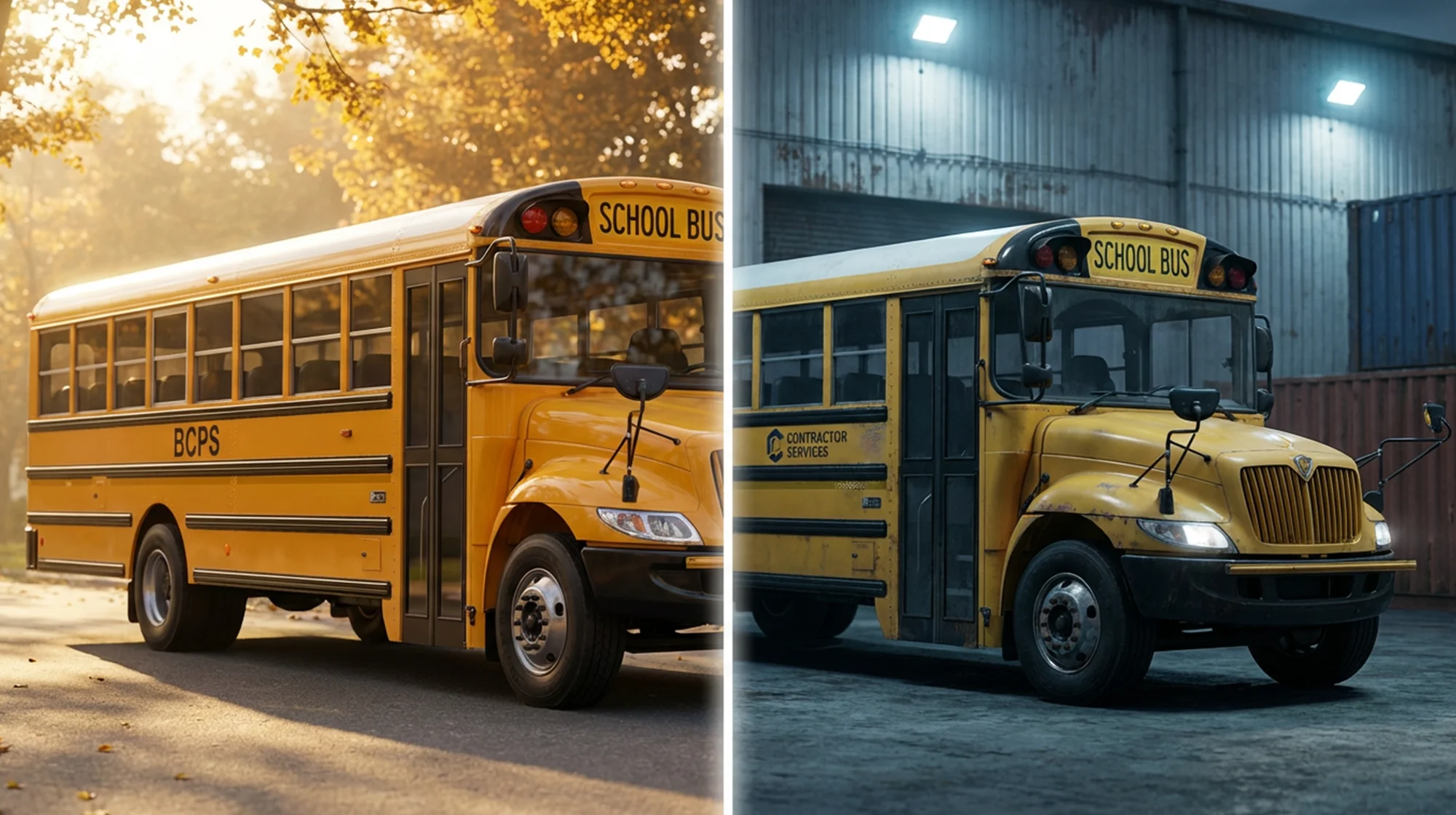
BCPS operates one of Maryland's largest student transportation systems — roughly 77,000 to 80,000 students transported daily across approximately 785 routes, using a fleet of around 1,000 buses. But BCPS doesn't operate all of those buses itself. The district uses private contractors extensively, running 91 contractor routes out of five separate facilities. Known contractors include companies like Academy Express LLC, Chesapeake Charter Inc., Fleming Transportation Corp., and others.
Here's why this matters so much: governmental immunity does not extend to private contractors.
If the bus that injured your child was operated by a private contractor — not a BCPS employee — the contractor can be sued under standard tort principles with no immunity cap and no ceiling on damages. Economic damages are fully uncapped. Non-economic damages are subject only to Maryland's general cap, which is approximately $965,000 for injuries occurring in the current school year. That is a fundamentally different legal landscape than a capped Board of Education claim.
The contractor can also be held liable for its own independent negligence — failure to properly hire, train, or supervise its drivers, failure to maintain the vehicle. These are independent theories of recovery on top of vicarious liability for the driver's negligence.
The 2016 Baltimore City school bus disaster — though outside Baltimore County — illustrates exactly why this distinction matters. A contractor-operated bus traveling at nearly twice the speed limit crashed after the driver suffered a seizure caused by long-standing epilepsy the contractor had failed to identify. Six people were killed. That tragedy led directly to stricter regulations around pre-employment screening and driver oversight. It also demonstrated how catastrophically contractor negligence can manifest when oversight fails.
When a family contacts me after a school bus accident, one of the very first things I do is confirm whether the bus was BCPS-operated or contractor-operated. That answer can reshape the entire case.
How do you find out? The police report will often identify the bus and operating entity. The bus number is another starting point. Your attorney can quickly confirm through the BCPS Department of Transportation. Don't assume — verify.
If you're not sure whether your case involves a contractor, that's exactly the kind of thing I look into immediately. Contact me and I can help you find out.
Let me be direct about the damages cap, because I think families deserve honesty here.
For a child with serious injuries — a traumatic brain injury, a spinal cord injury, permanent disability — $400,000 may not come close to covering the full extent of what was lost. That is a real limitation of the current law, and I won't pretend otherwise. Maryland advocacy groups have argued for years that these caps are inadequate. The legislature hasn't acted.
But $400,000 is the floor, not necessarily the ceiling.
Here's why. Under § 5-518, if the Board of Education carries insurance above $400,000, the Board can only assert immunity for amounts exceeding its actual policy limit. Maryland law requires minimum coverage of $400,000 per occurrence — but BCPS may carry a higher policy. If the Board's actual insurance is $1 million, recovery up to $1 million is potentially available.
Investigating the Board's real insurance coverage is one of the first steps in any school bus case I handle. That information is available through a Maryland Public Information Act request, and it can significantly change the picture for your family.
A few other important points about the cap:
Each injured child has a separate claim. The $400,000 applies per individual claimant. In a multi-child accident, each injured passenger theoretically has their own $400,000 exposure against the Board — this is a meaningful distinction from other governmental liability frameworks that impose aggregate caps shared across all claimants from the same incident.
Economic damages can be substantial and are not capped. Future medical expenses, future lost earning capacity, and ongoing care costs are uncapped economic damages. For a child with serious long-term injuries, these figures can be significant and must be carefully documented and projected by qualified experts.
Your child's UIM coverage may fill the gap. If your family's auto insurance policy includes underinsured motorist coverage, and the Board's capped liability leaves a gap between the recovery and your child's actual damages, that UIM coverage may be available to help bridge the difference. This is a critical avenue that families often don't know exists — and there are strict procedural rules around preserving it, which I'll address below.
Maryland is one of only five jurisdictions in the country that still uses pure contributory negligence. Under this rule, if a plaintiff is even slightly at fault for an accident — even one percent — they are completely barred from any recovery.
I know how harsh that sounds, because it is.
In the cases I handle most often — children injured as passengers on the bus — this defense almost never gains any real traction. And the law supports why.
Children under age five are conclusively presumed incapable of contributory negligence under Maryland law. There is no argument to be had. For children five and older, the standard is not the adult "reasonable person" test — it's a modified, subjective standard based on what could reasonably be expected of a child of that particular age, intelligence, and experience. A six-year-old and a sixteen-year-old are judged very differently. A school bus driver or the Board asserting contributory negligence against a young child passenger faces a nearly impossible burden.
That said, there is one area where I'd caution parents to be careful: what you say in the immediate aftermath of the accident.
Insurance adjusters — whether for the Board, a contractor, or any third-party involved — may contact you quickly. They may seem helpful. They are doing their job, and their job is to gather information that could be used to limit the claim. Before you give any recorded statement, before you sign anything, before you accept anything — please speak with an attorney first.
This is not about being adversarial. It's about protecting your child's claim at a moment when you're already stressed, scared, and focused on your child's recovery. Statements made in the first hours and days after an accident can follow a case for years.
This is the part I want every parent to read carefully. Because this is where I've seen legitimate claims collapse — not from anything the family did wrong, but simply from not knowing the rules.
The child's own claim. Under Maryland law, the statute of limitations for a minor's personal injury claim is tolled — meaning paused — during their minority. Your child has until the day before their 21st birthday to file their own claim. This gives families meaningful time.
The parents' derivative claim. This is where the trap is. A parent's claim for the child's medical expenses is the parent's own claim — and it is not tolled by the child's minority. It follows the standard three-year statute of limitations from the date of the accident. Three years sounds like a long time. It isn't, when you factor in ongoing treatment, recovery, and everything else your family is managing. Miss this deadline, and the parents' claim for every medical bill paid on the child's behalf is gone.
PIP coverage under your family's auto policy. If your family has Personal Injury Protection coverage on your own vehicle, your child may be eligible to claim PIP benefits even though the injury occurred on a school bus. School buses themselves sometimes carry PIP coverage. But, if it does not, PIP under a parent's policy can extend to family members injured in other vehicles. PIP claims must be filed within one year of the injury.
UIM coverage — the consent requirement. If you intend to pursue an underinsured motorist claim through your family's auto policy after recovering from the Board or a contractor, you must obtain your UIM carrier's written consent before accepting any settlement. Settling without that consent forfeits your UIM coverage. This is one of the most consequential procedural requirements in these cases, and it's one that families — and sometimes attorneys unfamiliar with this area — can miss entirely.
The steps you take in the days and weeks immediately after a school bus accident matter more than most families realize. Here's what I'd tell any parent who called me today.
Document everything immediately. Photograph your child's injuries as soon as you can. Photograph the scene if you're able to get there. Save every communication — texts, emails, anything from BCPS or an insurance company. Write down everything you remember about what happened while it's fresh.
Get the police report. This is foundational. It will contain information about the bus, the driver, any involved third parties, and preliminary findings about the cause of the accident. Request it as soon as it's available.
Preserve the footage. School buses increasingly have cameras, and stop-arm camera programs mean more footage exists than ever. Baltimore County approved an $11 million stop-arm camera program with cameras on approximately 800 to 1,000 buses — enforcement began November 2024. Surveillance footage from nearby businesses or traffic cameras may also exist. This evidence disappears quickly. An attorney can send a spoliation letter demanding preservation immediately.
Confirm who operated the bus. BCPS employee or private contractor — find out as early as possible. This single fact can determine the entire shape of your case.
Do not give recorded statements without an attorney. Insurance representatives may call quickly and seem straightforward. You are not required to give a recorded statement, and doing so before you understand your rights is a risk you don't need to take.
Contact an attorney early. I can't say this strongly enough — not as a pitch, but as practical reality. The decisions made in the first weeks of a school bus accident case are often the most consequential ones. Identifying the right defendants, investigating the Board's insurance coverage, preserving UIM rights, filing PIP claims on time — these are not things that can wait indefinitely. The law in this area is genuinely complex, and early guidance is the most protective thing your family can do.
If your child was injured in a Baltimore County school bus accident, I'm here to help you understand exactly where your case stands. Reach out to me at SG Legal Group — there's no cost to have that initial conversation, and it may be the most important call you make.
You can also learn more about how I approach personal injury cases and what it looks like to work with me directly.
Disclaimer: The information provided in this article is for general informational purposes only and does not constitute legal advice. Laws and regulations are subject to change, and individual circumstances vary. For advice specific to your situation, please consult with a qualified attorney.
Joshua C. Sussex, Esq.
Stay informed with our latest articles and resources.