Immigration Law
Search "N-400 processing time 2026" and you will find a number that appears constantly: somewhere between five and eight months. It is accurate as a national median. It is nearly useless as personal planning guidance.
Whether your naturalization case takes three months or eighteen depends entirely on which USCIS field office handles your application, whether your paperwork is complete and consistent, and whether anything in your background triggers additional review. For applicants in the Baltimore and Maryland area, the realistic timeline I discuss at the first consultation is often different from what people have read online — and the gap between expectation and reality is where anxiety lives.
This guide breaks down what actually drives N-400 processing times in 2026, what has genuinely changed this year, and what you can do to make sure your case moves as efficiently as possible.

Before discussing timelines, it is worth confirming that you are filing at the right time. The two main eligibility tracks are:
The five-year rule. You must have been a lawful permanent resident for at least five years, with continuous residence and physical presence in the United States for at least half of that period, and have lived in the state where you are filing for at least three months.
The three-year rule. If you obtained your green card through marriage to a U.S. citizen and you have been living with that spouse continuously for three years, you can apply after three years of permanent residency rather than five.
One important planning detail: USCIS allows you to file Form N-400 up to 90 days before you complete your continuous residence requirement. Filing on the earliest eligible date — rather than waiting — is one of the simplest ways to avoid unnecessary delays at the back end of your timeline.
If your immigration history includes criminal charges, extended trips abroad, prior immigration violations, or tax issues, eligibility is a more complex question that requires a legal review before you file. I cover that in more detail in the complex cases section below. For a full overview of what naturalization involves and the benefits it provides, see the SG Legal Group naturalization services page.
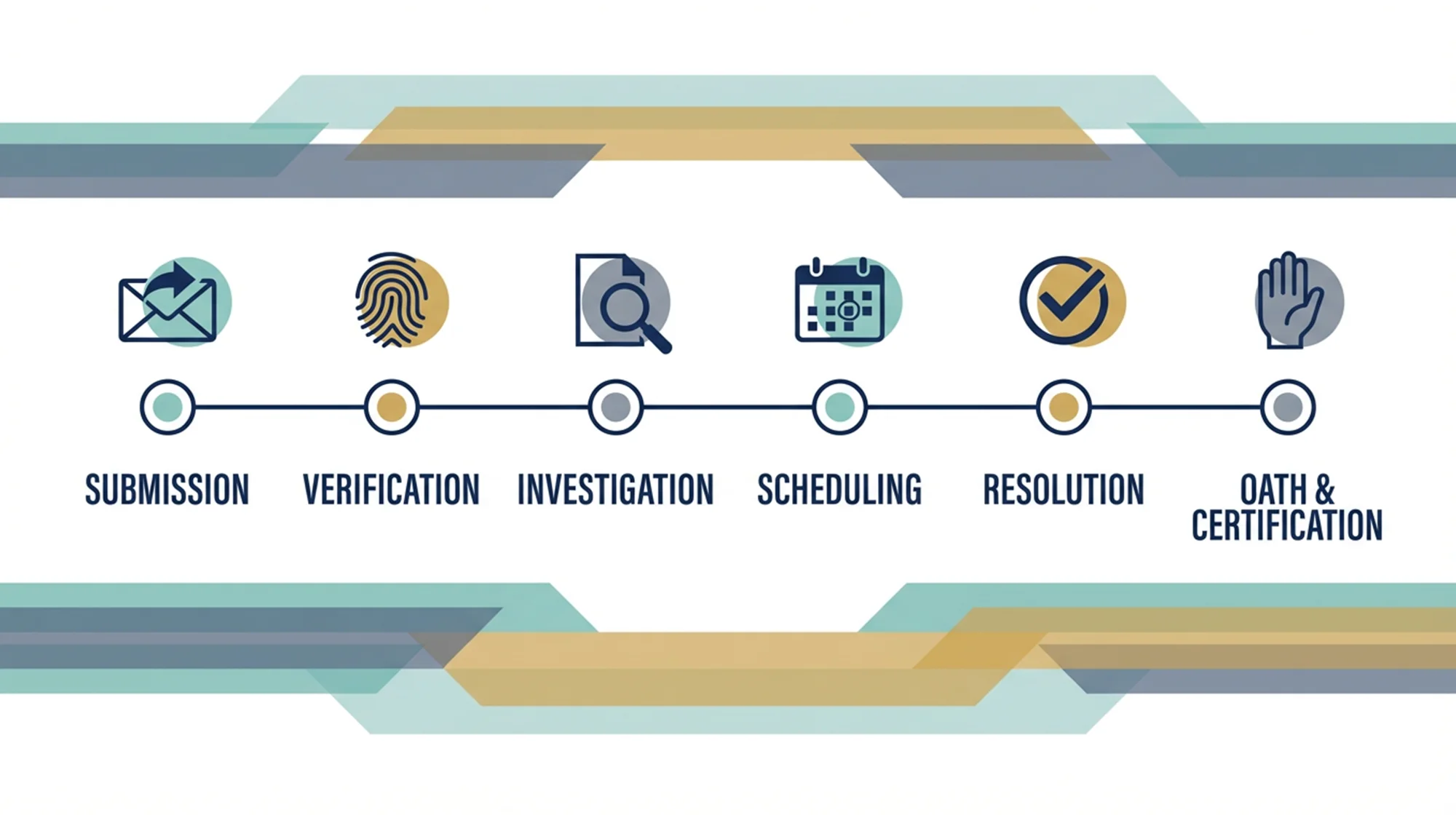
The naturalization process moves through six distinct stages. Here is what each involves and how long each realistically takes in 2026.
Stage 1: Filing and Receipt Notice — 1 to 4 Weeks
You can file Form N-400 online through your USCIS account or by mailing a paper application. Online filing is faster, $50 less expensive ($710 versus $760), and means your documents are already digitized when USCIS begins reviewing your case. For most applicants, online filing is the better choice.
After filing, USCIS sends a receipt notice — Form I-797C — confirming they received your application. This notice contains your ten-digit receipt number, which you will use to track your case status throughout the process. Receipt notices typically arrive within two to four weeks of filing. If you receive a rejection notice instead, it means something was missing or incorrect in your submission — and it adds weeks to your overall timeline, which is exactly why thorough preparation before filing matters.
Stage 2: Biometrics Appointment — 4 to 8 Weeks After Filing
After receiving your receipt notice, USCIS schedules a biometrics appointment at an Application Support Center near you. At this appointment, USCIS collects your fingerprints, photograph, and signature. These are used to conduct your background checks.
The biometrics appointment itself is brief — typically 15 to 30 minutes. Do not reschedule it unless you have no alternative. Every rescheduled appointment adds weeks to your overall timeline, and in a process where the main bottleneck is field office scheduling, giving back time at the early stages is a mistake that compounds later.
Stage 3: Background Checks and Case Review — Ongoing
While you are waiting for your interview notice, USCIS and the FBI are running background checks on your application. For most applicants, these checks complete without issue and without adding visible time to the process.
For some applicants, however, this stage becomes the hidden source of delay. FBI name checks can take significantly longer for common names or for applicants whose names match entries in criminal or national security databases — even if those entries have nothing to do with the applicant. USCIS also operates a program called CARRP (Controlled Application Review and Resolution Program) for cases flagged with national security concerns, which can place a case in a holding pattern with no visible status update for months.
If your case has been pending well beyond the posted processing time for your field office and the status has not moved, a stalled background check is often the reason — and there are specific steps an attorney can take to address it.
Stage 4: Interview Notice and Interview — 3 to 8 Months After Biometrics
This is the most variable stage in the entire process, and it is driven almost entirely by the workload at your assigned USCIS field office.
Nationally, the median N-400 processing time from filing to completion is approximately 5 to 6 months as of early 2026 — but that national figure conceals an enormous range. Some field offices are completing 80% of cases in under 3 months. Others are taking 13 months or more. Large metropolitan offices in cities like Miami, Los Angeles, and New York consistently run longer than smaller regional offices because they process significantly higher case volumes.
The interview itself covers your N-400 application, your background, your eligibility, and the English and civics tests (unless you qualify for an exemption). Most interviews last under 30 minutes for applicants who arrive prepared and organized. You should bring originals of all documents you submitted with your application, plus any documents specifically requested in your interview notice.
One practical note on interview scheduling: if you receive a notice for a date that is genuinely impossible to attend, you can request a reschedule — but do so sparingly and only when necessary. Each reschedule pushes your oath ceremony further out and adds to the total elapsed time.
Stage 5: Decision — Same Day or By Mail
If your interview goes well and your background checks have cleared, the officer will typically approve your application on the spot. You will sign your application and receive a written decision before leaving.
In some cases, the officer will "continue" the case — meaning a decision cannot be made that day. This most commonly happens when background checks are still pending, when the officer needs additional documentation, or when a second interview is required. A continued case does not mean denial, but it does add time. If your case is continued, you will receive written instructions on what is needed and by when.
Stage 6: Oath Ceremony — Days to Weeks After Approval
After approval, USCIS sends Form N-445 with the date, time, and location of your oath ceremony. For administrative ceremonies conducted by USCIS, scheduling can be relatively quick — sometimes the same day as your interview. Judicial ceremonies, conducted by a federal judge in certain districts, may take longer to schedule.
You are not a U.S. citizen until you take the Oath of Allegiance. At the ceremony, you will return your green card, take the oath, and receive your Certificate of Naturalization. USCIS generally requires you to take the oath within 120 days of approval — if you miss your scheduled ceremony without requesting a reschedule, your application can be delayed or administratively closed.
The USCIS processing time tool publishes estimates for each field office based on how long it took to complete 80% of cases over the prior six months. That is a useful benchmark, but it is important to understand what it does and does not tell you.
It tells you how long the typical case took. It does not tell you how long your case will take — because your case is shaped by factors the statistic cannot capture: the completeness of your application, what your background check surfaces, whether you reschedule any appointments, and whether you respond to any USCIS requests promptly.
Here are the main factors that actually drive processing time beyond the field office baseline:
Application errors and omissions. A missing document, an inconsistency between your answers and your supporting records, or a failure to disclose something USCIS will find in the background check — any of these can generate a Request for Evidence or require a second interview. The instinct to omit something minor because it seems irrelevant is, in my experience, one of the most consistent sources of delay and complication in naturalization cases. USCIS will find it. Disclosing it proactively with context is almost always better than having them find it without explanation.
Travel history discrepancies. The N-400 requires a detailed accounting of all trips outside the United States over the past five years. Applicants who reconstruct this from memory rather than from actual passport records frequently have gaps or inaccuracies. An officer who notices that your stated travel history doesn't match your passport stamps has an immediate basis for further inquiry.
Background check flags. Any prior arrest — even for something minor, even if charges were dropped, even if the record was expunged — must be disclosed and documented. Failing to disclose it is treated more seriously than the underlying incident in most cases. Court dispositions, police reports, and any related paperwork should be gathered before filing, not scrambled for after an RFE arrives.
Form version issues. USCIS began requiring the 01/20/2025 edition of Form N-400 last year. Applications submitted on the outdated form are rejected. Cases that were filed during the transition period in 2025 may still be experiencing delayed adjudication due to version mismatch backlogs — if your case falls into this window, it is worth checking.
Enhanced vetting in the current environment. The broader immigration enforcement posture of 2025 and 2026 has extended to naturalization cases. Security checks are taking longer for certain applicants, particularly those with complex immigration histories, extended foreign travel, prior removal proceedings, or any prior immigration violations. This makes a clean, thoroughly documented, carefully prepared application more important than at any point in recent years.
1. The New Civics Test
Effective October 20, 2025, USCIS implemented a revised civics test. The question pool expanded from 100 to 128 questions. Officers now ask up to 20 questions during the interview, and applicants must answer at least 12 correctly to pass. The test places greater emphasis on understanding U.S. history and government, rather than rote memorization of facts.
Applicants who studied for the old 100-question format using outdated materials need to update their preparation. USCIS has published the full 128-question study guide, and I strongly recommend reviewing it before your interview rather than relying on third-party study materials that may not reflect the current version. For more detail on the 2025 civics test changes and how the interview format has evolved, see my article on the naturalization interview and test.
You are given two attempts to pass the English and civics tests. If you fail one or both portions at the initial interview, you will be retested only on the failed portion, with the retest scheduled 60 to 90 days later. Failing adds at minimum two to three months to your timeline — solid preparation before the first interview is far more efficient than banking on the retest.
2. The New Form Version
The 01/20/2025 edition of Form N-400 is the only version USCIS will accept. It includes permanent removal of the "X" gender marker and updated digital filing validations. If you are filing in 2026 using a form downloaded from a third-party website or saved from a previous download, verify that it is the correct current edition before submitting. A rejected application due to an outdated form version adds weeks to your timeline for a completely avoidable reason.
3. A More Scrutiny-Intensive Environment
The current administration's approach to immigration vetting has affected naturalization processing as well as visa and green card adjudications. Background checks are being conducted more thoroughly, and cases involving any complexity in immigration or criminal history are receiving closer review than they did two or three years ago.
For straightforward cases — applicants with clean backgrounds, consistent residence, and well-documented applications — this change is largely invisible. The process moves normally. For applicants whose cases involve any of the complications I describe in the next section, the difference between a carefully prepared filing and a rushed one has never been greater.
Generic advice to "submit a complete application" is accurate but not particularly useful. Here is what I actually tell clients:
Reconstruct your travel history from your passport, not from memory. Go through every page of every passport you have held over the past five years. List every trip, every entry and exit date, every destination. Then cross-reference it with your calendar, your email, your boarding passes if you have them. The travel history section of the N-400 is where I see more innocent discrepancies surface than anywhere else.
Gather all criminal history documentation before filing, not after. If you have ever been arrested, cited, or charged with anything — including arrests that did not result in conviction, charges that were dismissed, or records that were expunged — obtain the full documentation before your application is filed. Court dispositions, police reports, and official records of expungement all need to be ready. Disclosing the incident with complete documentation in hand looks very different from disclosing it and then scrambling to gather records under an RFE deadline.
File online. It costs $50 less, your application is already in USCIS's system, and there is no risk of a paper application being lost or delayed in mail processing. For most applicants in 2026, there is no meaningful reason to file by paper.
Respond to every USCIS request immediately. If USCIS sends an RFE or a request for additional information, the clock on your response is running from the day it was issued — not the day you check your mail. Every week you delay on your end adds time on their end. Build a habit of checking your USCIS online account regularly throughout the process.
Do not reschedule appointments unless it is genuinely unavoidable. Both your biometrics appointment and your interview can be rescheduled if you cannot attend — but every reschedule adds weeks to your total timeline. Treat both as fixed commitments.
If your case exceeds the posted processing time, act. USCIS publishes processing time estimates by field office. If your case has been pending longer than the posted time and you have not received an interview notice, you can submit an inquiry through your myUSCIS account. If that does not produce a response, there are additional legal steps available — including filing a mandamus action in federal court to compel adjudication. These options are more viable than many applicants realize, and they are not adversarial in the way people fear.
If your N-400 has been pending beyond the posted processing time and you are unsure of your options, reach out to me. There are specific steps we can take to move the case forward, and the earlier we start, the more options are available.
The N-400 is one of the more predictable processes in immigration law for applicants with straightforward backgrounds. For applicants with complications, it requires careful strategy before filing — not after.
Categories that warrant a legal consultation before filing:
None of these factors are automatically disqualifying. In many cases, with proper documentation and a clear explanation of the circumstances, they can be addressed directly in the application. What they cannot survive is being filed without a strategy, only to surface during the interview when there is no time to prepare a response.
The naturalization service page on the SG Legal Group website describes how I approach these cases — including the eligibility review I conduct before any application is filed.
The N-400 in 2026 is a process where preparation has a direct and measurable effect on outcome. Applicants who file complete, accurate, well-documented applications — who have gathered their records in advance, disclosed their history fully, and prepared seriously for the civics test — consistently move through the process faster and with fewer complications than applicants who treat it as a form-filling exercise.
The national median of five to six months is achievable for applicants in that first category. It becomes 12 or 18 months for applicants in the second.
If you are ready to file, want to confirm your eligibility, or have a case that involves complications you are not sure how to handle, I am happy to help. Schedule a consultation with SG Legal Group. Consultations are available in English, Russian, and Romanian.
Disclaimer: The information provided in this article is for general informational purposes only and does not constitute legal advice. Immigration laws and policies are subject to change, and individual circumstances vary. For advice specific to your situation, please consult with a qualified immigration attorney.
Oleg Gherasimov, Esq.
Stay informed with our latest articles and resources.


