Personal Injury
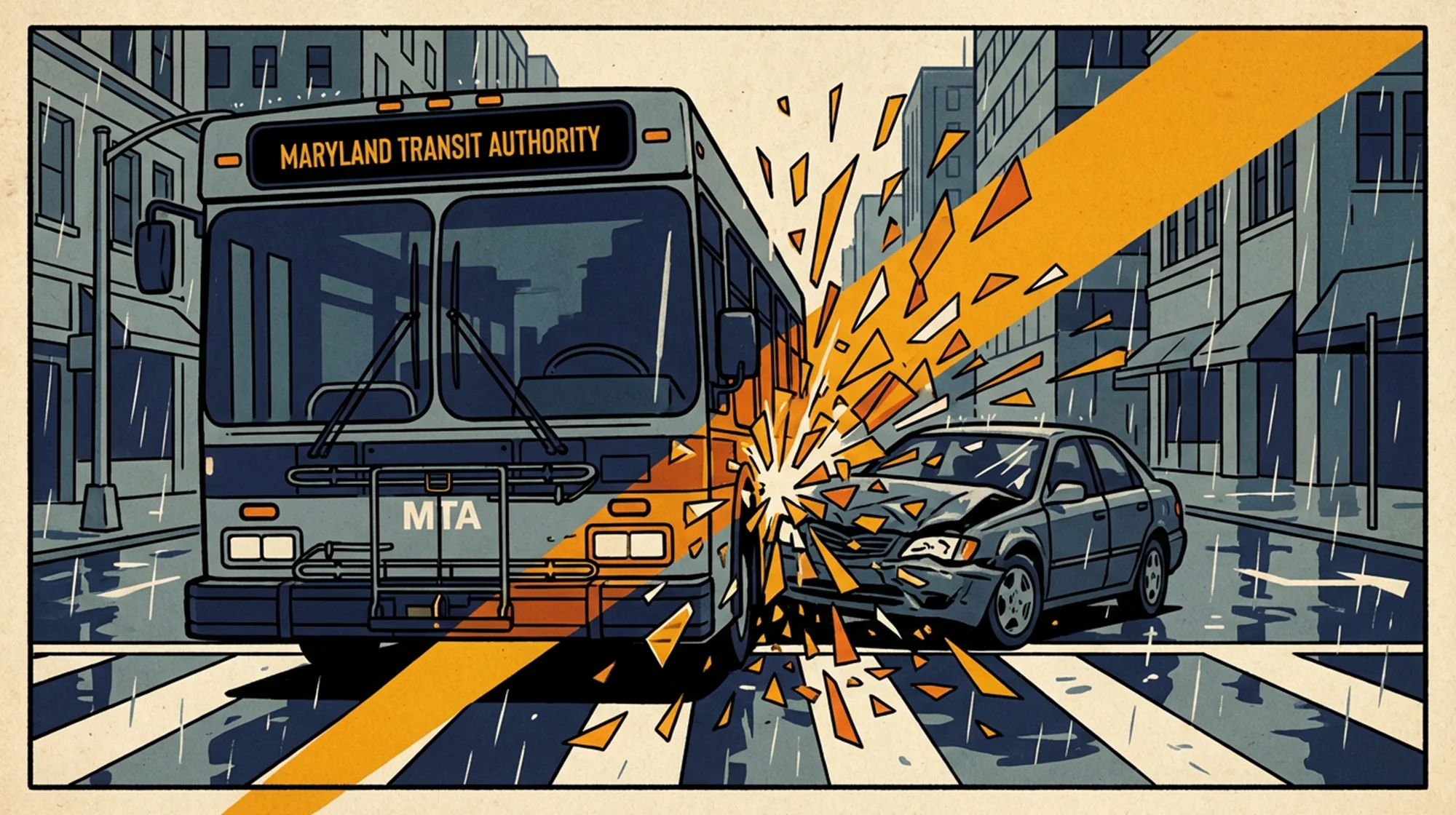
A bus accident is not a bigger version of a car accident. It is a fundamentally different kind of case — one that involves a different legal standard, different defendants, different insurance structures, and a set of procedural traps that can kill your claim before it ever gets started.
I say this because I've seen what happens when people treat bus accident claims like routine fender-benders. They wait too long. They file against the wrong party. They miss a government notice deadline they didn't know existed. And by the time they realize the mistake, the damage is done.
If you or someone you care about was hurt in a bus accident anywhere in Maryland — whether it involved an MTA bus in Baltimore, a county transit vehicle, a school bus, a charter coach, or a private shuttle — this article explains what you're dealing with, why it matters, and what a bus accident lawyer does that a general personal injury attorney typically does not.
Here's something most people don't realize: under Maryland law, bus operators owe their passengers a significantly higher duty of care than an ordinary driver on the road.
In a typical car accident case, the legal question is whether the at-fault driver acted with "ordinary reasonable care." That's the baseline. Did they drive the way a reasonably careful person would under the same circumstances?
Bus operators are held to a different standard entirely. Maryland courts have consistently ruled that common carriers — which includes buses that transport passengers for hire — owe their passengers the highest degree of care to provide safe means and methods of transportation. The Maryland Court of Appeals reinforced this principle in Todd v. Mass Transit Administration (2003), and the standard traces back more than a century in Maryland case law.
What does "highest degree of care" mean in practice? It means conduct that might be perfectly acceptable for a regular driver can constitute negligence when a bus operator does it. It means the duty extends beyond just safe driving — it covers vehicle maintenance, driver training and qualification, passenger boarding and discharge procedures, and even protecting riders from foreseeable harm by other passengers.
This elevated standard is one of the most powerful tools available in a bus accident case. But it only works if your attorney knows it exists, understands the case law behind it, and knows how to present it to a jury. A lawyer who handles mostly car accident cases may never have argued a common carrier standard in court.
One of the first questions I ask when someone contacts me about a bus accident is: what kind of bus was it? The answer determines the entire legal framework for the case.
If you were injured on a Maryland Transit Administration bus in Baltimore or elsewhere in the state, your claim is governed by the MTA Tort Claims Act. You have one year from the date of your injury to provide written notice to the MTA, and that notice must include specific information — your name, how and when the injury occurred, the nature of your injuries, and a demand for damages.
One significant advantage in MTA cases: unlike claims against most other government entities in Maryland, the MTA does not impose its own damages cap beyond the general noneconomic damages cap. That distinction matters when injuries are severe.
Claims against county-operated buses — like Montgomery County's Ride On or other local transit services — fall under the Local Government Tort Claims Act. The notice deadline is the same (one year), but the damages cap is $400,000 per individual claimant and $800,000 per incident. For someone with catastrophic injuries, that cap can be devastating.
School bus claims add another layer of complexity. If the bus is operated by the public school system, you're filing against a government entity with sovereign immunity protections. If a private contractor operates the bus, the rules shift — standard tort law applies, the statute of limitations is three years with no one year notice requirement, and there's no government damages cap.
The distinction between a government-operated and privately contracted school bus can mean the difference between a $400,000 cap and full compensation for your injuries. Getting this wrong at the outset is not something you can fix later.
Private bus companies — charter operators, Greyhound, tour bus companies, party buses, airport shuttles — operate under a completely different framework. There are no government immunity protections. The standard three-year statute of limitations applies. And federal insurance minimums are substantial: $5 million for buses carrying 16 or more passengers, and $1.5 million for smaller vehicles.
Compare that to Maryland's personal auto insurance minimum of $30,000 per person. The insurance available in a commercial bus case can be 80 to 160 times higher than what's available in a typical car accident. That sounds like good news — and it is — but it also means the insurance company will fight proportionally harder to deny or minimize your claim.
Beyond the legal standard and the type of bus involved, several structural features make bus accident claims fundamentally different from car accident claims.
Most transit buses, school buses, and motorcoaches do not have passenger seatbelts. School buses rely on a design concept called compartmentalization — high-backed, closely spaced seats meant to absorb impact. Transit buses and coaches often have nothing beyond a handrail.
When a bus stops suddenly, swerves, or collides with another vehicle, unrestrained passengers absorb the full force. They're thrown from seats, slammed into poles and windows, or struck by other passengers. The injuries tend to be severe: traumatic brain injuries, spinal cord damage, broken bones, and soft tissue injuries that produce chronic pain.
The absence of seatbelts also eliminates a common defense tactic. In car accident cases, insurance companies routinely argue the injured person's failure to wear a seatbelt contributed to their injuries. In a bus case, that argument doesn't exist — because there was no seatbelt to wear.
A single bus accident can injure ten, twenty, or more people simultaneously. Every one of those passengers has a potential claim against the same pool of insurance money.
Even $5 million in coverage — substantial by personal auto standards — can become inadequate fast when divided among dozens of seriously injured claimants. This creates a race-to-settle dynamic that requires careful strategy. If early claimants exhaust the available coverage, later claimants may recover nothing regardless of how severe their injuries are.
A bus accident lawyer who has handled mass-injury events understands how to navigate this. It may involve coordinating with attorneys representing other passengers, pursuing interpleader actions where the insurer deposits policy limits with the court for equitable distribution, or identifying additional insurance layers and liable parties to expand the available recovery.
In a car accident, the liability picture is usually straightforward: one driver hit another. In a bus accident, the list of potentially responsible parties can be extensive.
The bus driver may be liable for direct negligence — distracted driving, speeding, fatigue, running a red light. The bus company or transit authority is typically liable for the driver's actions under respondeat superior, and may also face direct claims for negligent hiring, inadequate training, or failure to properly maintain the vehicle. A third-party maintenance contractor may be liable if a brake failure or mechanical defect caused the crash. The bus manufacturer could face a product liability claim if a design or manufacturing defect contributed to the accident or worsened the injuries. And if another driver caused the collision, they're a defendant too.
Identifying all viable defendants early — before evidence disappears and before statutes of limitations start running — is one of the most critical things a bus accident lawyer does. Miss one, and you may leave significant compensation on the table. This multi-party analysis is something I approach the same way I would in a commercial vehicle accident or a trucking case — systematically, and immediately.
This is the part that matters most if you're deciding who to hire. Bus accident cases require specific knowledge and investigative steps that go well beyond standard car accident practice.
If your accident involved a government-operated bus, your attorney needs to know exactly which claims act applies — the MTA Tort Claims Act, the Maryland Tort Claims Act, or the Local Government Tort Claims Act. Each has different notice requirements, different damages caps, and different procedural rules. Filing under the wrong act, serving notice on the wrong official, or missing the one-year deadline by even a day can result in your entire claim being dismissed.
This is not an area where close enough counts. I've seen claims fail on procedural grounds that had nothing to do with the merits of the case. The injuries were real, the negligence was clear, and the case died because notice wasn't properly served within the statutory window.
Bus accident evidence has a shelf life measured in days, not months.
Modern buses are equipped with event data recorders — essentially black boxes — that capture speed, braking, steering inputs, and other data in the moments surrounding a crash. Many buses also have onboard surveillance cameras that record continuously. The problem is that this data gets overwritten on short cycles. If no one sends a formal preservation demand within the first 48 to 72 hours, the footage may be gone permanently.
A bus accident lawyer sends spoliation preservation letters immediately upon being retained — to the bus company, the transit authority, any maintenance contractors, and any third-party defendants. These letters are legal demands to preserve all potentially relevant evidence, and they create consequences if evidence is destroyed after the demand is received.
Beyond the black box and video footage, a bus accident attorney secures the driver's qualification file (which includes their application, driving record, medical certificate, and drug test results), electronic logging device data showing hours-of-service compliance, vehicle maintenance records, inspection reports, GPS and route data, and the company's FMCSA safety history.
Commercial bus operators are regulated by the Federal Motor Carrier Safety Administration. These regulations set minimum standards for driver qualifications, hours of service, vehicle maintenance, drug and alcohol testing, and insurance coverage.
When a bus company or driver violates an FMCSA regulation and that violation contributes to an accident, the violation can be used to establish negligence — and in some cases, negligence per se, meaning the violation itself proves the defendant failed to meet the required standard of care.
For example, FMCSA rules limit passenger carrier drivers to 10 hours of driving after 8 consecutive hours off duty, and 15 hours of total on-duty time. If a bus driver exceeds those limits and causes an accident due to fatigue, the hours-of-service violation is powerful evidence of negligence. Similarly, if a bus company fails to conduct required pre-employment drug testing and hires a driver who later causes an accident while impaired, the company's regulatory violation supports a direct negligence claim for negligent hiring.
A general personal injury attorney may not know these regulations exist, let alone how to obtain compliance records and use violations as evidence at trial. A bus accident lawyer works with them routinely.
When a bus accident injures many passengers, the insurance and litigation dynamics change dramatically. Someone needs to coordinate the process — assessing each claimant's injuries relative to available coverage, determining whether additional policies or liable parties can expand the recovery pool, and ensuring that early settlements don't consume all available funds at the expense of more seriously injured passengers.
This requires experience with mass-injury litigation that most car accident attorneys simply don't have.
Maryland remains one of only a handful of states that follows the pure contributory negligence doctrine. If you are found even one percent at fault for your own injuries, you are completely barred from recovering anything.
Here's the good news for bus passengers: contributory negligence is very difficult for defendants to prove against a passenger who was simply riding the bus. You didn't drive the vehicle. You didn't control its speed or its route. You were a passive occupant who trusted the bus operator to transport you safely — which, under the common carrier standard, they had the highest legal duty to do.
The calculus changes for pedestrians struck by buses. If you were jaywalking, crossing against a signal, looking at your phone, or otherwise engaged in conduct that contributed to the accident, a defense attorney will raise contributory negligence. These arguments aren't always successful — Maryland also recognizes the last clear chance doctrine, which allows recovery if the defendant had the final opportunity to avoid the accident and failed — but they need to be anticipated and addressed with evidence from the outset.
This is another reason why having an attorney who understands bus accident litigation specifically matters. The contributory negligence defense plays out very differently in a bus case than in a standard car accident, and the strategy for defeating it requires a different approach.
Bus accidents are not rare events. Nationally, more than 65,000 bus crashes occur each year. According to FMCSA data, roughly 10,000 of those result in injuries, producing approximately 18,000 injured people annually. In 2021 alone, 204 fatal bus crashes killed 221 people across the country.
One statistic stands out: the vast majority of people killed in bus accidents — between 71% and 87% depending on the year — are not bus occupants. They are people in other vehicles and pedestrians. Bus accidents don't just endanger passengers. They endanger everyone on the road.
Maryland is no exception. During the 2024-25 school year, Maryland State Police recorded 1,928 school bus crashes statewide — the highest number in seven years. In January 2026, eight people were hospitalized after an MTA bus crash in Baltimore's Mid-Town Belvedere neighborhood. In May 2024, a bus crash on I-95 in Harford County killed one person and sent 23 to the hospital.
These incidents are a reminder that bus accidents happen regularly in Maryland, the injuries are often serious, and the legal claims that follow are anything but simple.
Don't wait. The single most important thing you can do after a bus accident is talk to an attorney who handles these cases before any deadlines pass and before critical evidence disappears.
If the bus was government-operated, you may have as little as one year to file a formal notice of claim — and missing that deadline means losing your right to compensation entirely, no matter how severe your injuries are. Even if the bus was privately operated and you have the full three-year statute of limitations, evidence degrades fast. Surveillance footage overwrites. Black box data cycles. Witnesses' memories fade.
You don't need to have everything figured out before you call. You don't need to know who was at fault, which claims act applies, or whether you have a viable case. That's my job.
If you or someone you love was injured in a bus accident in Maryland, I'm here to help. I offer a free consultation — no cost, no obligation, just a direct conversation about your situation and what your options are. Contact me at SG Legal Group or call to schedule a time to talk.
— Joshua C. Sussex, Esq., Partner & Personal Injury Attorney, SG Legal Group

Disclaimer: The information provided in this article is for general informational purposes only and does not constitute legal advice. Laws and regulations are subject to change, and individual circumstances vary. For advice specific to your situation, please consult with a qualified attorney.
Joshua C. Sussex, Esq.
Stay informed with our latest articles and resources.