Personal Injury
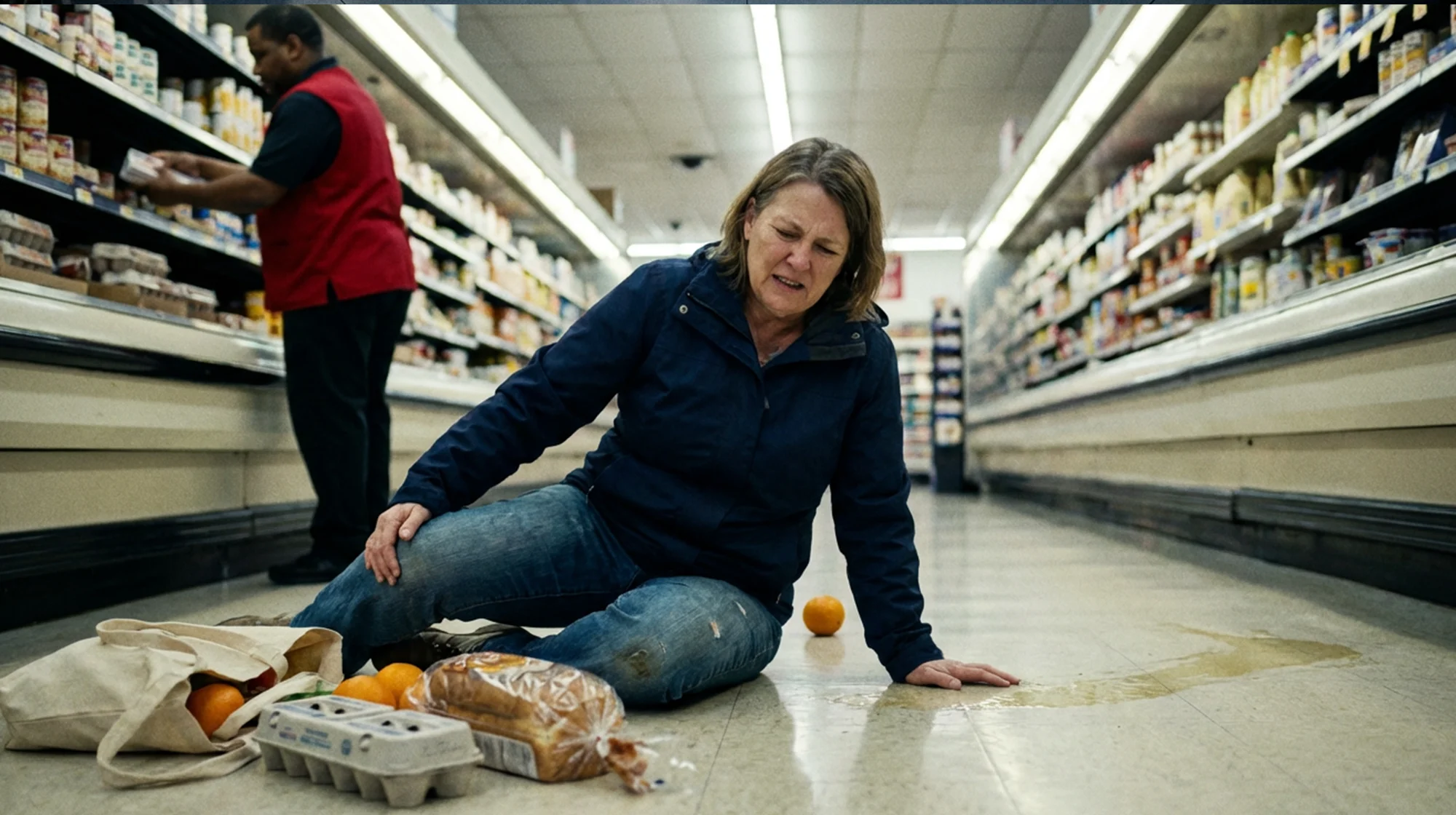
A spilled bottle of cooking oil in aisle seven. A puddle of condensation under the freezer case. A crushed grape on the produce section floor. These are the kinds of hazards that send Maryland grocery shoppers to the emergency room every day — and the kinds of cases where the law can work against you if you don't understand how it operates in this state.
I'm Joshua Sussex, a personal injury attorney at SG Legal Group, and I handle premises liability claims throughout Maryland. Grocery store slip and fall cases are some of the most misunderstood injury claims I encounter. People assume that if they fell on a hazard the store should have cleaned up, the case is straightforward. In Maryland, it almost never is.
Maryland is one of only five jurisdictions in the entire country that follows a pure contributory negligence rule. That means if the grocery store's insurance company can show you were even one percent at fault for your fall — you were looking at your phone, you were wearing worn-out shoes, you walked past a wet floor sign — your case can be worth zero. Not reduced. Zero.
That's why understanding Maryland's specific legal framework before you file a claim isn't just helpful. It's essential.
Here's the good news: as a paying customer walking into a grocery store, Maryland law classifies you as a "business invitee." That's the highest duty-of-care category our courts recognize. The store owes you more than it owes a social guest or a trespasser.
Under Maryland law, a grocery store must do three things for its customers. First, keep the premises in a reasonably safe condition using ordinary care. Second, inspect the premises to discover hidden dangers. Third, warn you of known or reasonably discoverable hazards.
Maryland adopted the framework from the Restatement (Second) of Torts § 343 through the case Deering Woods Condominium Association v. Spoon in 2003. The practical meaning is that stores must protect customers against unreasonable risks — the kind you wouldn't discover on your own through ordinary care.
But here's the critical limitation: grocery stores are not insurers of your safety. The Maryland Court of Appeals made that clear in Giant Food, Inc. v. Mitchell back in 1994. No presumption of negligence arises simply because you were injured on store premises. You have to prove the store did something wrong — or failed to do something it should have done.
And proving that in Maryland requires clearing a hurdle that most people don't even know exists.
In most personal injury cases, you need to prove four things: duty, breach, causation, and damages. In a Maryland grocery store slip and fall, there's effectively a fifth element that towers over all the others — notice.
You must prove that the grocery store either created the hazardous condition itself or had actual or constructive notice of it with enough time to clean it up or warn customers.
Actual notice means someone at the store — a manager, an employee, anyone — personally knew about the hazard. Maybe a customer reported the spill. Maybe an employee walked past it. Maybe the store's own security cameras captured it sitting there for twenty minutes while employees stocked nearby shelves.
Constructive notice is more nuanced. It means the hazard existed for long enough that the store should have discovered it through reasonable inspection. The burden of proving how long the spill was on the floor falls squarely on you, the injured customer.
This is where cases live or die. And one Maryland case illustrates it better than any other.
In Maans v. Giant of Maryland, L.L.C. (2005), a woman who was six and a half months pregnant slipped on water near a Giant checkout lane. After she fell, an assistant manager directed someone with paper towels to clean up the water and warned paramedics to be careful of the wet floor. Sounds like a strong case, right?
She lost.
The Court of Special Appeals ruled that without evidence of how long the water had been on the floor, she couldn't prove Giant had constructive notice. The store's response after her fall — cleaning up the water, warning the paramedics — didn't prove the store knew about the hazard before the fall.
This case also settled a question that makes Maryland grocery store claims harder than in many other states. At least fifteen states follow what's called the "mode of operation" rule, which excuses plaintiffs from proving notice when a store's self-service operations — think produce sections, salad bars, or self-checkout areas — create foreseeable, recurring hazards. The reasoning is simple: if you invite customers to handle loose grapes and cherry tomatoes, spills are inevitable, and you should be prepared.
Maryland has rejected this rule. The Maans court was explicit: under Maryland law, the store has no duty to keep records to lighten the customer's burden of proving negligence. This was reaffirmed in Rehn v. Westfield America (2003) and subsequent cases.
The practical impact is enormous. In a mode-of-operation state, a customer who slips on a grape in the produce section can argue that the store's business model created the hazard. In Maryland, that same customer must prove specifically how long that grape was on the floor — and if they can't, their case fails.
In Rehn v. Westfield America, a customer slipped on a spilled soda near a food court Chick-fil-A and fractured his hip. Evidence showed the spill had been on the floor for less than four minutes. Summary judgment for the defendants was affirmed — four minutes wasn't enough time to establish constructive notice.
Compare that with a case where a customer slips on a mashed, discolored piece of produce that has clearly been stepped on multiple times. The browning, the flattening, the track marks — all of these suggest the debris has been there for a while. That kind of circumstantial evidence can support an inference of constructive notice.
The lesson: the physical condition of whatever caused your fall can be just as important as how long it sat there. A fresh, clear puddle of water is harder to prove than a brown, dried, smeared substance with shopping cart tracks through it.
Even if you can prove the store had notice, you face a second challenge that exists in only a handful of American jurisdictions. Maryland's contributory negligence doctrine means that any negligence on your part — even one percent — completely bars your recovery.
In a comparative fault state like Pennsylvania or New Jersey, a jury that finds you 20 percent at fault would simply reduce your award by 20 percent. In Maryland, that same finding means you get nothing.
Grocery store defense attorneys know this, and they use it aggressively. Common arguments I see include: the customer was distracted by their phone; they were wearing inappropriate footwear; they ignored visible wet floor signs; they were carrying items that blocked their view of the floor; or they should have seen the obvious hazard.
In Lexington Market Authority v. Zappala (1964), the court noted that the plaintiff was carrying a large paper bag — a factor that went to whether she exercised reasonable care for her own safety. These details matter enormously in Maryland.
Contributory negligence isn't always the end of the story. Maryland recognizes two doctrines that can save an otherwise barred claim, and both are underutilized in grocery store cases.
The first is the distraction doctrine. Maryland courts have recognized that when a store's own displays and merchandising draw a customer's attention — which is, after all, the entire point of a grocery store layout — the customer may not be contributorily negligent for failing to notice a floor hazard. Cases like Diffendal v. Cash and Carry Service (1988) support the argument that a shopper whose attention is directed toward a colorful endcap display or promotional signage is doing exactly what the store intended.
The second is the last clear chance doctrine, though it applies less frequently in slip and fall cases. This doctrine requires showing that the store had a fresh, sequential opportunity to prevent the injury after the customer's own negligence occurred — and failed to take it. Because a store's failure to clean a spill and a customer's failure to see it typically happen simultaneously rather than in sequence, last clear chance is a harder fit. But it's not impossible in the right factual scenario.
Grocery stores are full of slip and fall hazards, and many of them are built into the store's own business model. The most common causes of falls I encounter include spilled liquids from broken bottles of juice, wine, milk, or cooking oil. Wet floors from mopping without adequate warning signs — or with signs that are too small, poorly positioned, or placed at only one end of a large wet area.
Produce debris is another frequent culprit. Grapes, cherry tomatoes, lettuce leaves, and berries end up on the floor constantly in self-service produce sections. Round produce like grapes and cherry tomatoes are particularly dangerous because they roll underfoot.
Leaking refrigerator and freezer cases create recurring hazards from condensation, defrost water, and failed door gaskets. These are especially significant from a legal perspective because stores often have maintenance records documenting prior leak complaints — which can establish actual notice.
Other common hazards include melting ice from seafood displays, torn or bunched floor mats, cracked or uneven tile, cluttered aisles from restocking operations, and weather-tracked water at store entrances where runners and mats are inadequate.
Parking lots matter too. The store's duty to its customers extends to the parking lot, which means potholes, cracked asphalt, concealed wheel stops, and icy conditions during winter months are all potential liability hazards.
The injuries from grocery store falls can be devastating, and the severity often depends on factors like the customer's age and the type of surface involved.
Wrist fractures are the most common injury because of the instinctive reaction to catch yourself with an outstretched hand. A Colles fracture — the classic "dinner fork" deformity — can require surgery with plates and pins, and many patients experience permanent stiffness even after treatment.
Hip fractures are among the most serious, particularly for older adults. The CDC reports that falls cause more than 95 percent of hip fractures in older Americans, and approximately 319,000 older adults are hospitalized for hip fractures each year. The recovery trajectory for elderly hip fracture patients is sobering. Many never regain their pre-injury mobility, and research shows significantly elevated mortality rates in the year following the fracture.
Traumatic brain injuries are another major concern. Falls are the number one cause of TBI in the United States, and according to the CDC, 81 percent of TBI-related emergency department visits among older adults are fall-related. What makes TBI particularly dangerous in the slip and fall context is that symptoms can be delayed by a day or two. A person who hits their head on a grocery store floor might feel fine initially, then develop headaches, confusion, or balance problems the following day.
Back and spinal injuries, including herniated discs and compression fractures, knee injuries such as ACL and meniscus tears, and shoulder injuries like rotator cuff tears are all common as well. Many of these injuries require surgery and months of rehabilitation, and some lead to chronic pain or post-traumatic arthritis that lasts for years.
The actions you take immediately after a grocery store fall can make or break your case. Here's what I tell every prospective client.
First, if you suspect a head, neck, back, or hip injury, don't try to get up. Call for help and wait for EMS.
Report the incident to the store manager — get their name — and request that they complete a written incident report. The store will create one regardless of whether you ask. Your version of events on that report matters.
Document the scene with your phone. Take photos and video of the hazard from multiple angles. Capture the absence of warning signs, any nearby leaking cases or mop buckets, your shoes, your clothing, and any visible injuries. Photograph the aisle signage so the exact location is clear. If the substance is something that will evaporate or be cleaned up quickly, this documentation needs to happen immediately.
Get the names and phone numbers of any witnesses. Independent witnesses often make the difference in contested cases.
See a doctor the same day, even if your injuries seem minor. Adrenaline masks pain. Concussions and internal bleeding have delayed symptoms. And any gap in treatment gives the insurance company ammunition to argue your injuries weren't that serious.
Preserve the shoes and clothing you were wearing — bag them without washing. Save your receipt to prove you were a customer. Keep all discharge paperwork and medical records.
Do not give a recorded statement to the store's insurance company or its third-party claims administrator. They will call within 24 to 72 hours. That recorded statement will be used to lock in inconsistencies and minimize your claim.
Do not post about the incident on social media. A photo of you smiling at a family dinner can be taken out of context to argue you aren't really hurt.
And contact a Maryland personal injury attorney promptly. The reason timing matters isn't just the statute of limitations — it's surveillance footage. Most grocery store security systems auto-overwrite video within 14 to 30 days. An attorney can send a certified preservation letter demanding the store retain footage from all relevant cameras. Once that footage is gone, critical evidence is lost forever.
Most people don't realize that when they file a claim after a grocery store fall, they're not dealing with a traditional insurance company. Major grocery chains — including many operating in Maryland — are self-insured and use third-party claims administrators like Sedgwick Claims Management Services, Gallagher Bassett, or Broadspire to handle injury claims.
These administrators work for the grocery chain, not for you. Their job is to resolve your claim for as little money as possible. The tactics I see over and over include early recorded statements designed to lock in inconsistencies before you understand the full extent of your injuries, surveillance investigators who follow claimants and record them carrying groceries or walking their dog, social media monitoring across all platforms, and quick lowball settlement offers — sometimes as little as $500 to $5,000 — designed to close the file before you know how badly you're hurt.
They will request broad medical authorizations to dig through your entire medical history looking for pre-existing conditions. They will blame you — your shoes, your phone, your pace, your failure to see the obvious hazard — to invoke Maryland's contributory negligence rule. And they will invoke the notice defense, arguing the store didn't know about the hazard or didn't have enough time to address it.
Perhaps most frustrating is what happens with surveillance footage. Some stores allow footage to auto-overwrite before any preservation letter arrives, then claim the cameras didn't cover the relevant angle. This is why getting an attorney involved early — before that footage cycle completes — is so critical.
If your case succeeds, the damages available in Maryland fall into two categories.
Economic damages are uncapped. These include past and future medical expenses, lost wages and loss of earning capacity, out-of-pocket costs like transportation to medical appointments and household help you need during recovery, and any property damage.
Noneconomic damages — which cover pain and suffering, physical impairment, disfigurement, inconvenience, and loss of consortium — are subject to Maryland's statutory cap under Md. Code, Cts. & Jud. Proc. § 11-108. For causes of action arising between October 1, 2025 and September 30, 2026, the cap is $965,000 for a single injury. The cap increases by $15,000 each October 1.
An important detail: the cap is fixed by the date of your fall, not the date of settlement or trial. And juries are never told the cap exists — the court applies it after a verdict if necessary. I've written more about how pain and suffering settlements work in Maryland on our blog.
Maryland also follows the collateral source rule, which means you can recover the full billed amount of your medical expenses even if your health insurance negotiated a lower rate. Evidence of your insurance coverage is generally inadmissible at trial.
Maryland's general statute of limitations for personal injury claims is three years from the date of the injury. Miss this deadline and your claim is barred — no exceptions, no extensions, no matter how strong your case is.
There are limited tolling provisions for minors, whose statute of limitations doesn't begin to run until they turn 18, and for individuals with mental incapacity.
One critical exception applies if your fall occurred on government-owned property — for example, a grocery store in a building leased from a county or municipality. In that scenario, the Local Government Tort Claims Act requires written notice of your claim within one year of the injury, and damages are capped at $400,000 per individual.
Different grocery chains handle injury claims differently. Some use Sedgwick. Some use Gallagher Bassett. Some have in-house claims departments. The chain's claims process, its surveillance retention policies, its employee training protocols, and its history of prior incidents at the specific store where you fell can all influence how your case is investigated and valued.
Maryland shoppers frequent a wide range of chains — Giant, Safeway, Harris Teeter, Wegmans, Food Lion, Weis, Shoppers, ALDI, Lidl, Trader Joe's, Whole Foods, H Mart, and others. Each has its own corporate structure for handling liability. Understanding which entity you're actually making a claim against — and what their specific claims procedures look like — is part of building an effective case strategy.
Grocery store slip and fall cases in Maryland are more complex than they appear. Between the notice requirement, the contributory negligence rule, and the tactics used by corporate claims administrators, these cases require both legal knowledge and strategic preparation from day one.
If you've been injured in a fall at a Maryland grocery store, I'd like to hear about your situation. Every case is different, and a conversation costs you nothing. We work on contingency, which means you pay no attorney fees unless we recover compensation for you.
Contact me at SG Legal Group to schedule a free consultation. You can also call us at 410-618-1277. We serve clients throughout Maryland, including Baltimore, Towson, Columbia, Frederick, Hagerstown, Bel Air, and surrounding communities.

Disclaimer: The information provided in this article is for general informational purposes only and does not constitute legal advice. Laws and regulations are subject to change, and individual circumstances vary. For advice specific to your situation, please consult with a qualified attorney.
Joshua C. Sussex, Esq.
Stay informed with our latest articles and resources.