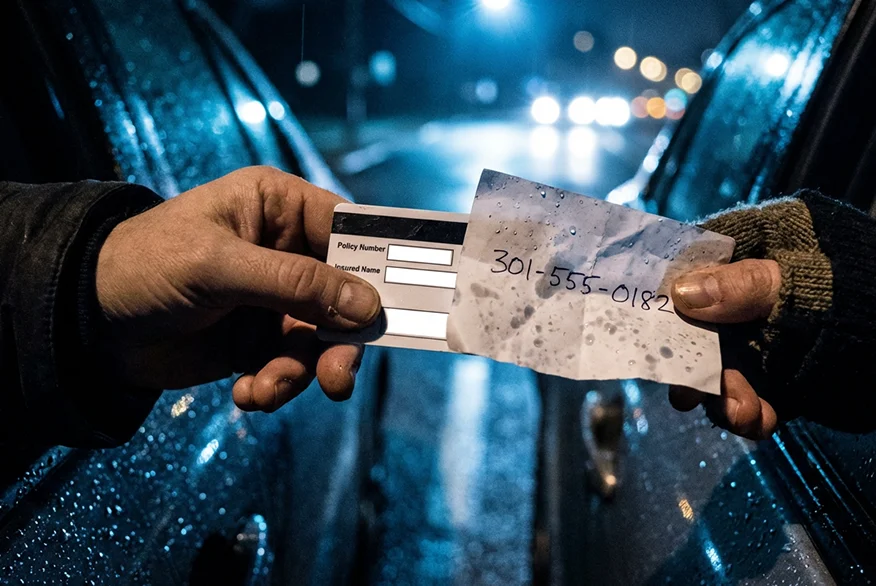
Accidents
A delivery van runs a red light and T-bones your car at an intersection. A cable company truck rear-ends you on I-695 during rush hour. A company sedan drifts into your lane because the driver is answering work emails on a phone.
These are not ordinary car accidents — and if you treat them like one, you will almost certainly leave money on the table or lose your claim entirely.
I'm Joshua Sussex, a personal injury attorney at SG Legal Group, and I handle commercial vehicle accident cases throughout Maryland. When I tell clients that their case is "more complicated than a regular car crash," I can see the frustration on their faces. They just want to get better, get their car fixed, and move on. I understand that completely. But the reality is that commercial vehicle claims operate under a different set of rules — and understanding those rules early is what separates people who recover full compensation from people who settle for a fraction of what they deserve.
This article breaks down what makes commercial vehicle accidents different, who can be held liable, how insurance works in these cases, and what you should do in the first 72 hours if a commercial vehicle hits you.
When most people hear "commercial vehicle accident," they picture an 18-wheeler jackknifed on the highway. That's part of the picture, but it's far from the whole thing. A commercial vehicle is any vehicle used primarily for business purposes. That includes delivery vans from Amazon, FedEx, and UPS. It includes the box truck from a local moving company. It includes the cable or utility repair truck parked halfway in your lane. It includes company fleet sedans, municipal buses, private charter coaches, and even rideshare vehicles operating during an active trip.
The Federal Motor Carrier Safety Administration (FMCSA) defines commercial motor vehicles as those with a gross vehicle weight rating over 10,000 pounds, or those transporting hazardous materials, or those designed to carry 9 or more passengers for compensation. But here is the critical point many people miss: even vehicles that fall below those federal thresholds can still be classified as commercial vehicles under state law and insurance policies. A plumber's work van, a catering company's delivery car, a real estate agent's company-branded SUV — these are all commercial vehicles in the eyes of the law when they're being used for business purposes at the time of the accident.
Why does this distinction matter? Because the moment a vehicle is classified as commercial, the legal landscape shifts dramatically. Different insurance policies apply. Different parties become potentially liable. Different regulations may govern how that vehicle should have been maintained, inspected, and operated. And the defense strategies used by the companies behind these vehicles are far more aggressive than what you'd encounter from an individual driver's auto insurer.
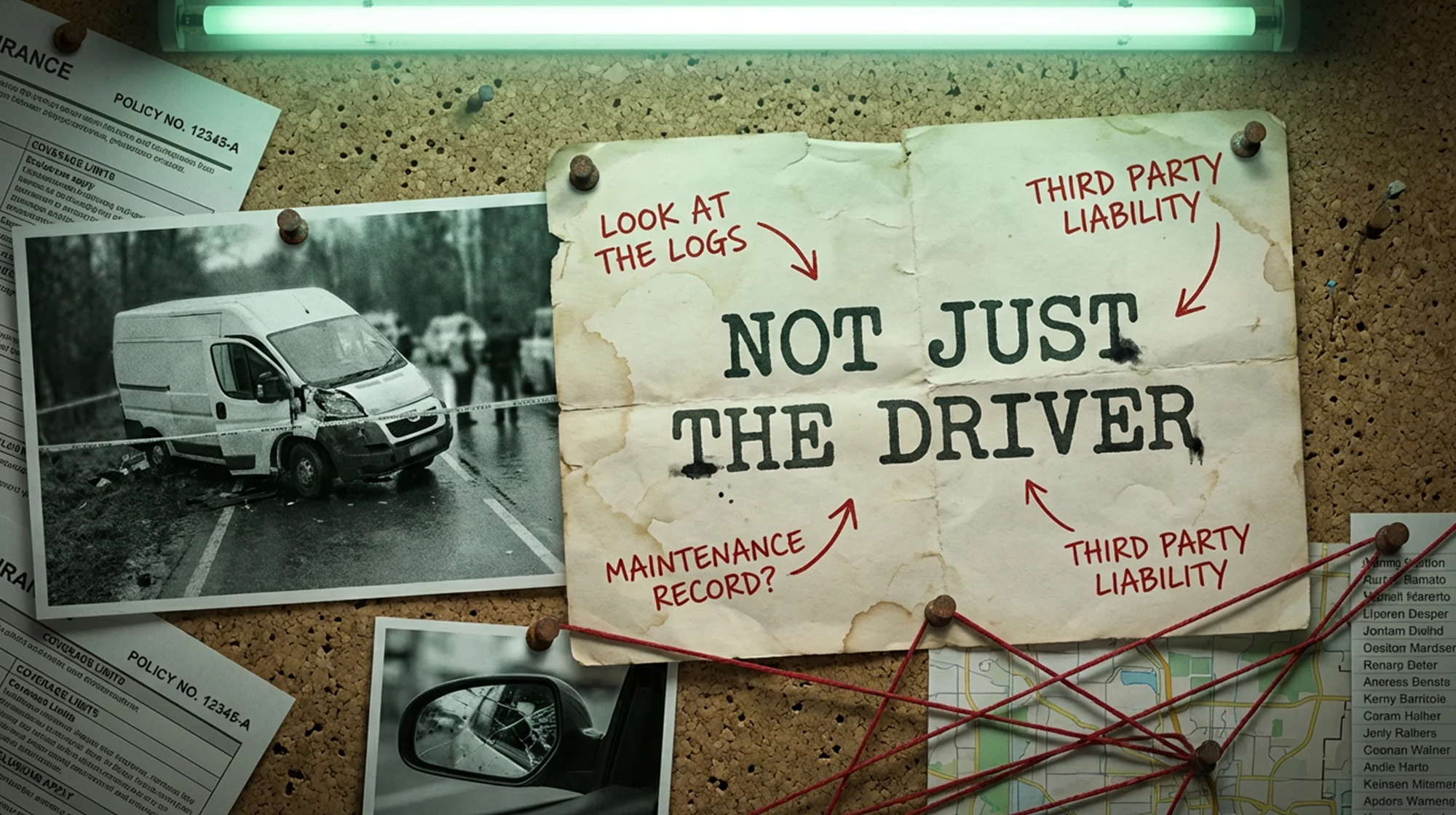
Multiple Parties Can Be Liable — Not Just the Driver
In a typical car accident, the at-fault driver is usually the only defendant. Their personal auto insurance covers the claim, and the negotiation is between you (or your attorney) and that one insurance company.
Commercial vehicle accidents almost never work that way.
When a driver is operating a vehicle for work, the legal doctrine of respondeat superior — Latin for "let the master answer" — means the employer can be held liable for the driver's negligence. If a FedEx driver runs a stop sign while making deliveries, FedEx's corporate liability insurance is in play, not just the driver's personal coverage. If a municipal bus driver causes a collision, the government entity operating that transit system may bear responsibility.
But it doesn't stop at the employer. Depending on the circumstances, other potentially liable parties can include the company that owns the vehicle (which may be different from the employer), the maintenance company responsible for keeping the vehicle roadworthy, a third-party logistics company that loaded cargo improperly, or even the manufacturer of a defective vehicle part.
I've worked cases where identifying all of the responsible parties was the single most important factor in the outcome. Miss one liable party, and you miss an entire insurance policy that could have covered your damages.
The "Independent Contractor" Defense
One of the most common tactics I see companies use is the independent contractor defense. Here's how it works: a company hires drivers but classifies them as independent contractors rather than employees. When one of those drivers causes an accident, the company argues that because the driver wasn't technically an "employee," the company has no liability under respondeat superior.
This defense has become especially prevalent with the rise of gig economy delivery services and last-mile logistics companies. But the classification on paper doesn't always hold up in court. Maryland courts look at the actual relationship between the company and the driver — factors like who controls the work schedule, who provides the vehicle, who dictates the route, and who has the authority to hire and fire. If the company exercises significant control over how the work is performed, that driver may be deemed an employee regardless of what the contract says.
Defeating this defense requires investigation, documentation, and legal knowledge that goes beyond what a standard car accident claim demands. It's one of the reasons commercial vehicle cases benefit from early attorney involvement.
Commercial Policies Are Structured Differently
One of the few silver linings in a commercial vehicle accident is that commercial auto insurance policies typically carry much higher coverage limits than personal policies. Maryland requires individual drivers to carry minimum liability coverage of $30,000 per person and $60,000 per accident. Commercial vehicles, particularly those regulated by the FMCSA, are often required to carry between $750,000 and $5 million in liability coverage depending on the type of vehicle and what it carries.
More coverage sounds like good news for the victim — and it can be. But higher policy limits also mean the insurance company has more at stake, which means they fight harder. The adjusters and defense attorneys assigned to commercial vehicle claims are specialists. They are experienced, well-funded, and aggressive. They know every tactic in the book for minimizing payouts, and they start deploying those tactics within hours of the accident.
Layered Insurance and Self-Insurance
Many commercial vehicle claims involve multiple layers of insurance coverage. The driver may have a personal policy. The employer may carry a commercial auto policy. There may be an excess or umbrella policy that kicks in above the primary coverage limit. Some large companies are self-insured, meaning they set aside their own funds to cover claims rather than purchasing traditional insurance — and self-insured entities often have in-house legal teams that begin building a defense immediately.
Navigating these layers requires knowing they exist in the first place. I've seen cases where a victim's prior attorney settled with one insurance carrier without realizing there were additional policies available. Once you settle and sign a release, you generally cannot go back and pursue those other policies. That's money left on the table permanently.
FMCSA Rules That Can Make or Break Your Case
Commercial vehicles that cross state lines or meet certain weight and passenger thresholds are regulated by the FMCSA. These federal regulations impose requirements that go far beyond what's expected of ordinary drivers, including hours of service (HOS) rules that limit how long a driver can operate without rest, mandatory use of electronic logging devices (ELDs) to track driving time, regular vehicle inspection and maintenance schedules, driver qualification standards including medical examinations, and drug and alcohol testing requirements.
When a commercial driver causes an accident, violations of these federal regulations can be powerful evidence of negligence. If a delivery driver was in their 14th consecutive hour behind the wheel when they hit you — violating the FMCSA's 11-hour driving limit — that violation can establish that the driver and their employer acted negligently. If the company's maintenance records show that brake inspections were overdue, that's evidence that the company cut corners on safety.
But here's the catch: this evidence doesn't preserve itself. Electronic logging data can be overwritten. Maintenance records can be "lost." Internal communications about driver schedules can be deleted. This is why sending a formal preservation letter to the trucking or commercial vehicle company immediately after an accident is so critical — and why having an attorney who understands this process matters from day one.
Maryland-Specific Rules That Make Things Harder
Maryland's contributory negligence doctrine is one of the strictest liability rules in the country. Under this rule, if the insurance company can prove that you were even one percent at fault for the accident, you can be completely barred from recovering any compensation. Maryland is one of only a handful of jurisdictions that still follows this harsh standard.
In a commercial vehicle case, defense teams use contributory negligence aggressively. They will scrutinize your speed, your lane position, whether you were wearing a seatbelt, whether you were distracted — anything to shift even a small fraction of blame onto you. I've seen adjusters argue that a client's failure to honk their horn before a collision constituted contributory negligence. It sounds absurd, but under Maryland law, these arguments carry real weight.
This is exactly why preserving evidence of what the commercial driver did wrong — and having an attorney who can anticipate and counter contributory negligence arguments — is essential in every Maryland commercial vehicle case. The three-year statute of limitations in Maryland applies to these claims, but the real deadline is much shorter in practice. The longer you wait, the more evidence disappears.
Delivery Van Accidents
The explosion of e-commerce has put more delivery vehicles on the road than ever before. Amazon alone operates tens of thousands of delivery vans through its Delivery Service Partner (DSP) program, where drivers work for small third-party companies contracted by Amazon. When one of those vans causes an accident, the question of whether Amazon itself bears liability — or just the small DSP company — becomes a complex and aggressively contested legal issue.
I see similar dynamics with food delivery drivers, courier services, and last-mile logistics companies. The driver is in a rush. The schedule is tight. Corners get cut. And when the accident happens, the corporate structure is designed to insulate the parent company from liability.
Company Fleet and Employee-Driven Vehicles
Not every commercial vehicle accident involves a large truck or branded van. If an employee is driving a company car — or even their personal vehicle — while performing work duties, the employer can be liable for any accident that employee causes. This includes salespeople driving between client meetings, executives traveling to a business lunch, or maintenance workers commuting between job sites in a company vehicle.
The key question is whether the driver was acting within the "scope of employment" at the time of the accident. Employers and their insurers will often argue that the driver was on a personal errand or had deviated from their work duties. Establishing the scope of employment requires evidence — GPS records, work schedules, dispatch logs, and sometimes testimony from coworkers.
Bus Accidents
Bus accidents — whether involving public transit, school buses, or private charter services — come with their own set of complications. Government-operated buses introduce sovereign immunity issues, meaning there are special rules and shorter deadlines for filing claims against government entities. School bus accidents involve heightened emotional stakes and often require notice to be filed with the school board or municipality within a compressed timeframe. Private charter and motorcoach companies are regulated under federal rules similar to those governing trucking companies.
Utility and Service Vehicles
Cable, electric, gas, and water company trucks are a frequent source of accidents, particularly in residential neighborhoods where these vehicles stop suddenly, block lanes, or create blind spots for other drivers. Many of these vehicles are operated by subcontractors rather than the utility company itself, which creates the same employer-versus-independent-contractor liability questions discussed earlier.
The first few days after a commercial vehicle accident are when your case is won or lost. Here's what I tell every client:
Get medical attention immediately. Not next week. Not when you "see how you feel." Today. Insurance companies routinely argue that delayed treatment means your injuries weren't caused by the accident. Close that door before they can walk through it.
Document everything about the vehicle. Take photos of the company name and logo, any vehicle identification numbers, the DOT number (usually displayed on the side of commercial trucks), the driver's license plate, and the overall scene. If there is a vehicle number or fleet identifier on the van or truck, photograph that too. This information is how we trace the vehicle back to the correct owner, employer, and insurance carrier.
Do not give a recorded statement to any insurance company. The commercial vehicle's insurer will likely contact you within days — sometimes within hours. They will sound friendly and concerned. They will tell you they just want to "understand what happened." What they actually want is for you to say something that can be used to reduce or deny your claim. Politely decline and direct them to your attorney.
Contact a personal injury attorney who handles commercial vehicle cases. The earlier an attorney gets involved, the sooner a preservation letter can be sent to the commercial vehicle company demanding that they retain all relevant evidence — electronic logs, GPS data, driver qualification files, maintenance records, internal communications, and dashcam footage. Once this evidence is destroyed, it's gone forever.
Maryland's three-year statute of limitations gives you a finite window to file a lawsuit, but the practical window for preserving critical evidence is measured in days and weeks, not years.
I'll be direct about this: commercial vehicle cases are not the same as fender benders. They require a different level of investigation, a different understanding of the insurance landscape, and a different litigation strategy. An attorney who primarily handles simple car accident claims may not know to look for excess insurance policies, may not understand how to obtain and interpret ELD data, and may not recognize when a company is hiding behind an independent contractor shield.
At SG Legal Group, I approach every commercial vehicle case with the assumption that the company on the other side is already building its defense. My team sends preservation letters immediately. We identify every potentially liable party and every applicable insurance policy. We obtain the driver's qualification file, the company's safety history, and any federal or state inspection records. And we prepare every case as if it's going to trial — because that's the only way to maximize your leverage during settlement negotiations.
If you've been hit by a delivery van, a company car, a fleet truck, a bus, or any other commercial vehicle in Maryland, the complexity of your case is not a reason to feel overwhelmed. It's a reason to get the right help early. Every accident is different, and the details matter. Contact me to discuss your specific situation — the consultation is free, and there's no fee unless we recover compensation for you.
If your case involves a large truck, you may also want to read my article on truck accident liability and commercial vehicle safety issues. For cases involving a fatality, I've written a detailed guide on fatal trucking cases and what families should know about pursuing a wrongful death claim in Maryland.

Disclaimer: The information provided in this article is for general informational purposes only and does not constitute legal advice. Laws and regulations are subject to change, and individual circumstances vary. For advice specific to your situation, please consult with a qualified attorney.
Joshua C. Sussex, Esq.
Stay informed with our latest articles and resources.