Immigration Law
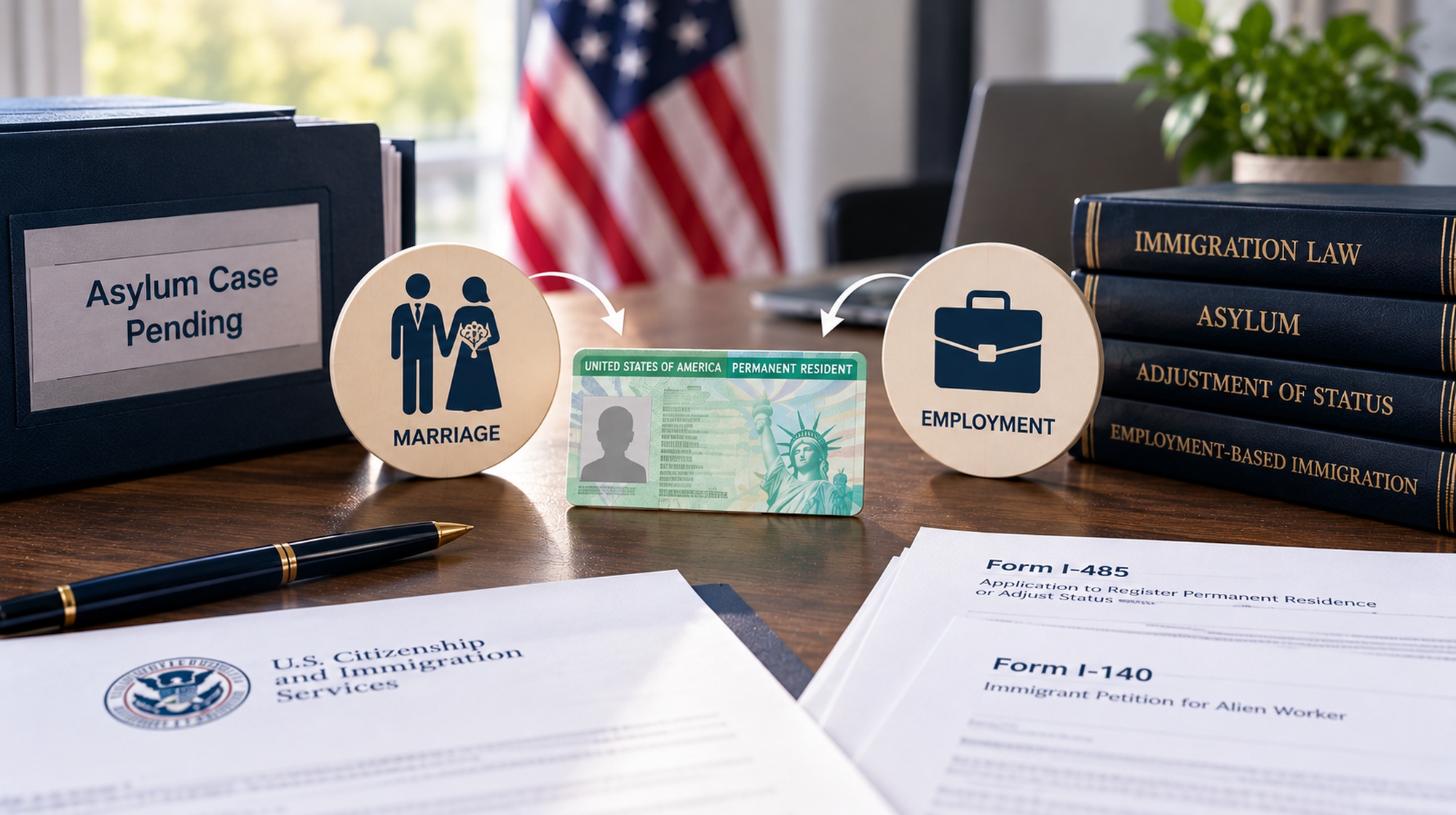
Short Answer: Often yes through marriage, rarely through an employer. A pending asylum application is not lawful immigration status, but the spouse of a U.S. citizen who was inspected and admitted or paroled can generally apply for a green card through adjustment of status, because immediate relatives are exempt from the adjustment bars for status violations. Employment-based adjustment generally requires lawful nonimmigrant status, so most asylum applicants cannot use it. If you are in removal proceedings, the immigration judge, not USCIS, usually decides the green card application. A final finding that you knowingly filed a frivolous asylum application permanently bars a green card.
Immigration courts are deciding asylum cases at record volume, and nearly all of those decisions are denials. If you also have a U.S. citizen spouse or an employer ready to sponsor you, the time to evaluate that green card path is before a judge rules on your asylum case.
Asylum histories come up often in my consultations for family-based and employment-based green cards. The first thing I check is whether the asylum application was truthful, because the answer shapes every option that follows.
I do not handle asylum or removal defense cases. This article covers the green card side of the question and flags the points where you need a removal defense attorney.
Immigration judges denied 94 percent of the asylum cases they decided in June 2026, according to an August 2026 report from TRAC, a nonpartisan research organization that analyzes immigration court records. Judges granted asylum to 771 people that month, less than a quarter of the number granted three years earlier. Asylum decisions reached record levels at the same time, topping 14,000 in both March and June 2026.
Those figures describe immigration court decisions only. They do not measure affirmative asylum cases decided by USCIS asylum offices.
TRAC links part of the shift to turnover on the bench: 279 immigration judges were fired or resigned during fiscal years 2025 and 2026. TRAC also cautions that denial rates reflect other factors, including the types of cases on a judge's docket, whether respondents are detained, and current immigration policy.
Affirmative asylum cases pending with USCIS are moving too. An interim final rule effective July 28, 2026 allows USCIS to refer certain affirmative asylum applications to immigration court without an interview when the applicant has no lawful basis to remain in the United States. DHS estimated that up to 444,724 pending affirmative cases filed more than one year after the applicant's last arrival could be affected.
A referral matters for green card planning because, once a case is in immigration court, the green card decision generally moves from USCIS to the immigration judge. As of the date of this article, the rule is in effect, and DHS is accepting public comments through September 28, 2026.
A pending asylum application does not give you lawful immigration status, even if it has supported a work permit for years. The regulation that defines lawful immigration status for green card purposes, 8 CFR 245.1(d)(1), covers permanent residents, nonimmigrants within their authorized stay, refugees, asylees, and people with unexpired parole. Pending asylum applicants are not on that list.
Clients sometimes believe they are in status because their asylum case is pending and their work permit is valid. The work permit authorizes employment. It does not create status.
Immigration law does give pending asylum applicants one narrower protection. Under INA 212(a)(9)(B)(iii)(II), time while a bona fide asylum application is pending does not count toward the three-year and ten-year unlawful presence bars, unless the applicant worked without authorization during that time. The State Department treats an application as bona fide if it has an arguable basis in law or fact and is not frivolous (9 FAM 302.11).
This protection matters if you ever have to leave the country for a visa interview. It does not make you eligible for any benefit that requires lawful status.
The spouse of a U.S. citizen can often apply for a green card through adjustment of status while an asylum case is pending, as long as the applicant was inspected and admitted or paroled into the United States. Spouses of U.S. citizens are "immediate relatives," and 8 CFR 245.1(b) exempts immediate relatives from the adjustment bars for being out of status, failing to maintain status, and working without authorization.
A pending asylum case therefore does not, by itself, block a marriage-based green card. The other requirements still apply: a genuine marriage, admissibility, and a favorable exercise of USCIS discretion.
Adjustment of status under INA 245(a) is available only to people who were inspected and admitted or paroled. Someone who entered on a visa, or who was paroled at a port of entry, generally meets this requirement. Someone who entered without inspection generally does not, and marriage to a U.S. citizen does not change that.
INA 245(i) offers a narrow exception for beneficiaries of certain immigrant petitions or labor certifications filed on or before April 30, 2001. An asylum application does not qualify anyone for 245(i) (8 CFR 245.10). For more on how entry and overstays interact with marriage, see my article on overstaying a visa and getting a green card through marriage.
The spouse of a lawful permanent resident is not an immediate relative, so the adjustment bars for status violations apply in full. Because a pending asylum case is not lawful status, a spouse of a green card holder who has been out of lawful status at any point since entering generally cannot adjust inside the United States unless 245(i) applies. The realistic options are usually consular processing, or waiting until the permanent resident spouse becomes a U.S. citizen.
USCIS Policy Memorandum PM-602-0199, issued May 21, 2026, directs officers to treat adjustment of status as a discretionary benefit and to weigh the totality of an applicant's circumstances. The factors officers consider include current or previous fraud or false testimony in dealings with USCIS or any other government agency. For an applicant with an asylum history, that puts the asylum file squarely inside the discretion analysis. I explain the memo in Adjustment of Status Discretion: What the New USCIS Memo Means for Your Green Card.
An employer can sponsor a worker who has a pending asylum case, but that worker usually cannot complete the green card through adjustment of status inside the United States. 8 CFR 245.1(b)(9) bars employment-based adjustment for anyone who is not maintaining lawful nonimmigrant status when they file, and a pending asylum application is not lawful nonimmigrant status.
Clients sometimes expect that an employer's sponsorship will let them adjust status here. For most pending asylum applicants, it will not.
The INA 245(k) exception is narrow. It forgives status violations and unauthorized work for EB-1, EB-2, EB-3, and certain religious worker applicants, but only if the applicant is present under a lawful admission and the total violations since the most recent lawful admission do not exceed 180 days (USCIS Policy Manual, Vol. 7, Part B, Ch. 8). USCIS does not treat parole as an admission, so a paroled worker cannot rely on 245(k), and the exception does not cure entry without inspection.
In practice, a worker whose visa-based stay expired more than 180 days ago, and who has relied on a pending asylum case since then, generally falls outside 245(k). For employers, the asylum-based work permit lets the employee work now, but it does not make an in-country green card possible. The petition can still support an immigrant visa abroad, which raises the consular processing issues covered below. For the general rules, see my guide to EB-3 adjustment of status eligibility.
When a person is in removal proceedings, the immigration judge generally has exclusive jurisdiction over that person's green card application, and USCIS cannot approve it (8 CFR 1245.2(a)(1)). If your asylum case is pending only with USCIS and no Notice to Appear has been filed with the immigration court, USCIS decides the green card application.
People placed in removal proceedings as "arriving aliens" are treated differently. Some people who were paroled at a port of entry are charged this way, and USCIS generally keeps jurisdiction over their adjustment applications, even when an unexecuted final removal order exists (USCIS Policy Manual, Vol. 7, Part A, Ch. 3). The charging language on your Notice to Appear matters.
A marriage entered after removal proceedings begin faces a higher standard of proof. Under 8 CFR 245.1(c)(8), proceedings begin when the Notice to Appear is filed with the immigration court, and a green card based on a later marriage requires clear and convincing evidence that the marriage is genuine. The request for this bona fide marriage exemption must be made in writing and supported by evidence.
Removal defense is not part of my practice. If your case is already in immigration court, you need a removal defense attorney to handle the court side, and any family-based or employment-based strategy has to be coordinated with that attorney.
My position is that a pending asylum application should stay pending until the green card is actually approved. Withdrawing it early gives up protection without gaining anything in return.
The regulations anticipate exactly this sequence. After USCIS grants adjustment of status to an asylum applicant, it may send notice that the asylum application will be treated as abandoned and dismissed unless the applicant asks for a decision within 30 days (8 CFR 208.14(g)).
A green card application can also be denied, particularly under the discretion standard in PM-602-0199. If that happens, the asylum claim may be the remaining defense. A new asylum application filed later would generally have to meet the one-year filing deadline in INA 208(a)(2)(B) or qualify for an exception.
Withdrawal also ends the unlawful presence protection described earlier, which lasts only while a bona fide application is pending.
This analysis assumes the asylum application is truthful. If it may not be, have it reviewed before making any decision about it. If your case is in immigration court, decisions about the asylum application belong with your removal defense attorney.
Leaving the United States without advance parole while an asylum application is pending with USCIS is presumed to abandon the application. Returning to the country of claimed persecution, even with advance parole, carries the same presumption unless the applicant shows compelling reasons (8 CFR 208.8).
Advance parole travel carries a separate new risk. On August 13, 2026, the Board of Immigration Appeals held in Matter of Delcarmen-Lara, 29 I&N Dec. 830 (BIA 2026), that a trip on advance parole counts as a departure for the unlawful presence bars (USCIS alert). Anyone who accrued unlawful presence before filing for asylum should not travel without legal advice.
An asylum application is a signed account of your history, and USCIS can compare it with everything you file afterward. It can damage a later green card case in two ways: through a frivolous asylum finding, and through inconsistencies between the asylum file and later applications.
INA 208(d)(6) makes a person permanently ineligible for any benefit under the immigration law, including a green card through marriage or employment, if they knowingly filed a frivolous asylum application after receiving the required warning. Under the long-standing rule in 8 CFR 208.20, an application is frivolous when a material element is deliberately fabricated, and the permanent bar requires a final finding by an immigration judge or the Board of Immigration Appeals.
A denied asylum application is not the same thing. Losing an asylum case, even in immigration court, does not by itself trigger the frivolous bar.
A December 2020 regulation would broaden the definition for applications filed on or after January 11, 2021. A federal court blocked that rule before it took effect, and based on the most recent available information, that injunction remains in place as of the date of this article.
The Form I-589 instructions warn that following someone else's advice to include false information does not protect an applicant from a frivolous finding. That warning matters for anyone whose application was prepared by a notario or unlicensed preparer. In the July 2026 referral rule, USCIS also described affirmative applications filed ten or more years after entry as often filed to reach immigration court and seek cancellation of removal, rather than to seek protection. That is the agency's own characterization, not a finding about any individual case.
Confirming that the asylum application was not fraudulent is the first step in any green card case with an asylum history. A meaningful review requires a complete copy of what was actually filed, compared against the facts the green card case will rely on: entry date and manner, marital history, addresses, employment, travel, and arrests. If you do not have a copy of your asylum filing, you can request your immigration records through a Freedom of Information Act (FOIA) request.
One inconsistency I sometimes see: an applicant describes an arrest in the asylum application, then leaves it off later USCIS forms, including Form I-765 work permit applications. The arrest may have happened abroad, and it may even be part of the persecution the asylum claim describes. The forms still ask.
Form I-765 asks pending asylum applicants whether they have ever been arrested for or convicted of any crime. Form I-485 asks whether the applicant has ever been arrested, cited, charged, or detained for any reason by any law enforcement official. Neither question is limited to events in the United States.
USCIS can see these answers side by side. INA 212(a)(6)(C)(i) makes a person inadmissible for willfully misrepresenting a material fact to obtain an immigration benefit, and whether a particular omission meets that standard depends on the facts, including whether it was willful and whether it mattered. An omission that falls short of that standard can still count against the applicant under the discretion factors in PM-602-0199.
An applicant found inadmissible for misrepresentation may be eligible for a waiver under INA 212(i), which requires showing extreme hardship to a U.S. citizen or permanent resident spouse or parent (USCIS Policy Manual, Vol. 9, Part F, Ch. 2). U.S. citizen or permanent resident children are not qualifying relatives for this waiver. Answering the green card application accurately does not erase an earlier omission, but repeating the omission makes the problem worse.
Consular processing means leaving the United States for an immigrant visa interview at a U.S. embassy or consulate, and for someone with an asylum claim, the threshold question is whether that trip is possible at all. Before recommending consular processing to a client with an asylum history, I assess whether that person can actually return to their home country.
Since November 1, 2025, the State Department has required immigrant visa applicants to interview in the consular district where they live or, on request, in their country of nationality (State Department notice). Interviewing elsewhere requires proof of residence there or a rare exception for humanitarian, medical, or foreign policy reasons. For someone whose asylum claim rests on fear of their home country, this rule can decide the case. I cover the policy in more detail in Immigrant Visa Applicants Must Interview in Their Country of Residence or Nationality.
Leaving also has consequences for the asylum case itself. A USCIS asylum application is presumed abandoned on departure without advance parole. If your case is in immigration court, do not leave without advice from your removal defense attorney, because missing a hearing can lead to a removal order entered in your absence.
Presidential Proclamation 10998, effective January 1, 2026, fully suspends visa issuance to nationals of 19 countries, including Afghanistan, Haiti, and Iran, and suspends all immigrant visas for nationals of 19 more, including Cuba, Nigeria, and Venezuela (State Department guidance). The categorical exceptions that previously covered immediate-relative immigrant visas are no longer available.
The State Department's guidance says the proclamation applies to people who were outside the United States on January 1, 2026 and did not hold a valid visa. How it applies to someone who was in the United States on that date and departs later for an immigrant visa interview must be analyzed before anyone leaves.
Leaving the United States can trigger the three-year or ten-year unlawful presence bar. Time while a bona fide asylum application was pending generally does not count, but time before the application was filed does, and a frivolous application is not bona fide.
The Form I-601A provisional waiver can address those bars before departure for applicants who can show extreme hardship to a U.S. citizen or permanent resident spouse or parent. It is not available to someone in removal proceedings unless the proceedings are administratively closed and have not been recalendared, and someone with a final removal order must first obtain an approved Form I-212 (USCIS).
In effect as of the date of this article: the July 28, 2026 interim final rule on asylum referrals without interview, which DHS may revise after the comment period closes on September 28, 2026; Matter of Delcarmen-Lara, decided August 13, 2026; PM-602-0199, a policy memo rather than a regulation; and Presidential Proclamation 10998.
Blocked by courts and subject to further litigation: USCIS memos PM-602-0192 and PM-602-0194, which placed holds on benefit applications and asylum cases for nationals of 39 countries, were enjoined on August 24, 2026 in Red Eagle Law, L.C. v. Edlow (USCIS alert). The State Department's January 2026 pause on immigrant visa issuance to nationals of 75 countries is no longer in effect as of August 21, 2026, under a court order in CLINIC v. Rubio (State Department). Appeals or new court orders could change either result.
Not official data: the TRAC figures are an independent analysis of immigration court records, not an agency announcement.
Not addressed in guidance we have located: the July 2026 referral rule preserves interviews for applicants who maintain a lawful basis to remain in the United States. As of the date of this article, we have not located USCIS guidance stating that a pending family-based or employment-based green card application protects an asylum case from referral. Do not assume it does.
A pending asylum case changes how every green card option has to be approached. Before filing, make sure these points are covered:
If you have a pending asylum case and a U.S. citizen spouse or an employer willing to sponsor you, I can review your asylum history and tell you whether a family-based or employment-based green card is realistic. I don't handle asylum or removal defense, and if your case needs court counsel, I'll tell you that at the start. Contact me here to schedule a consultation.
Disclaimer: The information provided in this article is for general informational purposes only and does not constitute legal advice. Immigration laws and policies are subject to change, and individual circumstances vary. For advice specific to your situation, please consult with a qualified immigration attorney.
Oleg Gherasimov, Esq.
Stay informed with our latest articles and resources.