Immigration Law
The question I hear most often from clients in this situation comes in different forms, but it always means the same thing: I overstayed my visa and I'm married to a U.S. citizen — am I okay?
The honest answer is that it depends. Not on the overstay itself, and not just on the marriage. It depends on two specific facts that most people never think to ask about: how you entered the United States, and what immigration status your spouse holds. Get those two facts wrong — or misunderstand how they interact — and a path that seems straightforward can become far more complicated than you expected.
This article walks through the legal framework clearly, including what marriage can and cannot fix, where the real risks are in 2026, and what you should do if you're in this situation.

Before getting into the marriage question, it's worth clearing up a common misconception about visas themselves.
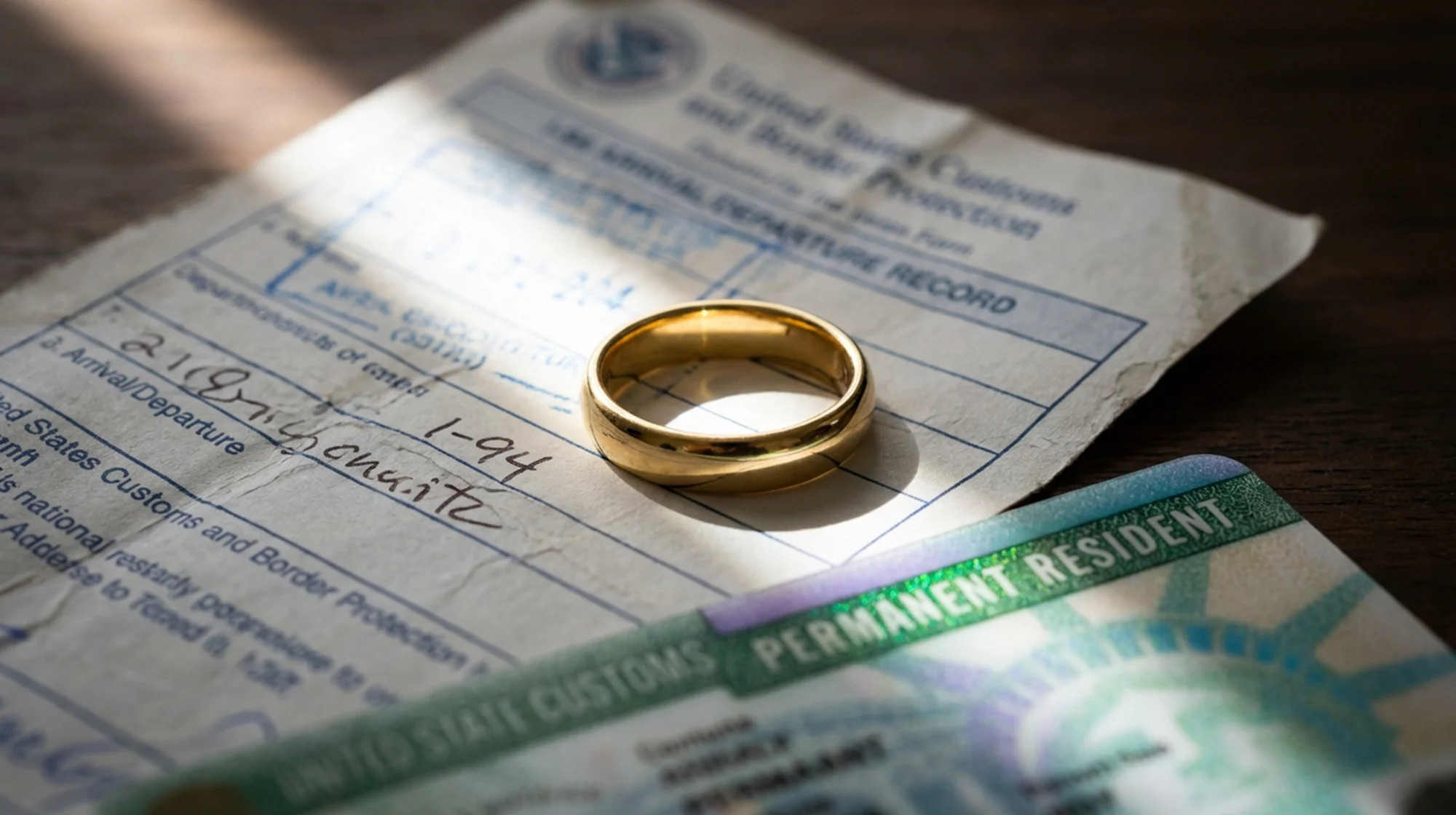
The visa stamp in your passport is not what determines how long you can stay in the United States. It's a travel document — it allows you to request entry at a port of entry. What actually controls your legal stay is the Form I-94 Arrival/Departure Record, which CBP generates when you're admitted. The date on your I-94 is your deadline.
The moment that date passes, unlawful presence begins to accrue. This triggers several automatic consequences. Your existing nonimmigrant visa is immediately voided under INA Section 222(g), meaning even a valid B-2 or F-1 stamp in your passport is no longer usable for reentry. And the longer the overstay, the more serious the consequences become — particularly if you leave the country.
The thresholds work like this:
Overstaying between 1 and 179 days voids your visa, but does not trigger a reentry bar if you depart. Once you cross 180 days of unlawful presence and then depart, a three-year bar on reentry activates. Overstay beyond one year and then depart, and a ten-year bar kicks in. If you accumulated more than a year of unlawful presence, departed, and then reentered the U.S. without authorization, you become subject to a permanent bar under INA Section 212(a)(9)(C).
The critical word in all of those scenarios is depart. The bars are triggered by leaving the United States, not by the overstay itself. This is why adjustment of status — applying for a green card from inside the U.S. — is so significant for overstayers. If you adjust status successfully, you never trigger those bars because you never depart.
If there is one thing I want you to take from this article, it's this: how you entered the United States matters more than almost any other fact in your case.
"Entering with inspection" means you came through a designated port of entry — an airport, a land crossing, a seaport — and a CBP officer processed your entry and admitted you. Most visa holders enter this way. "Entering without inspection," often abbreviated as EWI, means crossing into the U.S. without being processed by a CBP officer — typically an unauthorized land crossing.
For someone who entered with inspection and is married to a U.S. citizen, there is a real, viable path to a green card inside the United States, even after years of overstaying. For someone who entered without inspection, that domestic path is generally closed, regardless of the marriage. EWI entrants typically cannot adjust status inside the U.S. and must pursue consular processing — which means leaving the country and, in most overstay situations, applying for a waiver to overcome the reentry bars that departure will trigger.
When a client tells me they entered without inspection, the conversation shifts entirely. We're no longer talking about an adjustment of status application. We're talking about a completely different strategy, a different timeline, and a different level of risk. It is not an insurmountable situation — but it is a fundamentally different one.
Assuming you entered with inspection, who you married is the second major fork in the road.
If your spouse is a U.S. citizen, you are classified as an "immediate relative" under immigration law. This is the most favorable category in the entire family-based immigration system. There is no annual visa quota. There is no waiting list. And critically, immediate relatives are exempt from the Section 245(c) bars that would otherwise disqualify most people who have overstayed or fallen out of status. In practical terms, this means your overstay — even a lengthy one — is forgiven for purposes of the adjustment of status application, as long as you entered with inspection. Unauthorized employment, which would disqualify most other applicants, is also forgiven in this category.
If your spouse is a lawful permanent resident (LPR) rather than a U.S. citizen, the picture is significantly harder. Spouses of LPRs fall under the F2A family preference category, not immediate relatives. This matters for two reasons. First, F2A is subject to annual visa caps, which means you may wait a year or more for a visa number to become available. Second — and this is the part that catches many people off guard — spouses of LPRs are not exempt from the Section 245(c) overstay bars. Even a single day of overstay can technically bar adjustment of status inside the U.S. for an LPR spouse.
For most overstayed spouses of LPRs, the practical options are to pursue consular processing abroad (which requires departing and potentially triggering a reentry bar, then applying for a waiver) or to wait for the LPR spouse to naturalize and become a U.S. citizen. At that point, the applicant becomes an immediate relative and the domestic adjustment path opens up. The I-601A provisional unlawful presence waiver is another tool for this situation — it allows an applicant to apply for a waiver of the bars before departing, providing some insurance for the consular interview — but it still requires leaving the U.S. and it requires proving "extreme hardship" to a qualifying relative, which is a demanding legal standard.
One of the most common points of confusion I see in my practice involves what's known as the "90-day rule." Many clients who entered on a K-1 fiancé visa know there's a 90-day deadline to get married — and they sometimes conflate that with this rule. They are completely different things. (For more on the K-1 marriage deadline and what happens after it, see my article on [K-1 fiancé visa processing].)
The 90-day rule is not a law. It is a USCIS adjudication guideline. It says this: if a foreign national gets married to a U.S. citizen, or files for a green card, within 90 days of their most recent entry into the United States, USCIS will presume that they misrepresented their intent when they entered — meaning they entered claiming to be a tourist or student while secretly planning to stay permanently. Misrepresentation is a ground of inadmissibility, and it is permanent.
The 90-day rule does not automatically deny your case. But it does shift the burden of proof entirely onto you. You must demonstrate that your intention genuinely changed after you entered — that you didn't come to the U.S. with a plan to marry and stay. Credible reasons for a change of intent include an unexpected pregnancy, a sudden serious illness in the family, a significant change in conditions in your home country, or other documented unforeseen circumstances. "We fell in love" alone is typically not sufficient if the timeline raises the presumption.
One important detail: the 90-day clock resets with every new entry. It's not calculated from when the overstay began — it runs from the most recent time you crossed into the U.S. If you have traveled in and out of the country multiple times, it's the last entry that counts.
If you're not sure how your timeline interacts with the 90-day rule, or what evidence would support a change-of-intent argument in your specific case, that is exactly the kind of question that warrants a conversation with an attorney before you file anything.
One of the most misunderstood aspects of overstay cases is the relationship between the three- and ten-year bars and the adjustment of status process.
The bars are not triggered by overstaying. They are triggered by departing the U.S. after accumulating the threshold amounts of unlawful presence. If you adjust status inside the United States — if you never depart — you never trigger the bars. This is one of the most powerful practical advantages of the domestic adjustment process for overstayers married to U.S. citizens.
A related question comes up frequently among clients who want to travel while their adjustment application is pending: won't leaving the country trigger the bar and prevent them from coming back? Historically, yes. But a 2012 Board of Immigration Appeals decision, Matter of Arrabally and Yerrabelly, established that traveling on Advance Parole — the travel authorization USCIS issues to pending AOS applicants — does not count as a "departure" for purposes of triggering the reentry bars. This ruling has been reaffirmed in subsequent USCIS guidance. That said, traveling while an AOS is pending still carries real risks. CBP retains the authority to deny reentry for other reasons, and the Department of State does not always follow the BIA's interpretation when issuing new visas. Traveling outside the U.S. during a pending adjustment is a decision that should be made only after consulting with your attorney.
For individuals who may have triggered a bar through a prior departure and subsequent return to the U.S., there is another development worth knowing. A policy update and BIA guidance from 2022 and 2023 established that the three- and ten-year bars can be served from inside the United States — meaning if enough time has passed since a triggering departure, the bar may already be satisfied even if you're currently in the country. This can affect whether a waiver is needed for a prior violation. Note that this does not apply to the permanent bar under INA Section 212(a)(9)(C), which has its own separate and more demanding requirements.
Visa Waiver Program (ESTA)
If you entered on the Visa Waiver Program rather than a regular visa, the basic framework above still applies — immediate relatives of U.S. citizens who entered through ESTA can generally adjust status. However, VWP entrants sign a waiver of their right to contest removal when they enter, which creates a specific risk: if immigration enforcement encounters you before you've filed your AOS application, you can be deported without a hearing. Filing promptly is especially important for VWP overstayers. For a full treatment of the ESTA adjustment rules, see my article on [adjusting status after entering on the Visa Waiver Program].
K-1 Fiancé Visa
The K-1 visa carries a restriction that many people don't realize is absolute: you must marry the specific U.S. citizen who filed the original K-1 petition. If you entered on a K-1 visa and later marry a different U.S. citizen, you are not eligible to adjust status and must leave the country. There is no workaround for this rule.
J-1 Exchange Visitors
Many J-1 visas include a two-year home-country physical presence requirement under INA Section 212(e). This requirement is not waived by marriage to a U.S. citizen. If your J-1 visa included this requirement, you generally cannot adjust status or obtain an immigrant visa until you either spend two years in your home country or obtain a formal waiver from the Department of State and USCIS. Marriage changes a great deal in immigration law — but it does not change this.
Because an overstayed applicant is already in violation of immigration law, USCIS applies a higher level of scrutiny to the entire application. Officers are looking for proof that your marriage is "bona fide" — entered into for genuine reasons, not as a vehicle to obtain immigration benefits.
In practice, bona fide means a documented shared life. Joint bank accounts and tax returns filed together show financial integration. A joint lease or mortgage, shared utility bills, and matching addresses on driver's licenses demonstrate cohabitation. Children, joint insurance policies, shared travel, and family photographs provide evidence of a life actually built together. Affidavits from friends, family members, and coworkers corroborate the relationship from an outside perspective.
The adjustment interview is where all of this documentation gets tested. If an officer is not satisfied, the case may be escalated to a Stokes interview — a separate examination where you and your spouse are questioned individually, with your answers compared for consistency. Discrepancies on basic facts, daily routines, or family background can be treated as evidence of fraud.
One of the most common gaps I see in overstay-based adjustment packages is an underestimation of how much documentation is enough. Couples in genuine, long-term marriages sometimes submit thin files because the relationship feels self-evident to them. It is not self-evident to an adjudicator reviewing thousands of cases. For a deeper look at what USCIS is looking for and what triggers scrutiny, see my article on [immigration marriage fraud and how legitimate couples protect themselves].
The most important thing I can tell you about applying for a marriage-based green card after an overstay in 2026 is this: the consequences of a mistake are more serious than they were even two years ago.
Under a February 2025 policy memorandum, USCIS expanded its mandate to issue Notices to Appear — the document that formally begins deportation proceedings — in denied cases. Previously, if a marriage-based green card was denied for a technical error or a paperwork deficiency, the applicant often had a practical opportunity to refile without immediately facing removal. That is no longer the standard operating procedure. If your application is denied and you are out of status, the default is now an NTA and formal removal proceedings.
This has real implications for overstayers with genuine, legitimate marriages. You can have a real relationship, a real shared life, and still end up in immigration court if your application has a deficiency an officer finds disqualifying. A missing document, an income shortfall on the Affidavit of Support, an unexplained timeline — these are no longer just reasons for a Request for Evidence. They can be the beginning of a removal case.
The risk is even more acute if fraud is suspected. Under the current guidance, if USCIS has reason to believe there was misrepresentation in the application, an NTA is mandatory — and the applicant cannot avoid it by withdrawing the application. By the time you try to pull back, the referral may already be in motion.
This is no longer a situation where filing and waiting to see what happens is a reasonable approach. The decision to file — and how to file — needs to be made with a full understanding of your specific exposure.
If you're reading this because you're currently overstaying a visa and you're married to, or planning to marry, a U.S. citizen or green card holder, here is the most practical guidance I can offer.
Start by checking your I-94 at the CBP website and calculating your actual unlawful presence. Many people are uncertain about their exact timeline, and that number matters enormously for understanding what options are available. Confirm how you entered — with inspection through a port of entry, or without — because that single fact determines whether domestic adjustment is even possible. Confirm your spouse's current status: U.S. citizen or LPR, and if LPR, how close they are to being eligible for naturalization.
Do not travel outside the United States until you have spoken with an immigration attorney and understand your bar exposure. A trip that seems routine can trigger a reentry bar that turns a manageable situation into a years-long separation.
Most importantly, consult with an attorney before you file anything. In the current environment, this is not an abundance of caution — it is the minimum reasonable step. An experienced immigration attorney will review your specific facts, identify the risks and vulnerabilities in your case before USCIS does, and help you build a complete, defensible application rather than one that leaves you exposed.
If you're navigating this situation and want to talk through your options, I'm here to help. Contact my office at [SG Legal Group] to schedule a consultation. We work with clients in English, Russian, and Romanian, and we handle cases like this regularly.
Disclaimer: The information provided in this article is for general informational purposes only and does not constitute legal advice. Immigration laws and policies are subject to change, and individual circumstances vary. For advice specific to your situation, please consult with a qualified immigration attorney.
Oleg Gherasimov, Esq.
Stay informed with our latest articles and resources.