Immigration Law
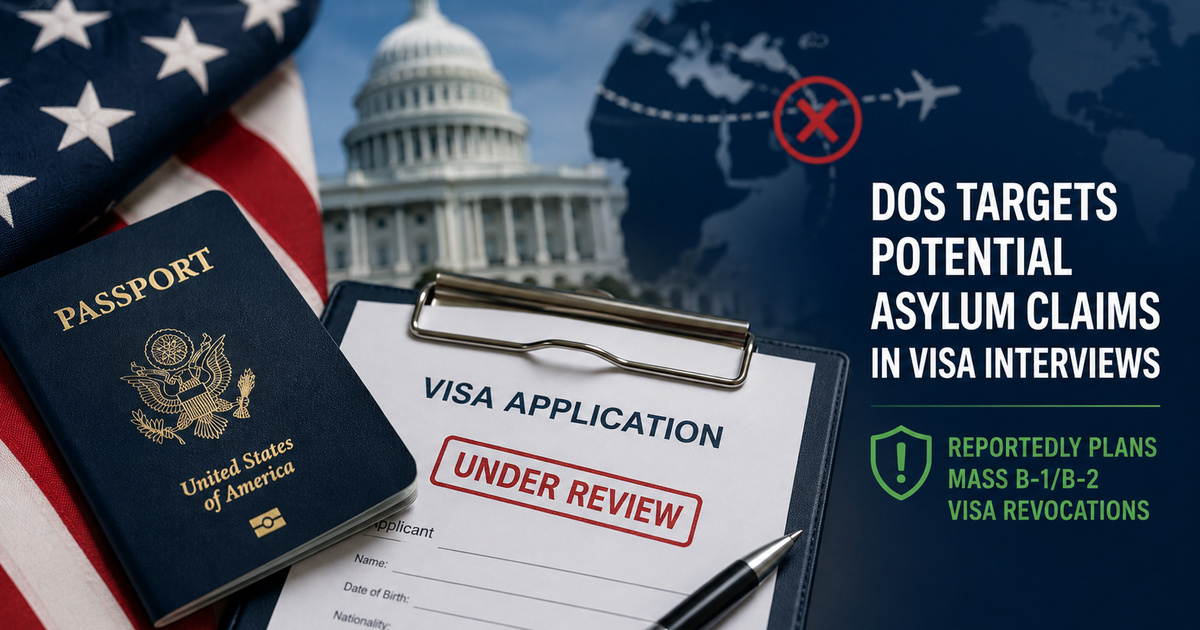
The Department of State has taken an increasingly aggressive approach toward nonimmigrant visa holders who may seek asylum after entering the United States.
In April 2026, DOS reportedly instructed consular officers worldwide to ask nonimmigrant visa applicants whether they had experienced harm in their home countries and whether they feared returning. An applicant who answers “yes” to either question, or refuses to answer, reportedly cannot proceed with visa issuance.
Now there is a significant new development. On August 24, 2026, the Associated Press reported that DOS is preparing to revoke up to 200,000 B-1/B-2 visitor visas issued between 2016 and 2026 to people who subsequently applied for asylum in the United States. The reported revocation initiative has not yet been formally announced or finalized, so its ultimate scope and implementation remain uncertain.
Taken together, these developments raise an important concern for visa applicants: statements made during a seemingly routine consular interview may have consequences long after the visa is issued.
On April 28, 2026, The Washington Post reported that DOS issued a cable instructing consular officers to add two asylum-related questions to nonimmigrant visa interviews. The directive reportedly took effect immediately.
Consular officers were instructed to ask:
The cable reportedly instructs officers to document the applicant’s answers in the case notes. It further states that the applicant must verbally answer “no” to both questions for the officer to continue with visa issuance.
An applicant who answers “yes” to either question, or declines to answer, reportedly faces refusal of the visa.
The stated rationale is immigrant intent. According to the reported cable, fear of returning to one’s country calls into question whether the applicant actually intends to use the nonimmigrant visa for a temporary stay.
For applicants in categories subject to INA § 214(b), that can result in a refusal based on failure to establish entitlement to nonimmigrant status. Different considerations apply to categories such as H-1B and L-1, which are not subject to the ordinary INA § 214(b) foreign-residence requirement.
The practical problem with these questions is obvious. A person applying for a temporary U.S. visa may genuinely have experienced mistreatment or may genuinely fear returning home without having formed an intention to apply for asylum in the United States.
The questions do not necessarily capture that distinction.
A truthful “yes” may prevent the applicant from receiving the visa. But answering “no” when the truthful answer is “yes” creates a potentially much more serious problem.
A visa applicant should not give a false answer simply because the truthful answer may result in a visa refusal.
That answer is reportedly being preserved in the consular case notes. If the person later enters the United States and applies for asylum based on events that existed before the visa interview, the prior statement could become highly relevant.
An asylum applicant generally must establish that the person qualifies as a refugee under U.S. immigration law, including the required connection between past persecution or a well-founded fear of future persecution and a protected ground.
Credibility can be central to that determination.
Suppose someone applies for a B-1/B-2 visa and is asked whether she has experienced harm in her country. She answers no. She is then asked whether she fears returning and again answers no.
The visa is issued.
Six months later, she enters the United States and files for asylum. Her Form I-589 alleges that she had already suffered serious persecution before the visa interview and had feared returning to her country for years.
The government now has a prior statement that appears inconsistent with the asylum claim.
That does not necessarily mean the asylum application must be denied. Facts can change. Fear can develop after a visa interview. New persecution can occur. Country conditions can deteriorate. An applicant may also have a legitimate explanation for an apparent inconsistency.
But when the asylum claim depends on events and fears that already existed at the time of the visa interview, the applicant may have to explain why she told a U.S. consular officer something different.
That can become a credibility issue before a USCIS asylum officer or an immigration judge.
A knowingly false answer during the visa process can potentially create an issue separate from whether the person’s later asylum claim is credible.
INA § 212(a)(6)(C)(i) provides a ground of inadmissibility for certain fraud or willful misrepresentations of material facts made in seeking a visa, admission to the United States, or another immigration benefit.
That does not mean every inconsistency between a visa interview and a later asylum application establishes fraud or material misrepresentation. The government would still have to establish the elements of the applicable inadmissibility ground.
There is also an important distinction between asylum eligibility and eligibility for other immigration benefits. INA § 212(a)(6)(C)(i) is not itself one of the statutory asylum bars listed in INA § 208(b)(2)(A).
But a misrepresentation finding can still have serious consequences outside the asylum determination, including for future visa applications, adjustment of status, or other immigration benefits.
This is why the safest advice is also the simplest: answer consular questions truthfully.
The April cable focuses on preventing the issuance of nonimmigrant visas to applicants DOS believes may intend to seek asylum.
The August development goes considerably further.
On August 24, 2026, the Associated Press reported that DOS is preparing what could become the largest mass visa revocation initiative in U.S. history. According to the report, DOS and DHS are reviewing B-1/B-2 visas issued between 2016 and 2026 to identify people who entered the United States as temporary visitors and later applied for asylum.
The reported universe is substantial: up to 200,000 visas could potentially be affected.
This development should be described carefully, however.
As of the date of this article, DOS has not published a final policy establishing exactly whose visas will be revoked, what exceptions will apply, how individual cases will be evaluated, or precisely what legal mechanism DOS will use in every case.
The reported plan therefore should not yet be treated as a completed government policy.
There is an important legal and factual distinction that should not disappear in the discussion of these revocations.
A person applying for asylum after entering on a B-1/B-2 visa does not, by that fact alone, establish that the person intended to seek asylum when applying for the visa or entering the United States.
Circumstances can change.
A political crisis can erupt after entry. A government can change. Family members can be threatened. New evidence can emerge. A person’s political, religious, or other activities after arrival in the United States can also create a new fear of persecution.
Even when the underlying circumstances existed earlier, a person’s intentions can genuinely change after entering the United States.
The relevant timeline therefore matters.
Someone who applied for a visitor visa while already planning to enter the United States and remain through asylum presents a very different factual situation from someone who entered intending to visit and later developed a legitimate basis or need to seek protection.
The mere filing of Form I-589 does not, by itself, answer what the applicant intended months or years earlier.
A visa and immigration status inside the United States are related, but they are not the same thing.
A visa is principally a travel document used to seek admission to the United States. Once someone has been admitted, the person’s authorized stay is generally governed by the admission and Form I-94 rather than by whether the visa stamp remains valid.
This distinction is particularly important when discussing the reported asylum-related revocations.
The State Department has statutory and regulatory authority to revoke nonimmigrant visas. INA § 221(i) and 22 CFR § 41.122 provide the underlying revocation framework, and the Foreign Affairs Manual contains detailed procedures for nonimmigrant visa revocations.
A visa revocation therefore does not necessarily mean that an asylum applicant physically present in the United States is immediately deported.
It can, however, prevent the person from using that visa for future travel to the United States. Other immigration consequences may depend on the person’s status, asylum application, immigration history, and the government’s stated basis for the revocation.
The AP report similarly indicates that the contemplated revocations would not themselves result in immediate deportation.
DOS’s Foreign Affairs Manual recognizes what it calls a “prudential revocation.”
Under 9 FAM 403.11-5(B), the Department may in certain circumstances revoke a visa when an ineligibility or lack of entitlement is suspected, when the person would not meet the requirements for admission, or in other situations where DOS determines that revocation is warranted.
That authority could become relevant to the reported asylum-related initiative.
But as of the date of this article, I have not seen published DOS guidance establishing that the contemplated B-1/B-2 asylum revocations will categorically be processed as prudential revocations.
That distinction matters. Until DOS publishes the actual policy or provides additional details, it would be premature to characterize every contemplated asylum-related revocation under a specific revocation mechanism.
There are now two related developments, but their evidentiary status is different.
The April 28 asylum-question directive has been widely reported based on a DOS cable. The reported instructions require nonimmigrant visa applicants to answer questions about past harm and fear of returning, with negative answers required to continue toward visa issuance.
The August development is newer and less complete. AP reports that DOS, working with DHS, is preparing to review and potentially revoke up to 200,000 B-1/B-2 visas issued between 2016 and 2026 to people who later sought asylum.
As of the date of this article, several important questions remain unanswered: whether all identified visa holders will actually face revocation, whether there will be exceptions, what findings DOS will make before revocation, whether the person’s asylum filing date or underlying facts will matter, and what procedures DOS will use.
Those details should not be guessed at until DOS provides them.
A nonimmigrant visa applicant should answer questions about past harm or fear of returning truthfully. Giving an inaccurate answer to avoid a visa refusal can create a much more serious immigration problem later.
Someone who previously answered “no” to these questions and is now considering asylum should carefully examine the timeline. If the asylum claim relies on persecution or fear that existed before the visa interview, the prior statement may need to be addressed and explained.
For someone who entered on a B-1/B-2 visa and already has a pending asylum application, the reported mass-revocation initiative is understandably concerning. But a news report that DOS intends to revoke certain visas should not be confused with an individual finding that the person’s asylum application is fraudulent or with an order requiring that person to leave the United States.
The details of the government’s implementation will matter enormously.
If you are concerned about statements made during a visa interview, a pending asylum application, or a possible visa revocation, contact me at SG Legal Group to discuss your circumstances. These cases can turn on exactly what was said, when it was said, and what happened afterward.
Disclaimer: The information provided in this article is for general informational purposes only and does not constitute legal advice. Immigration laws and policies are subject to change, and individual circumstances vary. For advice specific to your situation, please consult with a qualified immigration attorney.
Legal research verified as of: August 27, 2026
Oleg Gherasimov, Esq.
Stay informed with our latest updates.