Immigration Law
Few things spike anxiety faster than logging into your USCIS account and seeing a new status update you don't fully understand. If your case tracker now reads "Notice Explaining USCIS Actions Was Mailed," you are probably scanning forums, reading conflicting posts, and wondering whether this is the beginning of good news or bad news.
I see this reaction from clients regularly at SG Legal Group. The short answer is that this status message, on its own, does not tell you whether your case was approved, denied, or something in between. It simply means USCIS put a notice in the mail. The actual notice — the document itself — is what matters.
In this article, I explain every type of notice this status update could signal, what each one requires from you, and the steps you should take right now while you wait for that letter to arrive.
When USCIS takes an action on your case — any action — the agency updates your online case tracker and mails you a Form I-797C, Notice of Action, explaining what happened. The language you see online is standardized. It typically reads something like:
"We mailed you a notice informing you of the action we intend to take on your case. Please follow the instructions in the notice and submit any requested materials."
This exact same language appears whether USCIS is requesting more documents, signaling an intent to deny, or even approving your petition. The online tracker does not distinguish between these outcomes. That is why reading forum posts from other applicants can be so misleading — the person who got an approval and the person who got a Notice of Intent to Deny both saw the same words on their screen.
This status update applies across virtually every form type USCIS processes: I-130 family petitions, I-485 adjustment of status applications, I-140 employment-based petitions, I-539 change-of-status requests, and others. The form type does not change what the status message says, which is why the notice itself is the only document worth reacting to.
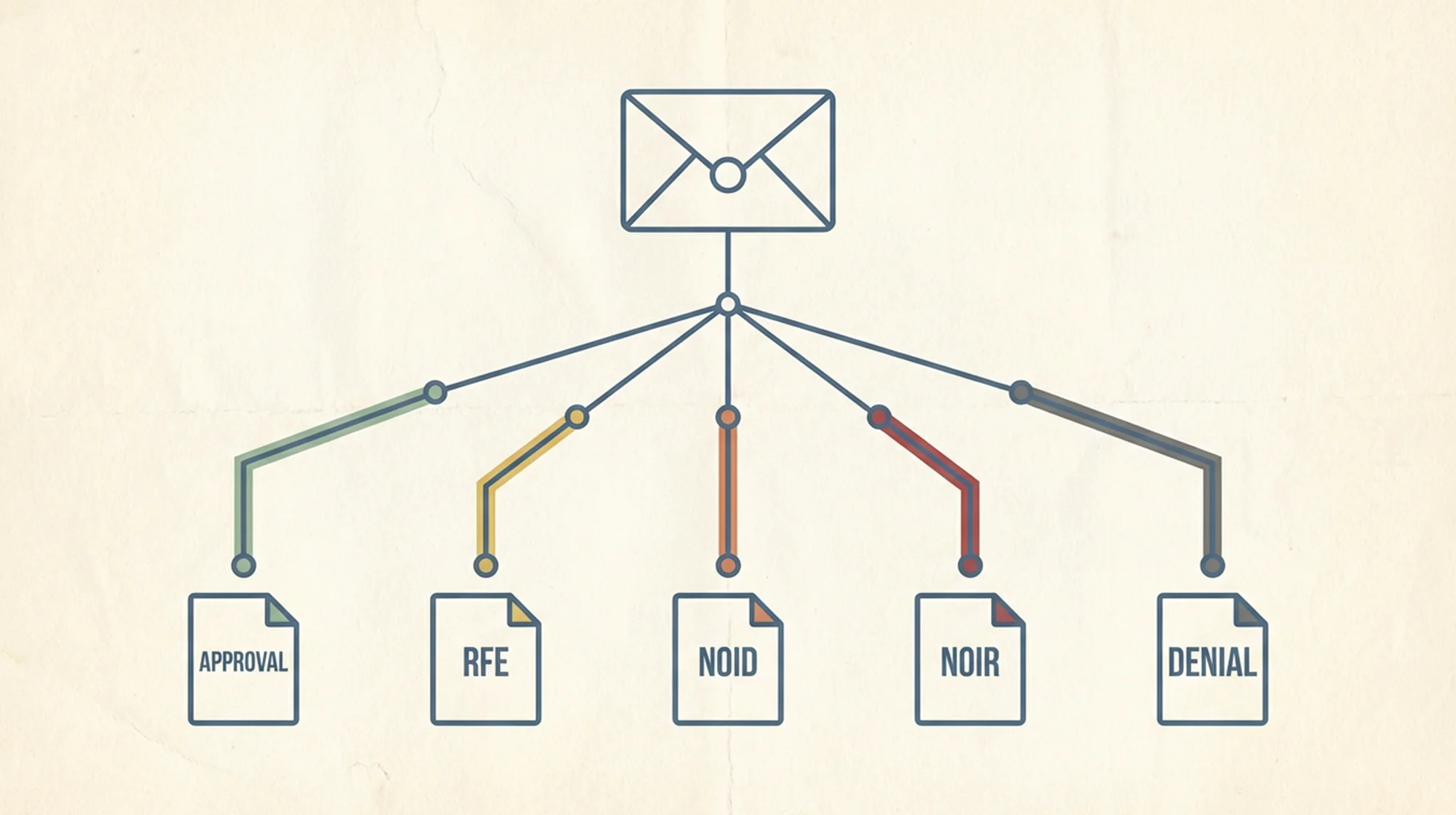
The "notice explaining USCIS actions was mailed" status can precede very different outcomes. Here are the main possibilities, ranked roughly from most to least common in my experience.
Request for Evidence (RFE)
A Request for Evidence means USCIS reviewed your application and determined it needs more information before making a decision. This is not a denial. It is not even a negative signal in most cases — it simply means something was missing, unclear, or insufficiently documented in your original filing.
Common RFE requests include proof of a bona fide marriage, financial documentation for the I-864 Affidavit of Support, employment verification letters, medical examination results, or clarification of prior immigration history.
USCIS will give you a deadline to respond, typically between 30 and 87 days depending on the case type and what is being requested. That deadline runs from the date printed on the notice — not the day you open the envelope. This distinction matters, and I will come back to it.
One pattern I see too often: a client receives an RFE and decides to handle it on their own because they assume the request is straightforward. They gather what they think USCIS wants, mail it back, and wait — only to receive a denial weeks later because the response was incomplete, disorganized, or missed the point of what the officer was actually asking. An RFE is your opportunity to strengthen your case. Treating it casually is one of the most expensive mistakes in the immigration process.
Notice of Intent to Deny (NOID)
A NOID is more serious than an RFE. It means USCIS has reviewed your case and preliminarily concluded that you are not eligible for the benefit you requested. The agency is telling you it plans to deny your application — but is giving you one final chance to change the officer's mind.
The response window for a NOID is usually 30 days. That is not a lot of time, especially when you consider that the clock starts on the date of the notice and mail delivery can eat into a significant portion of that window.
A NOID is not a final denial. I want to emphasize that because many applicants read the words "intent to deny" and assume their case is over. It is not. A well-prepared response that directly addresses every concern USCIS raised can result in an approval. But the margin for error is extremely thin, and this is genuinely not the stage to attempt a response without professional guidance.
If you want to understand more about what happens when USCIS moves toward a denial — including situations where they skip the NOID entirely — I have written about that in detail: Can USCIS Deny a Family Petition Without Giving You a Chance?
Notice of Intent to Revoke (NOIR)
A NOIR is different from a NOID in one important way: it applies to petitions that USCIS already approved. If the agency discovers new information — or if a U.S. consulate sends an approved petition back for review — USCIS may issue a NOIR signaling its intent to revoke the prior approval.
This most commonly arises in employment-based cases (such as H-1B or I-140 petitions) and in family-based cases where the consular officer raised questions during the visa interview. The petitioner typically has 30 days to respond with evidence rebutting the stated grounds for revocation.
I covered the consular return process in depth in a separate article, including what happens after a NOIR is issued: What Happens When a U.S. Embassy Sends Your Visa Petition Back to USCIS.
Approval Notice
Yes, sometimes the same vague case tracker language precedes good news. USCIS may be mailing you a notice confirming that your petition or application was approved. In some cases — particularly I-485 approvals — the next update you see may be "Card Is Being Produced," which means your green card is on its way.
There is no reliable way to distinguish an approval from other outcomes based on the online status alone. The timing, your case history, and whether you had any outstanding requests can offer clues, but ultimately you need to wait for the document.
Denial or Other Final Decision
In some situations, the notice is a final decision denying your application. Unlike a NOID, a denial does not invite a response — it is the conclusion. However, a denial notice typically includes information about your right to appeal or file a motion to reopen or reconsider, and those options come with their own strict deadlines.
If you just saw this status update on your case tracker, here is what I recommend.
Check your myUSCIS online account. Log in and look for a "Documents" tab associated with your case. USCIS sometimes uploads notices electronically before the physical letter arrives. Not every account has this feature, but it is worth checking.
Watch your mail carefully. The status update will usually include a line like "if you do not receive your notice by [date], contact the USCIS Contact Center." That date is typically about two weeks from the status update. Make sure someone is checking your mailbox daily.
Confirm your address is current with USCIS. If you have moved and did not update your address, the notice could be going to the wrong location. You can update your address at uscis.gov/addresschange. A lost notice does not extend your deadline to respond — USCIS counts the response period from the date on the notice regardless of when or whether you receive it.
Do not call USCIS repeatedly. The Contact Center agents generally cannot tell you what the notice says before you receive it. If the two-week window passes without the letter arriving, then calling to request a duplicate is appropriate.
If you have an attorney, let them know. If you are already represented, contact your attorney's office so they can prepare to review the notice as soon as it arrives. Time matters — especially if this turns out to be an RFE or NOID with a short response window.
If you are not currently represented and you are unsure what to expect, this is a reasonable moment to consult with an immigration attorney. Knowing what you are dealing with before the deadline starts running gives you the best chance of a strong response. I offer consultations in English, Russian, and Romanian — you can schedule one here.
The most consequential error I see is not panic — it is misplaced confidence. An applicant receives an RFE, reads it, and thinks: "They just need a few more documents. I can handle this myself."
Sometimes that is true. But more often than not, an RFE is asking for something specific in a specific way, and the response needs to be organized, complete, and directly on point. USCIS officers are not obligated to issue a second RFE if your first response falls short. Under current USCIS policy, if your response does not establish eligibility, the officer can move straight to a denial.
With a NOID, the stakes are even higher. You are not simply filling in a gap — you are making a legal argument for why USCIS's preliminary conclusion is wrong. That requires understanding what the officer found deficient, marshaling the right evidence, and presenting it persuasively within a very compressed timeline.
The common thread is this: by the time someone realizes they needed professional help, the deadline has often passed or the damage has been done. If your case has reached the point where USCIS is asking questions or signaling concerns, the cost of an attorney consultation is small compared to the cost of starting the process over — or worse, losing your eligibility entirely.
Every notice USCIS sends includes a response deadline, and those deadlines are enforced strictly. An RFE might give you anywhere from 30 to 87 days. A NOID typically gives you 30 days. A NOIR generally provides 30 days as well.
Here is the critical detail many applicants miss: the deadline is calculated from the date printed on the notice, not the date you receive it. If USCIS dates the notice on April 1 and it takes ten days to reach your mailbox, you have already lost ten days of your response window. For a 30-day NOID deadline, that leaves you roughly 20 days — barely enough time to retain an attorney, gather evidence, and prepare a response.
This is why I tell every client the same thing: deadlines are deadlines, and they must be respected. USCIS does not routinely grant extensions, and a late response can be treated the same as no response at all. If you miss the window, the officer can deny your case based on the existing record, and your options narrow dramatically from there.
Keep your address current. Check your mail. And when the notice arrives, read it immediately and act accordingly.
The "notice explaining USCIS actions was mailed" status update is deliberately vague, and that vagueness can work against you if it leads to paralysis or guesswork. The best thing you can do is prepare: know what the possibilities are, make sure USCIS can reach you, and have a plan for how you will respond once the notice arrives.
If you have received this status update and want to understand what it means for your specific case — or if the notice has already arrived and you need help responding — I am here to help. At SG Legal Group, I work with individuals, families, and employers on cases at every stage of the USCIS process.
Schedule a consultation or call us at 410-618-1288. Consultations are available in English, Russian, and Romanian.

Disclaimer: The information provided in this article is for general informational purposes only and does not constitute legal advice. Immigration laws and policies are subject to change, and individual circumstances vary. For advice specific to your situation, please consult with a qualified immigration attorney.
Oleg Gherasimov, Esq.
Stay informed with our latest articles and resources.