Immigration Law
If you're from one of more than 50 countries now subject to the U.S. visa bond requirement — or if you're planning to attend the FIFA World Cup 2026 — this article is for you. The rules have changed significantly since the program launched, and the consequences of not understanding them can be severe.

The visa bond program requires certain B-1/B-2 visitor visa applicants to post a financial bond — between $5,000 and $15,000 — before their visa is issued. The program is authorized under INA Section 221(g)(3) and was established through a Temporary Final Rule (TFR).
The bond serves as a financial guarantee that you will leave the United States before your authorized stay expires. If you comply fully, you get the money back. If you don't, you forfeit it — and face serious immigration consequences.
This isn't a new concept in immigration law. But the scale of implementation in 2025–2026 is unlike anything we've seen before.
When the program launched in August 2025, it applied to nationals of just two countries: Malawi and Zambia. I covered the original rollout in my earlier post on the visa bond pilot program.
The expansion since then has been rapid and far-reaching. As of May 2026, the Department of State has designated nationals from over 50 countries. Countries were added in waves:
August 2025 (original launch): Malawi, Zambia
October–November 2025: The Gambia, Mauritania, Sao Tome and Principe, Tanzania
January 1, 2026: Bhutan, Botswana, Central African Republic, Guinea, Guinea-Bissau, Namibia, Turkmenistan
January 21, 2026: Algeria, Angola, Antigua and Barbuda, Bangladesh, Benin, Burundi, Cabo Verde, Cote D'Ivoire, Cuba, Djibouti, Dominica, Fiji, Gabon, Kyrgyz Republic, Nepal, Nigeria, Senegal, Tajikistan, Togo, Tonga, Tuvalu, Uganda, Vanuatu, Venezuela, Zimbabwe
April 2, 2026: Cambodia, Ethiopia, Georgia, Grenada, Lesotho, Mauritius, Mongolia, Mozambique, Nicaragua, Papua New Guinea, Seychelles, Tunisia
The requirement applies regardless of where you apply — your home country consulate or any U.S. consulate abroad.
The bond amount — $5,000, $10,000, or $15,000 — is determined by the consular officer at the time of your visa interview. There is no published formula for how that decision is made.
A few things to understand clearly:
You pay only when directed. Do not submit Form I-352 or attempt to pay until a consular officer explicitly instructs you to do so. If you pay without that direction, the funds will not be returned.
Use only Pay.gov. After being directed to pay, you will receive a direct link to the U.S. Department of the Treasury's Pay.gov platform. Do not use any third-party website — the U.S. government is not responsible for funds paid outside its systems, and scammers are already exploiting confusion around this program.
Paying does not guarantee a visa. The bond is a compliance mechanism, not a purchase. A consular officer can still deny your application after you've posted the bond.
This is one of the most important — and least-discussed — aspects of the program. As a condition of the bond, visa holders must enter and exit the United States through designated ports of entry only.
If you enter or exit through an unauthorized port, your departure may not be properly recorded — which could trigger a bond breach finding even if you left on time. This is a trap that can catch well-meaning travelers who simply didn't know the rules.
The bond is canceled and your money returned automatically if:
A bond breach can be triggered if:
That last point is significant. Simply applying for asylum or a change of status while inside the U.S. is treated as a potential breach. If DHS believes a breach occurred, the case is referred to USCIS for a formal determination.
Beyond losing the bond amount, a breach finding can follow you into future immigration proceedings.
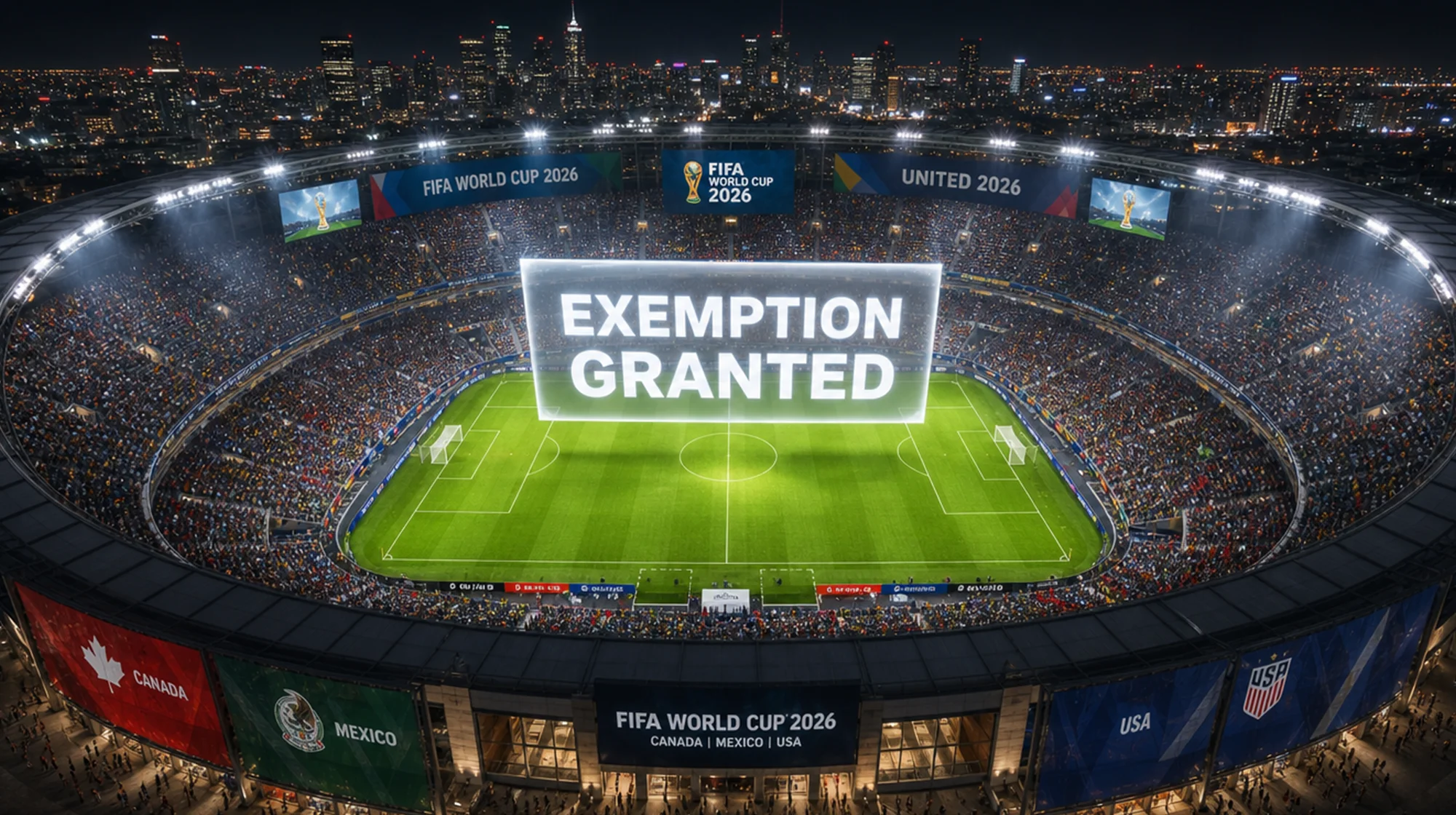
With the FIFA World Cup 2026 taking place across the United States this summer, the Administration has announced a waiver of the visa bond requirement for certain travelers. Here's exactly who qualifies:
Group 1 — Athletes and Team Members: The bond is waived for athletes and team members — including coaches, support staff, and immediate family members — who are nationals of competing countries and demonstrate full eligibility for a U.S. visitor visa.
Group 2 — Ticketed Fans: The bond is also waived for nationals of competing countries who, by April 15, 2026:
This is an important distinction. The waiver does not apply to all nationals of bond-affected countries who simply want to visit during the World Cup period. It applies specifically to those who took both qualifying steps before the April 15 deadline.
If you're a fan from a bond-affected country who did not purchase tickets and register through PASS by April 15, you are likely still subject to the bond requirement. Standard visa screening applies in all cases — no visa is issued without full vetting by a consular officer.
This is where the complexity becomes real. The interaction between the bond requirement, the FIFA waiver, port-of-entry restrictions, and standard visitor visa eligibility is not straightforward — and the consequences of a mistake are both financial and legal.
If you're a national of a bond-affected country planning travel to the U.S. — for the World Cup or otherwise — get clarity on your specific situation before your visa interview. The consular officer makes decisions at the interview. Walking in unprepared is a significant risk.
If you have questions about whether the visa bond applies to you, whether the FIFA waiver covers your situation, or how to best prepare for your B-1/B-2 interview, feel free to reach out to me directly. Every case is different, and I'm happy to help you understand where you stand.
Disclaimer: The information provided in this article is for general informational purposes only and does not constitute legal advice. Immigration laws and policies are subject to change, and individual circumstances vary. For advice specific to your situation, please consult with a qualified immigration attorney.
Oleg Gherasimov, Esq.
Stay informed with our latest articles and resources.