Personal Injury
The room is loud. You're in pain. An ER nurse is asking you questions and all you can think about is the fire in your back.
In that moment, the answer you give — the body parts you name — may be one of the most important things you say in your entire workers' compensation case.
I've handled work injury claims in Maryland for over 15 years, and this is the moment where I've seen so many cases begin to go wrong. Not because of anything the injured worker did intentionally, but because of a completely understandable, very human reaction to pain: you focus on what hurts the most.
What most people don't realize is that under Maryland law, every single body part you injure is treated as a separate injury — with its own separate value. Think of it like a building insurance policy that covers each room independently: damage to the kitchen is one claim, damage to the bedroom is another. If you don't report the bedroom, it simply isn't covered. Miss a body part on day one, and you may end up fighting much harder to get it recognized later — or not getting it recognized at all.
It happens all the time, and it makes sense when you think about it.
Someone is hurt at work — a fall, a car accident, a slip — and they go to the emergency room. Their back is in agony. That's what they report. That's what gets documented. What they don't mention, or don't fully register yet, is that they also hit their knees when they landed. Their legs felt sore, but next to the back pain? It barely seemed worth mentioning.
Then a few days pass. The back pain is still there, but now the knees are screaming too. The legs are stiff and swollen.
By this point, the workers' compensation insurance carrier has often already processed the claim based on that initial ER visit — and they've accepted only the back as the compensable injury. The knees and legs? Not on the initial report. The insurer may refuse to cover treatment for those body parts entirely.
I see this pattern in fall accidents and work-related car accidents more than anywhere else. These types of incidents almost always affect multiple parts of the body simultaneously. But in the chaos of the moment, injured workers zero in on the loudest pain signal — and the rest gets left out.
When an insurance carrier receives the first medical report, they use it to define the scope of your claim. That initial documentation is their starting point — and often their finish line.
If a body part isn't on the initial record, the insurer will frequently argue it isn't related to the work accident at all. They may claim it's a pre-existing condition, or simply deny it without explanation.
I've represented many injured workers who reported only one body part at first and then, weeks later, began experiencing significant pain in other areas. In those situations, the treating physician must carefully document that the additional injuries are related to the original accident. If the insurance carrier refuses to authorize treatment for those body parts, I file a request for a hearing before the Maryland Workers' Compensation Commission.
That hearing is where we fight to get a ruling on whether the additional body part is compensable. We win many of those hearings — but the process takes time, adds stress, and costs the client months of delays in receiving the treatment they need. It is a fight that is often avoidable if the full picture is documented from the start.
The earlier and more completely your injuries are documented, the stronger your claim. Every week that passes before an injury is reported gives the insurance company more room to dispute it.
This is something I explain to every single client I represent in a workers' compensation case in Maryland, because it surprises almost everyone who hears it.
Maryland's Workers' Compensation Commission uses what is called a "scheduled member" chart. Under this system, every body part — your hand, your knee, your shoulder, your foot, your hearing, your vision — is assigned a specific number of weeks of compensation. Those weeks translate directly into dollars.
Lose the use of a hand? That's a set number of weeks. Damage your knee? A different number. Injure your back? Another calculation entirely.
I describe it to my clients this way: imagine a mosaic made of individual tiles. Each tile is beautiful and distinct — and each one has its own value. If a tile is cracked, you document that crack and address it. But if you don't notice a cracked tile in the corner at first and it isn't recorded, fixing it later becomes a separate, harder conversation. Maryland workers' compensation law works the same way with your body. Each body part is its own tile — its own distinct claim. It doesn't matter that your back injury is also causing radiating pain down your leg, or that a knee injury is affecting how you walk and therefore straining your hip. In the eyes of Maryland workers' compensation law, each body part must be identified and claimed individually.
Medically, this is simply not how the human body works. The body functions as a whole, and injuries almost always have cascading effects. But legally, this rigid framework is the reality — and it means that every body part that is affected by your work accident must be identified, reported, and documented individually.
The practical consequence is significant: failing to document an injured body part doesn't just mean missing out on treatment for that part — it means losing the weeks of compensation that are assigned to it under the schedule. Depending on which body part is at issue, that can represent a substantial portion of your total workers' compensation award.
This is why I tell my clients: don't filter. Don't minimize. Tell the doctor about every single area of your body that was affected — from the most serious injury to the mildest ache.
Here is something I want every injured worker in Maryland to understand, because it is not widely discussed.
In many workers' compensation cases, employers direct injured workers to specific clinics for their initial treatment — employer-designated urgent care facilities or in-house Employee Health offices. These clinics are employer-driven. Their relationship is with your employer and the insurance carrier, not with you.
In my experience, these clinics do not always fully document everything the injured worker reports. An employee may mention discomfort in three or four areas, but the intake notes reflect only one or two. Whether this is the result of rushed appointments, incomplete intake processes, or the clinic's relationship with the employer, the result is the same: your record becomes incomplete before you've even left the room.
If you are sent to one of these clinics, here is what I recommend. Be thorough, be specific, and be persistent. Name every part of your body that hurts or feels different than it did before the accident. Ask the treating provider to confirm that everything you reported is being documented. If you receive a copy of your visit notes and something is missing, bring it to your attorney's attention immediately.
Your right to treat with your own physician exists under Maryland workers' compensation law, and in many cases, getting you to a doctor who is genuinely focused on your recovery — rather than on the employer's interests — can make a real difference in how your injuries are documented and treated.
While the problem of incomplete injury documentation can appear in any workers' compensation case, two types of work accidents stand out in my practice as particularly high-risk.
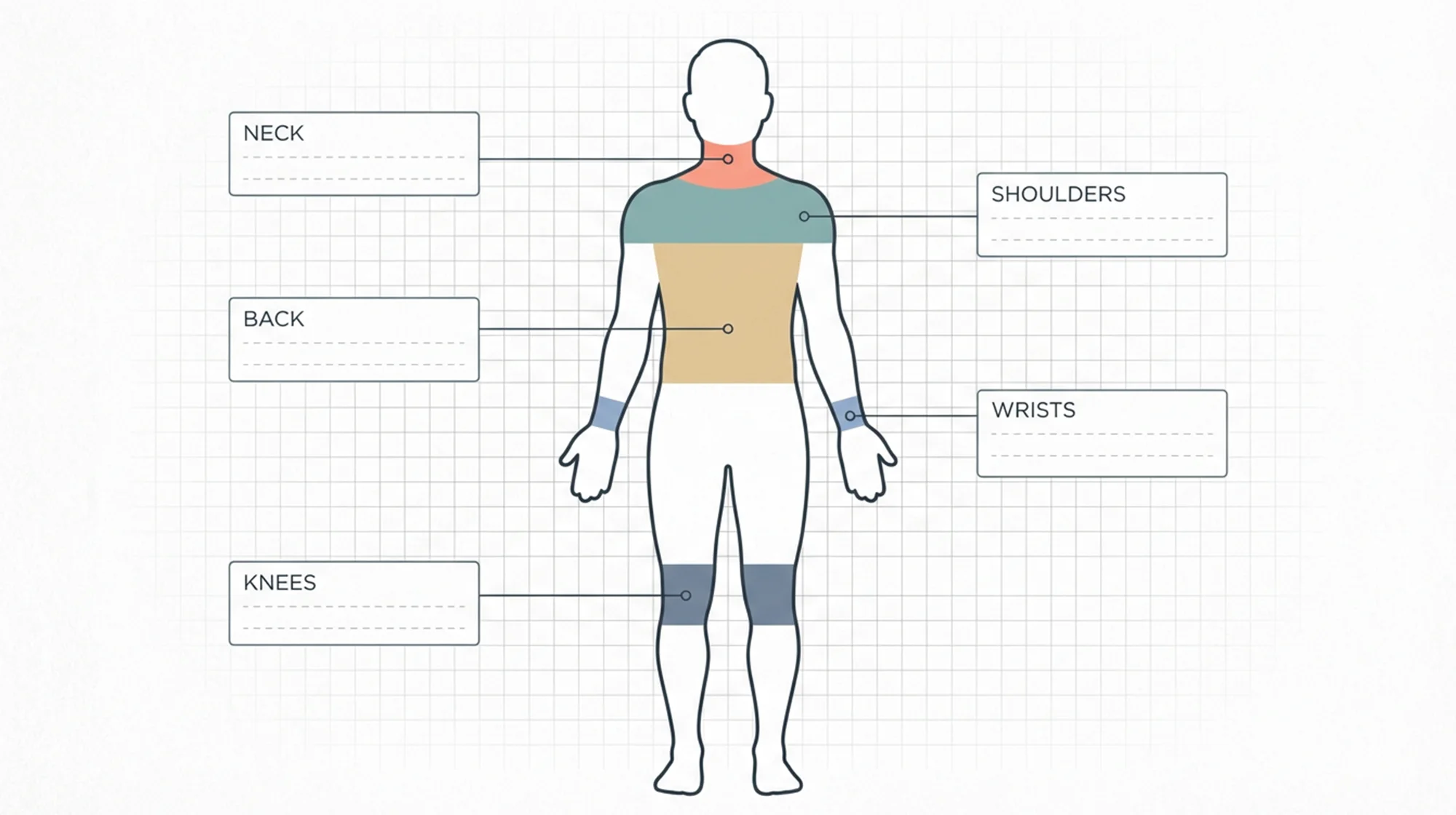
Fall accidents are at the top of the list. When a person falls — from a ladder, off a loading dock, on a wet floor — the body instinctively reacts in a split second. Hands go out to break the fall, resulting in wrist and shoulder strain. Knees absorb impact on landing. The head may strike a surface. The back takes a jolt from the sudden stop. And yet, the dominant pain signal in the hours immediately after is often just one of those — usually the back or the wrist — and that's what gets reported.
Work-related car accidents follow a similar pattern. A collision sends force through the entire body. Whiplash affects the neck and back together. Hands brace against the steering wheel. Knees hit the dashboard. All of this can occur in the same two seconds — but the injured worker may only report neck pain because that's what was most acute when emergency responders arrived.
If your work injury happened in either of these ways, I want you to slow down and think carefully about every part of your body before you describe the accident to a medical provider. Take a few minutes. Work from your head down to your feet. Note what hurts, what feels tight, what feels numb, what just feels off. All of it is relevant. All of it should be in the record.
The most important thing you can do in the immediate aftermath of a work injury is to give your treating provider a complete picture of your entire body — not just the parts that are screaming.
Before you speak to the doctor or nurse, take a breath and do a mental inventory. Start at your head and move downward. Does your neck feel stiff? Is there any tingling in your arms or hands? Any tightness in your chest? Does your back hurt in more than one place? What about your hips, your knees, your ankles? Did anything hit the ground? Did you brace yourself on anything?
Tell the provider everything — even the things that feel minor right now. A little soreness in the knee that you rate a "2 out of 10" today may become a genuine, debilitating injury within days or weeks. That mild discomfort is still a symptom of what happened to your body during the accident, and it belongs in the record from day one.
Every little discomfort can later become a full-fledged injury. If it isn't documented at the start, you will face an uphill battle to connect it to your work accident later — and in Maryland, where the law treats every body part as a separate claim, the stakes of that documentation gap are high.
Beyond the medical record, make sure the injury is formally reported to your employer in writing as soon as possible, including a description of all affected body parts. Keep a copy of everything.
If you've already filed a workers' compensation claim and you're now realizing that some of your injuries weren't fully documented in the initial report, don't panic — but don't wait.
The path forward depends on acting quickly. Your treating physician needs to document all additional injuries and clearly connect them to the original work accident. The language in the medical record matters enormously here: the physician must note that the additional body part complaints are causally related to the incident, not a separate issue.
If the insurance carrier refuses to authorize treatment for the additional body parts — and in my experience, they frequently will — that's where legal representation becomes critical. I have gone before the Maryland Workers' Compensation Commission many times to argue that a body part the insurer refused to recognize is, in fact, compensable. We present the medical evidence, the accident history, and the causal connection — and we fight for the full scope of what my client is owed.
The sooner you involve an attorney when this issue arises, the better positioned you are. Delays allow gaps in the record to widen and give the insurance carrier more time to build a defense against the additional claims.
If you've been hurt at work in Maryland and aren't sure whether your injuries have been fully documented, I encourage you to reach out. Contact me at SG Legal Group for a consultation. Every case is different, and I want to understand the full picture of what happened to you.
Disclaimer:
The information provided in this article is for general informational purposes only and does not constitute legal advice. Laws and regulations are subject to change, and individual circumstances vary. For advice specific to your situation, please consult with a qualified attorney.
Ioana David, Esq.
Stay informed with our latest articles and resources.