Immigration Law
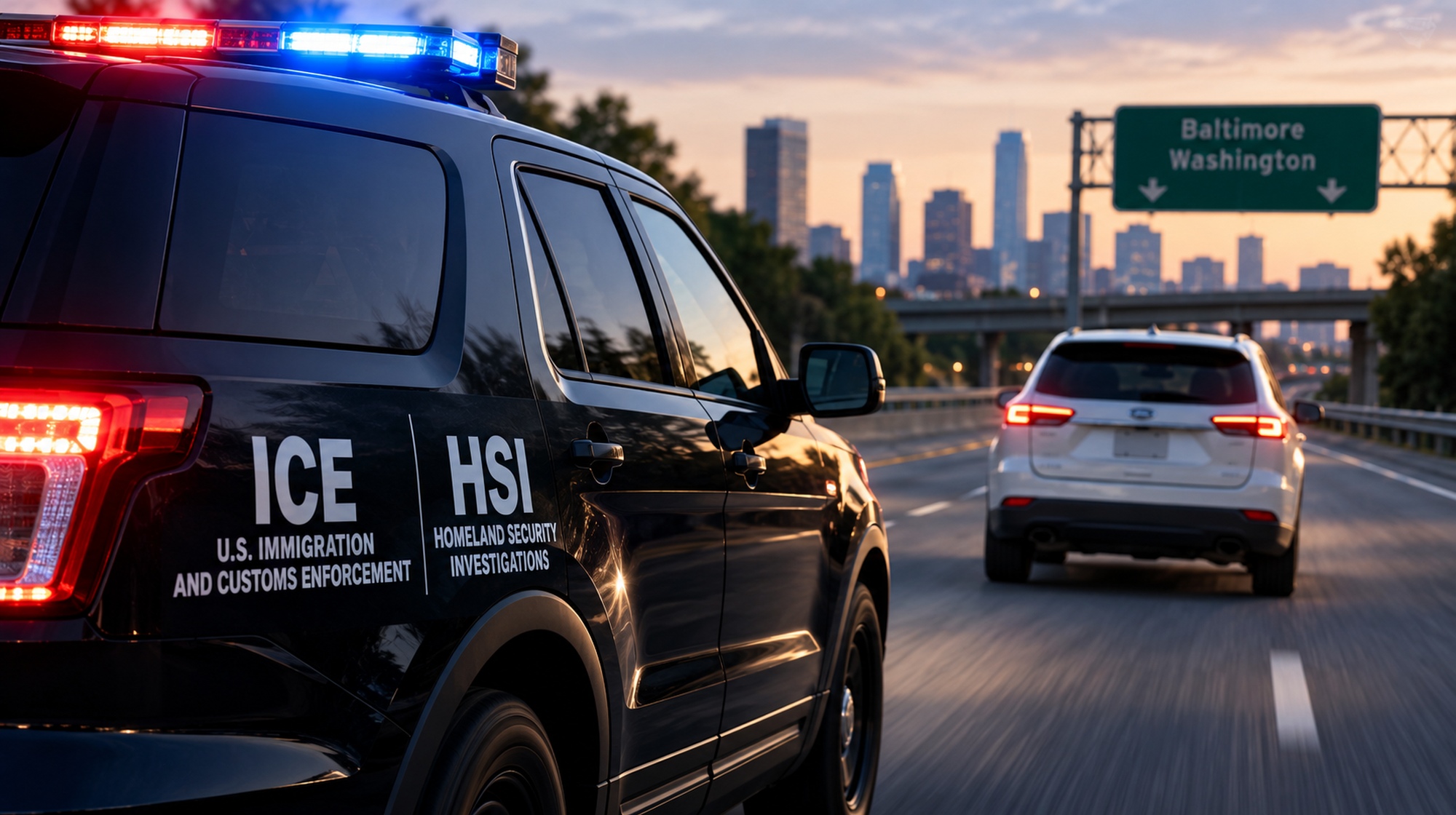
Short Answer: If you drive away when a Homeland Security Investigations (HSI) agent signals you to stop, the encounter becomes a "pursuit" under HSI's Emergency Driving Handbook (HSI HB 26-04, July 22, 2026), even without high speed. HSI agents may then chase the vehicle and, in appropriate circumstances, use tire-deflation devices, low-speed boxing in, and pinning. Ramming and PIT maneuvers are prohibited unless deadly force is justified. Agents must end a pursuit when its danger outweighs the need to continue. The handbook governs HSI only, not ICE ERO or CBP, and creates no enforceable rights.
Driving away from a federal immigration agent does not end the encounter. It changes the encounter into a vehicle pursuit, and the risks can escalate quickly from there.
Homeland Security Investigations is the investigative component of U.S. Immigration and Customs Enforcement (ICE). The HSI Emergency Driving Handbook (HSI HB 26-04) applies to HSI special agents and other HSI law-enforcement personnel when they engage in emergency driving while enforcing the law.
The handbook's coverage includes cross-designated task force officers acting under HSI authority. It was issued on July 22, 2026, and replaces HSI's previous emergency-driving handbook from May 2012.
The handbook does not govern ICE Enforcement and Removal Operations (ERO) officers or U.S. Customs and Border Protection (CBP) and Border Patrol agents. This article does not address the pursuit policies that apply to those officers.
The handbook is an internal HSI policy. It expressly says it does not create any right enforceable by anyone in an administrative, civil, or criminal matter. It also says it places no limits on ICE's otherwise lawful enforcement authority.
Under the HSI handbook, a pursuit begins when an agent tries to stop a motorist and the driver fails to comply and eludes the agent. A driver can elude the agent in any of these ways:
A pursuit therefore does not require a high-speed chase. A driver who simply keeps going at the same speed after being signaled to stop is already in a pursuit under HSI's definition.
Federal regulations separately address vehicular pursuits by immigration officers. Under 8 C.F.R. § 287.8(e), a vehicular pursuit is an active attempt by a designated immigration officer, in a vehicle equipped with emergency lights and siren, to apprehend fleeing suspects.
The regulation designates the officers who may initiate pursuits. They include Border Patrol agents, CBP officers, air and marine agents, their supervisors, and other immigration officers designated by agency leadership. All must have completed basic immigration law-enforcement training.
Yes. Under the HSI Emergency Driving Handbook, when an HSI agent tries to stop a vehicle and the driver refuses and tries to flee, the agent may choose to pursue it.
The decision is discretionary. Unless a supervisor directs otherwise, the individual agent decides whether to start, continue, or stop a pursuit.
Agents in a pursuit must activate their vehicle's lights and siren and notify a supervisor once it is safe to do so. Where state or local marked police vehicles are available and willing to help, the handbook says they should be allowed to take the lead.
Public safety is the overriding consideration under the HSI handbook. Agents should engage in emergency driving only when the seriousness of the emergency or suspected offense outweighs the risk of death or serious bodily injury the driving creates. They must keep reassessing that balance as conditions change.
Before and during any emergency driving, HSI agents must consider:
The last factor is significant. HSI's own policy directs agents to consider whether an arrest can happen some other way, such as later at a known address, without a chase on public roads.
The HSI handbook divides vehicle pursuits into two categories based on how the fleeing driver behaves.
A low-risk pursuit involves a vehicle that refuses to stop and tries to flee without excessive or dangerous speed or other hazardous moving violations. A high-risk pursuit involves a fleeing vehicle that uses excessive or dangerous speed or commits other hazardous moving violations.
A traffic stop or low-risk pursuit can become high-risk based on what the driver does. When that happens, agents must reassess. Factors that weigh toward continuing a high-risk pursuit include:
High-risk pursuits must also be formally reported within HSI. In practical terms, accelerating or driving dangerously escalates the encounter under HSI's own framework.
Yes. The HSI handbook allows trained agents to use approved tire-deflation devices, such as road spikes or stop sticks, either during a pursuit or as an alternative to one.
The devices may be used to stop automobiles and trucks. They may also be deployed on a stationary vehicle when agents can explain the threat it would pose if it started moving.
HSI agents may not use tire-deflation devices against motorcycles, three-wheeled vehicles, mopeds, or similar vehicles unless deadly force would be justified. The handbook also sets safety rules for deploying the devices and requires every deployment outside of training to be reported.
Yes, within limits. Under the HSI handbook, "boxing in" means multiple law-enforcement vehicles surrounding a suspect vehicle on all sides so it cannot move in any direction.
The handbook permits boxing in only at low speeds, after the agents weigh the safety factors listed above. The one exception is a response to an imminent threat of death or serious bodily injury.
HSI agents must seek supervisory approval and coordinate with the other officers involved. That approval may be given at the start of an operation. Outside of imminent-threat situations, HSI agents may box in a vehicle only during an HSI-led operation.
Yes. The HSI handbook authorizes agents to "pin" a vehicle, meaning they use government vehicles to hold a vehicle in place. The purpose is to prevent flight and to stop the vehicle from becoming a deadly threat to officers or the public.
Pinning is done through low-speed, controlled contact. The government vehicle touches the subject vehicle without striking or pushing it.
The handbook's preferred method uses vehicles at the front and rear, or pins the vehicle against a fixed object. The handbook states that pinning is generally not considered a use of force.
Agents may not attempt to pin a moving vehicle unless it is moving at an extremely slow speed. If the vehicle is not stationary, agents must weigh the added risk to everyone involved.
The HSI handbook is much more restrictive about ramming and the PIT (Precision Immobilization Technique) maneuver. A PIT maneuver is a technique in which the pursuing vehicle contacts the rear quarter panel of the fleeing vehicle, causing it to spin sideways and stop.
Under the 2026 handbook, HSI agents are prohibited from ramming or using a PIT maneuver to force a pursued vehicle to stop unless deadly force is justified under ICE's use-of-force policy. That prohibition does not extend to low-speed pinning.
The HSI handbook requires agents to end emergency driving immediately when any of the following occurs:
The handbook does not create a "pursue at all costs" policy. It requires a continuing balance between the law-enforcement objective and public safety.
Yes, if the specific elements of 18 U.S.C. § 758 are met. The statute makes it a federal crime to flee or evade a federal law-enforcement checkpoint in a motor vehicle and then flee federal, state, or local officers above the legal speed limit. The penalty is a fine, up to five years in prison, or both.
Section 758 has specific elements. Not every failure to stop immediately for an immigration officer violates it.
Other federal, state, or local laws may apply depending on what happens during an encounter. The HSI handbook itself lists among its legal authorities 18 U.S.C. § 111(a)(1), which covers assaulting, resisting, or impeding certain federal officers.
Do not try to solve a concern about your immigration status by speeding away or leading officers on a chase. Pull over safely when directed, and avoid sudden movements that officers could read as escalation.
What happens after the stop is a separate legal question. An officer's authority to question, detain, search, or arrest depends on the circumstances, and different rules apply at a checkpoint, during an investigative stop, and during an arrest. I cover those limits in What ICE Agents Can and Cannot Legally Do During Arrests.
No such conclusion follows from the HSI handbook itself. The handbook states that it is internal policy and creates no rights that any party can enforce in an administrative, civil, or criminal proceeding.
Whether an agent followed internal policy is a different question from whether the agent violated the Constitution, a federal statute, or a federal regulation. A policy violation does not, by itself, answer the constitutional or statutory question.
Policy violations still carry consequences inside the agency. The handbook states that agents have no blanket immunity for damages from emergency driving. Failing to drive with due regard for everyone's safety can lead to personnel action and possible legal liability for ICE, HSI, or the agents. Pursuits that cause injury or property damage must also be reported to ICE's Office of Professional Responsibility.
Enforcement encounters are frightening, especially for someone unsure of their immigration status. Fleeing in a vehicle, however, changes the nature of the encounter and exposes the driver, passengers, and bystanders to serious danger.
HSI's 2026 handbook allows agents to pursue fleeing vehicles and, depending on the circumstances, to use tire-deflation devices, boxing in, and pinning. The same policy requires agents to put public safety first and to end a pursuit when the danger outweighs the need.
If you are worried about your immigration status, whether because of an expired visa, an overstay, a pending application, or your eligibility for another benefit, the time to understand your options is before an encounter happens. Contact SG Legal Group to review your situation.
Disclaimer: The information provided in this article is for general informational purposes only and does not constitute legal advice. Immigration laws and policies are subject to change, and individual circumstances vary. For advice specific to your situation, please consult with a qualified immigration attorney.
Oleg Gherasimov, Esq.
Stay informed with our latest articles and resources.