Immigration Law
You checked the USCIS website. Your case has been pending longer than what they list as the normal processing time. Now what?
This is one of the most common questions I hear — from people waiting on green card applications, naturalization, I-751 renewals, and a range of other filings. The waiting is genuinely difficult, and the silence from USCIS makes it worse. What I want to do in this article is give you a clear picture of the options that exist once your case passes that threshold — what each one involves, what it realistically produces, and how they sequence together.
In my practice, the biggest mistake I see is not simply waiting too long — it is escalating in the wrong order, or relying on a remedy that sounds stronger than it actually is. What I can give you here is the framework. What I give clients in a consultation is the strategy.

Before anything else, it is worth understanding what the USCIS processing time estimate actually represents — because most people misread it.
USCIS publishes processing time estimates through its online tool at egov.uscis.gov/processing-times. These are not promises or deadlines. They are retrospective benchmarks — specifically, reflecting how long it took USCIS to complete 80% of similar cases over a recent six-month measurement period. The times are updated periodically, but they always reflect the past, not the present.
That means 20% of cases — often the more complex or administratively stuck ones — routinely fall outside that window, and USCIS treats that as within an acceptable range. Passing the posted time is meaningful, but it does not mean something has gone wrong with your specific case.
What most people get wrong: I regularly speak with clients who believe their case is delayed because a friend or family member received their result faster. That comparison is almost never useful. Processing times vary significantly by form type, case category, and — critically — which USCIS service center or field office is handling the file. Your I-485 at one field office may face a completely different timeline than someone else's I-485 at another. The only comparison that matters is your specific receipt date against the posted time for your exact form, your exact category, and your exact processing location.
Once you confirm that your case is genuinely outside the posted time for your form and office, you have crossed the threshold that unlocks the formal options below.
The first and most straightforward step is a formal USCIS service request — often submitted through the USCIS e-Request system or other USCIS customer-service channels — asking the agency to review why your case has not been decided.
Eligibility: USCIS will not meaningfully process a case inquiry until your case is actually outside the posted processing time for your specific form, category, and office. The processing times tool links the case inquiry date to when your case clears that threshold. Submitting one early typically generates an automated response telling you to wait.
What happens after you submit: The range of outcomes is wide. In some cases, the inquiry prompts a genuine review, a status update, or even interview scheduling. In many cases — probably more often than applicants would like — the response is a form letter confirming that the case is pending and under review. That is frustrating, but it is not without value: the inquiry creates a documented record that you asked, which matters if you escalate later.
Realistic expectations: A case inquiry is a low-cost first move, not a resolution mechanism. For cases sitting in a queue without substantive reason, it can sometimes prompt movement. For cases that are genuinely stuck on a substantive issue, the inquiry alone is unlikely to produce resolution. Think of it as a necessary first step before the more consequential options become available.
If you have researched delayed USCIS cases before, you have likely seen references to the CIS Ombudsman — an independent office Congress created under the Homeland Security Act of 2002 (6 U.S.C. § 272) to assist individuals and employers in resolving problems with USCIS. Historically, it served as a meaningful intermediate channel for delayed or mishandled cases, handling tens of thousands of individual case assistance requests annually.
That pathway changed dramatically in 2025.
On March 21, 2025, DHS issued reductions-in-force to most CIS Ombudsman staff, and litigation followed promptly. A coalition of state attorneys general challenged the closures as exceeding DHS's authority over a congressionally mandated office. DHS subsequently stated publicly that the office "continues to exist and will perform its statutorily required functions" — which means categorical statements about the office being fully abolished are not entirely accurate either.
The practical reality, however, is that the office's individual case-assistance capacity appears significantly reduced and far less dependable than it once was. Whether DHS Form 7001 submissions are being meaningfully processed is unclear. Practitioners should treat this pathway as uncertain and limited — not as a clearly available remedy, and not as a clearly dead one.
I am flagging this specifically because most articles on this subject — including content published on this website before this article — still reference the Ombudsman as a straightforward option. That is no longer accurate. Verify the current status of individual case assistance through the DHS website before relying on this pathway, and recognize that even if the submission mechanism is technically open, the office's capacity to act on requests is a separate and open question.
If the case inquiry has produced no meaningful response, and the Ombudsman pathway is uncertain, the congressional inquiry is the most reliable intermediate option currently available.
Here is how it works: you contact your U.S. Senator's or Representative's constituent services office directly and provide your case information. The office submits a formal inquiry to USCIS through the agency's Congressional Relations office. Unlike a private applicant's service request, USCIS is institutionally required to respond to congressional inquiries — and that institutional weight creates a meaningful difference.
What congressional inquiries can do: They bring formal attention to a stalled file. They create a documented record that the case has been flagged at the congressional level. In cases stuck in an administrative queue without substantive reason, they sometimes prompt movement.
What they cannot do: A congressional office has no authority to order USCIS to approve or prioritize a case. The inquiry does not override discretionary decisions or change where a case falls in a processing queue driven by actual complexity.
In practice, congressional inquiries may matter more now than they once did — because the Ombudsman route that historically sat alongside them is less predictable than it once was. With one intermediate remedy effectively diminished, the congressional inquiry carries more of the load between the initial service request and federal court.
Mandamus is a federal lawsuit asking a court to compel a government agency to perform a non-discretionary duty it has unreasonably delayed. In the immigration context, that duty is adjudication: USCIS has a legal obligation to decide your case. It has discretion over how it decides — approval or denial — but not over whether to decide at all. A mandamus action targets the failure to act, not the merits of the underlying case.
The legal basis: Mandamus actions in the immigration delay context are grounded in two federal statutes. The Mandamus Act, 28 U.S.C. § 1361, authorizes federal district courts to compel federal officials to perform duties owed to a petitioner. The Administrative Procedure Act, 5 U.S.C. §§ 555(b) and 706, separately requires agencies to conclude matters within a reasonable time and authorizes courts to compel agency action unlawfully withheld or unreasonably delayed. Immigration mandamus complaints typically invoke both.
How courts evaluate the claim: Federal courts assess whether a delay is legally unreasonable using a six-factor framework established in Telecommunications Research & Action Center v. FCC, 750 F.2d 70 (D.C. Cir. 1984) — known as the TRAC factors:
No single factor is dispositive. Courts weigh them in combination based on the specific record. A naturalization case benefits from a clear statutory framework — USCIS has a 120-day window to act after an interview under 8 U.S.C. § 1447(b) — which strengthens the applicant's position considerably. An adjustment of status case with no missed statutory deadline involves a more fact-intensive analysis.
What typically happens after a mandamus complaint is filed: USCIS frequently adjudicates the pending case shortly after litigation is initiated. Cases are often resolved — through agency action or settlement — before a court rules on the merits. In some instances, courts order adjudication within a fixed timeframe.
What mandamus does not guarantee: A favorable decision. Mandamus compels a decision — not an approval. If USCIS was sitting on a case with genuine evidentiary problems, it may respond to the lawsuit by denying the case it had been delaying. Case merits must be part of any evaluation before filing.
The real cost of this step: Mandamus involves federal litigation. The court filing fee is currently $405, absent any fee waiver or in forma pauperis relief. Attorney's fees vary by firm and case complexity. The process from complaint to resolution — even in the favorable scenario where USCIS acts quickly after service — takes weeks at minimum, often months. This is a serious escalation that requires careful evaluation, not a reflexive one.
My office does not handle mandamus litigation directly — that work requires attorneys with federal court litigation experience. But understanding when a case has reached the threshold where mandamus becomes appropriate is part of what I help clients assess.
If your USCIS case has passed the posted processing time and you want to understand where it stands and what your realistic options are, I'm here to help you think through it. Contact my office at 410-618-1288 or schedule a consultation online.
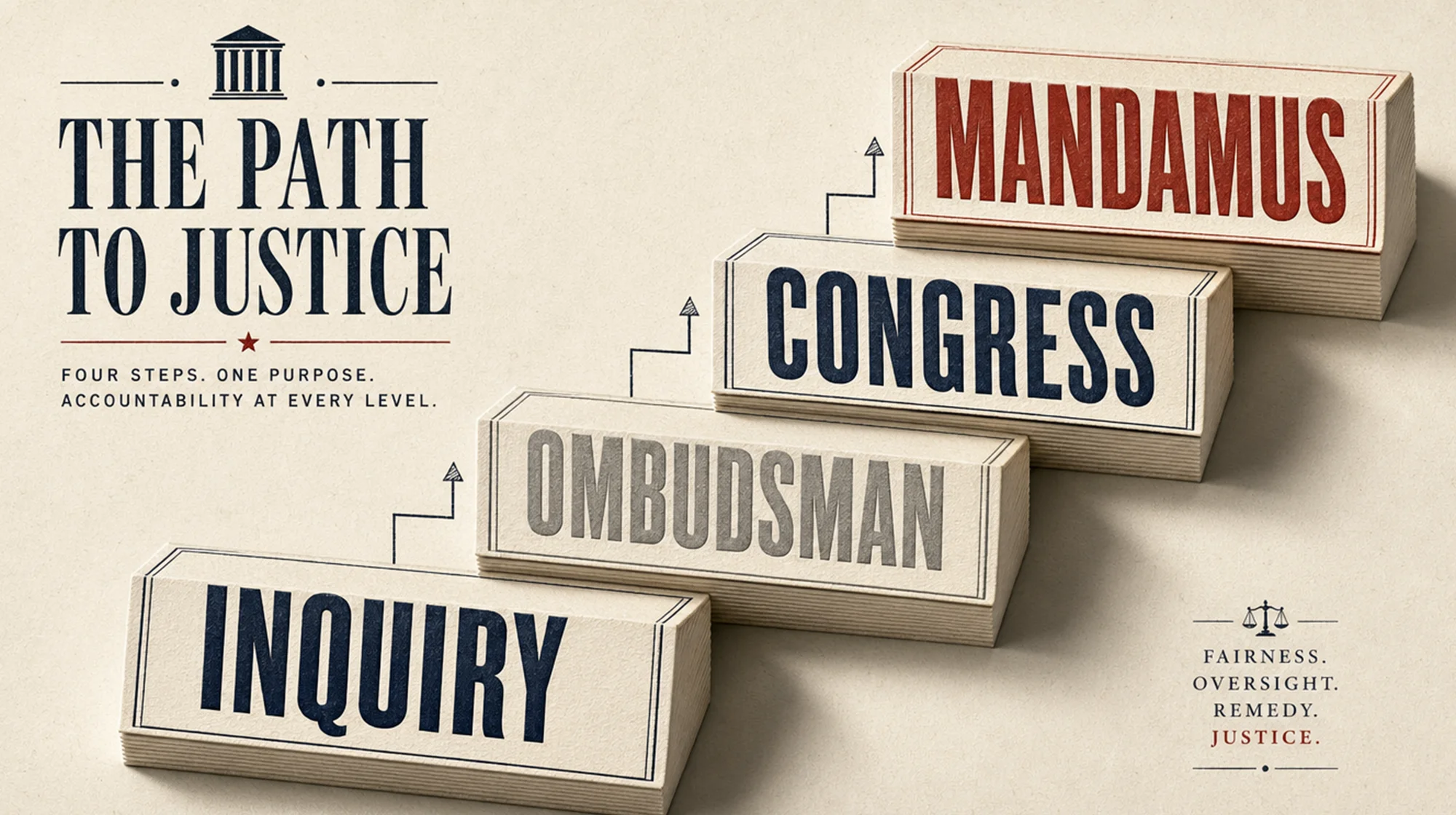
For cases delayed past the posted processing time, the logical escalation sequence runs as follows:
Step 1 — USCIS service request / e-Request. Once your case clears the posted processing time threshold, submit a formal inquiry through USCIS's e-Request system. Document it. Even if the response is a form letter, the record of that inquiry matters for what comes next.
Step 2 — CIS Ombudsman (with caveats). If your situation might benefit from an Ombudsman-style intervention, verify the office's current operational status before relying on it. The pathway is uncertain. It may still be technically available, but its practical reliability has been significantly diminished since March 2025.
Step 3 — Congressional inquiry. Contact your Senator's or Representative's constituent services office. This is currently the most dependable intermediate step between the initial service request and federal court.
Step 4 — Mandamus evaluation. If administrative remedies have been exhausted and the delay remains unreasonable, federal court action is the remaining option. This requires individual evaluation: how long the delay has been, what the case involves, what a court is likely to make of the TRAC factors given the specifics, and whether the underlying petition is strong enough to withstand a decision if USCIS is compelled to make one.
One practical note: these steps are not strictly sequential or mutually exclusive. A congressional inquiry can be pursued while a mandamus complaint is being evaluated or drafted. The sequence reflects escalating formality and cost — not a rigid requirement that each step fully exhaust before the next begins.
A separate note on expedite requests: An expedite request is a different track from this delay-escalation sequence. If your situation involves a genuine urgency — a work permit expiring, a severe financial loss, a documented medical need — an expedite request may be available independently. I cover that in detail in a separate article on how to expedite a USCIS case.
The right sequence and timing for a delayed case depend on the case itself: the form type, how far outside normal times it has gone, what the underlying record looks like, and what is at stake for the applicant. That judgment is what a consultation is for.
If your case is outside the posted processing time and you want to understand your options, reach out to my office.
410-618-1288
Disclaimer: The information provided in this article is for general informational purposes only and does not constitute legal advice. Immigration laws and policies are subject to change, and individual circumstances vary. For advice specific to your situation, please consult with a qualified immigration attorney.
Oleg Gherasimov, Esq.
Stay informed with our latest articles and resources.