Personal Injury
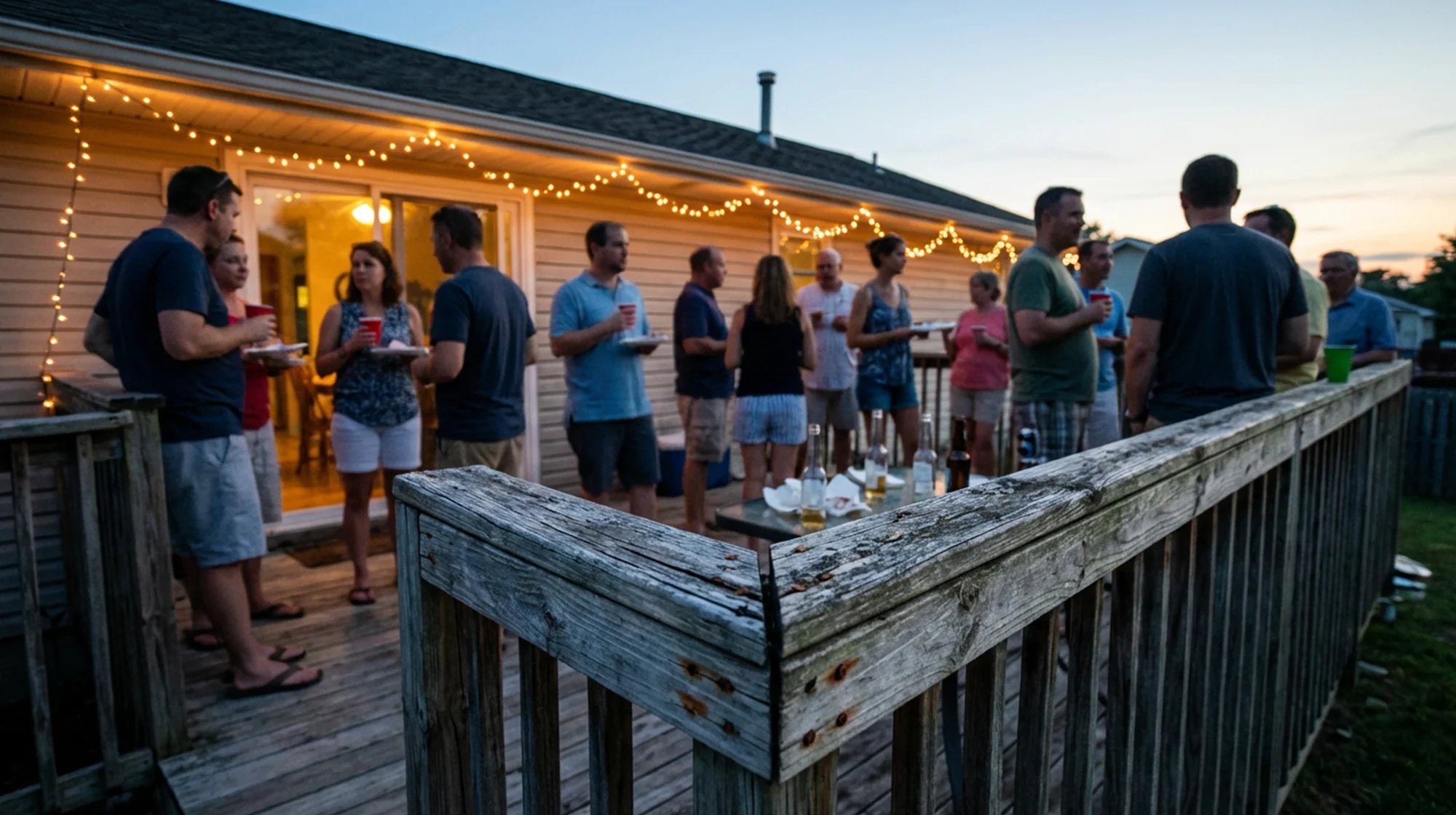
You invite your neighbors over for a Fourth of July cookout. The kids are running through the yard, adults are gathered on the deck, and your brother-in-law is heading back from the cooler when his foot drops into a groundhog hole hidden under the grass. He goes down hard — broken ankle, ambulance, surgery, six weeks off work.
Now comes the question nobody wanted to think about: who pays?
I handle cases like this regularly at SG Legal Group, and the answer is almost never as simple as people expect. Maryland has a set of legal rules around homeowner liability that can surprise both the injured guest and the homeowner. Some of those rules are genuinely protective. Others can feel deeply unfair, depending on which side of the injury you're standing on.
Here's what you need to know — whether you're the one who got hurt or the one who hosted the party.
This is the single most important thing to understand, and almost nobody knows it.
When you walk into a grocery store, you're what the law calls an "invitee." The store owes you the highest duty of care — they must actively inspect the premises, look for hidden dangers, and fix or warn about anything they find. That's why stores have those yellow "wet floor" signs.
When your friend comes to your house for dinner, they are not an invitee. Under Maryland law, a social guest is classified as a licensee by invitation — a legal category that carries a significantly lower duty of care.
The Maryland Court of Appeals (now the Supreme Court of Maryland) established this rule in Paquin v. McGinnis back in 1967, and it hasn't changed since. The court held that a homeowner's duty to a social guest boils down to three requirements. You must take the same care of your guest that you take of yourself and your own family. You must exercise reasonable care to make the premises safe, or warn the guest of known dangerous conditions that aren't reasonably discoverable. And the condition must be one the guest didn't actually know about.
That last part matters enormously. Unlike a store, you have no legal obligation to go out and inspect your property looking for hidden dangers before your guests arrive. Your liability is tied to what you actually knew — or should have known — about the hazard.
The court in Laser v. Wilson put it bluntly: Maryland has "turned a deaf ear" to suggestions that social guests should be treated the same as business visitors. And that distinction controls everything that happens after an injury at your home.
If you've been hurt on someone else's property and aren't sure where your situation falls, our premises liability page breaks down the basics of how these claims work in Maryland.
The specific danger that caused the injury matters because it determines whether the homeowner actually knew about it — which, as I just explained, is the threshold question under Maryland law.
Hidden Holes and Yard Defects
Groundhog burrows, old drainage pits, tree-root depressions, and soft spots covered by grass are the classic hidden hazard. They're invisible to the guest but often well-known to the homeowner who mows the lawn every week. When a guest steps into one and suffers a fracture or ligament tear, the Paquin test is directly in play: if you knew that hole was there and didn't fill it or warn your guests, you may be liable.
Decks, Porches, and Railings
This is the one that keeps me up at night, because the consequences can be catastrophic. Maryland has seen several serious deck collapses at gatherings. In 2019, a deck collapsed at a Germantown townhouse party that required roughly 100 people to be evaluated. In 2021, a deck failure in Ferndale injured eight people, including a two-year-old, with two adults transported to Shock Trauma.
The data backs up the concern. Industry estimates suggest more than 30 million decks nationwide are past their useful service life, and approximately 90 percent of collapses originate at the ledger board — the connection point where the deck attaches to the house. Maryland building code requires that connection be made with bolts or structural lag screws, never nails.
A homeowner who knows the deck wobbles, the boards are soft, or the railing is loose and then invites 20 people to crowd onto it has a real liability problem — and a code violation that will be used as evidence.
Icy Driveways and Walkways
Winter gatherings — Thanksgiving, holiday parties, Super Bowl Sundays — create a distinctive set of risks. Maryland applies a variation of what's called the natural accumulation rule, but it works differently depending on whether we're talking about a public sidewalk or your private driveway.
For public sidewalks, the homeowner generally owes no tort duty to pedestrians for natural snow and ice, even where a local ordinance requires you to shovel. Those ordinances are enforceable by the municipality, not by the person who slipped.
For your private walkway or driveway, the Paquin duty applies. If you knew about dangerous ice — especially the kind that's hard to see — and your guest fell on it, you may be liable. The strongest cases I see involve what lawyers call "artificial accumulations": ice formed from your downspout runoff, hose water, or melted-and-refrozen piles of snow you shoveled earlier.
Maryland courts have addressed this directly. In Poole v. Coakley & Williams Construction and Thomas v. Panco Management, the Court of Appeals made clear that assumption of risk cannot be applied automatically just because it's winter. The guest must have had actual knowledge of the specific hazard — not just a general awareness that it's cold outside.
Swimming Pools
Maryland doesn't recognize the attractive nuisance doctrine, which means a child trespasser who wanders into your unfenced pool generally cannot bring a successful claim. But a child you invited — your niece, your neighbor's kid at your pool party — absolutely can.
Pool fencing requirements in Maryland vary by county. Montgomery County requires a five-foot fence with self-closing, self-latching gates. Baltimore County requires 48 inches. Most jurisdictions follow the International Residential Code minimum of 48 inches with four-inch-or-less picket spacing. If your fence doesn't comply and a child is injured, that code violation becomes evidence of negligence.
The numbers here are sobering. Roughly 75 percent of child drowning fatalities involve children under five, and more than 80 percent occur in residential settings.
Trampolines
I'll be direct about this one: trampolines are a legal and insurance minefield. The American Academy of Pediatrics formally discourages home trampoline use, and roughly 100,000 trampoline-related ER visits occur annually nationwide. Three-quarters of injuries happen when multiple people are jumping at the same time.
The bigger issue for Maryland homeowners is that many homeowner's insurance policies exclude trampoline injuries entirely or require a special endorsement with safety netting. If your policy excludes trampolines and a guest's child is seriously hurt, you could be facing an uninsured personal liability claim. I'd encourage any homeowner with a trampoline to call their insurance agent before their next backyard gathering.
Dog Bites
Maryland has its own statutory framework for dog bite injuries under Courts & Judicial Proceedings § 3-1901, which went into effect in 2014. The law creates a rebuttable presumption that the owner knew about the dog's dangerous tendencies and imposes strict liability unless the owner can overcome that presumption. The statute applies regardless of breed.
This matters at gatherings because dogs that are perfectly calm in normal settings can become anxious, territorial, or aggressive when surrounded by unfamiliar people — especially children. The insurance data reflects this: dog bite claims accounted for roughly $1.86 billion in payouts in 2025, with average per-claim costs exceeding $65,000.
Here is where Maryland law takes a hard turn that surprises most people.
Maryland is one of only a handful of jurisdictions in the country that still follows pure contributory negligence. What this means in practice is stark: if the injured guest is found to be even one percent at fault for their own injury, they recover nothing. Not reduced damages. Nothing.
I've written about how contributory negligence intersects with premises liability claims in detail before, so I won't repeat the full analysis here. But in the context of a homeowner hosting a gathering, you need to understand how insurance companies use this rule.
The adjuster handling your friend's claim will look for any evidence that the guest contributed to their own injury. Were they looking at their phone when they stepped in the hole? Had they been to your house before and might have known about the icy patch? Were they wearing inappropriate shoes? Had they been drinking?
Because any of those findings can destroy the claim entirely under Maryland law, insurers frequently deny claims outright or offer token settlements. I've seen adjusters argue that a guest who had visited the property twice before "should have known" about a broken step — even though the guest had never used that particular entrance.
This is exactly why I tell injured guests: do not give a recorded statement to the homeowner's insurance company before speaking with an attorney. Anything you say about your own actions will be analyzed for contributory negligence, and offhand comments like "I probably should have been more careful" can be used to justify a denial. If you've been injured and are facing pushback from an insurance company, contact me directly — this is something I deal with constantly.
There are limited exceptions. The last clear chance doctrine can sometimes rescue a claim when the homeowner had a final opportunity to prevent the injury and failed to act. But this exception is narrow and rarely applies in premises liability cases.
Most Maryland homeowners assume their insurance will handle everything if a guest gets hurt. That assumption has some truth to it — but the gaps can be significant.
The Two Types of Coverage That Matter
Coverage E (Personal Liability) pays when you are found legally liable for a guest's injury. Standard limits range from $100,000 to $500,000. If your guest suffers a serious injury — a traumatic brain injury from a deck collapse, a spinal cord injury from an icy fall — those limits can be exhausted quickly. Industry data shows that the average liability claim on a homeowner's policy runs between $30,000 and $37,000, but catastrophic injuries can exceed policy limits by multiples.
Coverage F (Medical Payments to Others) is the one most homeowners don't know about. Often called "MedPay," this coverage pays your guest's medical bills regardless of who was at fault — typically between $1,000 and $5,000, though some policies go up to $25,000. In a contributory negligence state like Maryland, MedPay is enormously valuable for smaller injuries because it sidesteps the fault question entirely.
Exclusions That Can Leave You Exposed
Not everything is covered, and the exclusions tend to hit exactly the scenarios I've been describing. Common exclusions include injuries from trampolines (often excluded entirely or requiring a special endorsement), injuries involving certain dog breeds, unfenced swimming pools, and injuries arising from business activities on the property. Intentional acts are never covered.
The practical takeaway: before your next big gathering, review your policy or call your agent. Confirm your liability limits, ask about trampoline and pool exclusions, and consider whether an umbrella policy — which typically adds $1 million to $5 million in coverage — makes sense for your situation.
This comes up every holiday season: can you be liable if you serve alcohol at your party and a guest injures someone on the way home?
For adult guests, the answer in Maryland is largely no. The Court of Appeals declined to impose social host liability in Warr v. JMGM Group in 2013, and that holding has not been overturned.
But there is a critical exception. Under Kiriakos v. Phillips (2016) and Maryland Criminal Law § 10-117(b) — known as "Alex and Calvin's Law" — an adult who knowingly permits an underage person to consume alcohol on their property can face both civil liability and criminal penalties if that minor causes injury. This is not a gray area. If you are hosting a party where teenagers might have access to alcohol, you need to take affirmative steps to prevent underage drinking. The consequences are severe, and many insurance policies will deny coverage for claims arising from criminal conduct.
Maryland law doesn't require you to hire an inspector before a cookout. But the Paquin standard — treat your guests with the same care you'd give yourself and your family — creates practical expectations. A quick walkthrough before guests arrive can prevent both injuries and lawsuits.
Walk the yard and fill or flag any holes, depressions, or soft spots. Test every handrail and railing by hand — if it wobbles, either fix it or block access. Inspect your deck for rot, loose boards, and rust at the connection points. Replace burned-out exterior bulbs and add path lighting for evening events. In winter, shovel and pre-treat with ice melt well before guests arrive, and keep a bag near the door for touch-ups. If you have a pool, verify that fencing, gate latches, and alarms are functional. Tape down extension cords and secure loose rugs inside the house. Confine your dog in a separate area, especially if children will be present.
And if there's a hazard you can't fix in time, say something. A verbal warning — "watch the third step, it's loose" — is legally significant under Paquin. The homeowner who warns has met the duty. The homeowner who stays silent has not.
Under Maryland Code, Courts & Judicial Proceedings § 5-101, you have three years from the date of injury to file a premises liability claim. For wrongful death, it's three years from the date of death under § 3-904. I've written a full guide to Maryland's statute of limitations that covers the nuances, including tolling exceptions.
Three years sounds like plenty of time, but evidence disappears fast. The homeowner fills the hole. The deck gets repaired. The ice melts. If you've been injured at someone's home, documenting the scene — photos of the hazard, the lighting conditions, your shoes, the exact location — is critical. And reaching out to an attorney sooner rather than later ensures that evidence is preserved before it's gone.
Not every injury at a friend's house requires a lawyer. If the medical bills are small and the homeowner's MedPay covers them, you may be able to resolve things without legal involvement.
But if the injury is serious — a fracture, a surgery, a head injury, a period of lost wages — the dynamics change. The homeowner's insurance company is not on your side. Their job is to minimize what they pay, and in Maryland, contributory negligence gives them a uniquely powerful tool to deny your claim entirely.
I've spent my career representing people who've been hurt through no fault of their own and then told by an insurance adjuster that they don't deserve compensation. If that's where you are — or if you're a homeowner facing a claim and aren't sure what your obligations are — I'm here to help. Every situation is different, and a conversation costs you nothing.
Reach out to me directly or call my office at 410-618-1277. I'll give you an honest assessment of where you stand.

Disclaimer: The information provided in this article is for general informational purposes only and does not constitute legal advice. Laws and regulations are subject to change, and individual circumstances vary. For advice specific to your situation, please consult with a qualified attorney.
Joshua C. Sussex, Esq.
Stay informed with our latest articles and resources.