Immigration Law

The U.S. Department of State (DOS) has issued updated guidance that significantly affects where nonimmigrant visa (NIV) applicants should schedule their visa interviews. Although this change does not amend the governing regulations, it represents a clear policy shift that may limit third-country national (TCN) visa processing at many U.S. embassies and consulates worldwide. Understanding what this guidance does—and does not—do is essential for anyone planning to apply for a U.S. nonimmigrant visa outside their country of nationality. This nonimmigrant visa policy update should also be viewed alongside the Department of State’s subsequent guidance affecting immigrant visa applicants, which we discuss in detail in our related article, “Immigrant Visa Applicants Must Interview in Their Country of Residence or Nationality: DOS Policy Update Explained.” Together, these policies reflect a coordinated shift by DOS toward requiring visa interviews to occur in an applicant’s country of residence or nationality and significantly reducing the availability of third-country consular processing across visa categories.
Watch The Video Overview
On September 6, 2025, DOS updated its public guidance to state that:
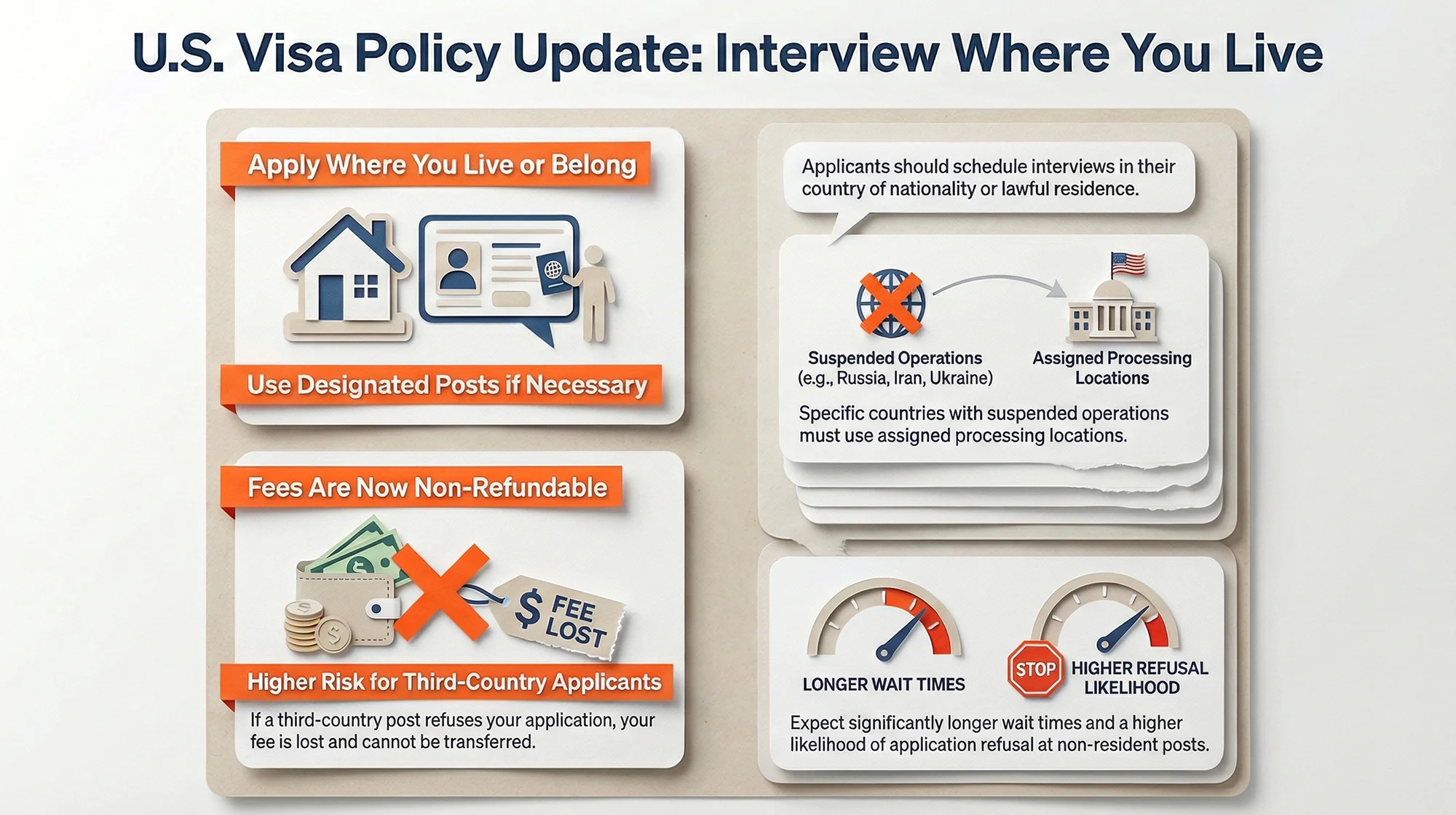
Applicants for U.S. nonimmigrant visas should schedule their visa interview appointments at the U.S. Embassy or Consulate in their country of nationality or residence.
DOS further clarified that nationals of countries where the U.S. government is not conducting routine nonimmigrant visa operations must apply at a designated processing post, unless they can demonstrate residence elsewhere.
While DOS used the word “should” rather than “must,” this guidance signals a strong policy preference and marks a notable departure from the more flexible third-country national processing that developed during and after the COVID-19 pandemic.
On December 12, 2025, DOS updated the list of designated posts for nationals of certain countries. As of that date, the designated locations include:
For applicants from these countries, applying at a different post—absent lawful residence elsewhere—may no longer be feasible in practice.
Residence Requirements
Applicants who apply based on residence rather than nationality must be able to demonstrate lawful residence in the country where they are applying. This may include evidence such as long-term visas, residence permits, or other documentation showing more than a temporary presence.
Fees Are Non-Refundable
If an applicant schedules a nonimmigrant visa interview outside their country of nationality or residence and the post declines to accept or adjudicate the application:
Appointment Availability
Applicants attempting to apply outside their country of nationality or residence should expect:
Existing Appointments
DOS has indicated that existing appointments will generally not be cancelled, though post-specific practices may vary.
This policy does not apply to:
Rare exceptions may also be made for humanitarian emergencies, medical necessity, or foreign-policy reasons, though such exceptions are discretionary and uncommon.
Despite the September 2025 guidance, the underlying regulatory framework remains unchanged.
22 CFR § 41.101
This regulation generally requires applicants to apply in:
However, it expressly grants consular discretion to accept applications from non-residents.
As of September 2025, the Foreign Affairs Manual continues to authorize acceptance of third-country national applicants:
Consular officers have discretion to accept or refuse NIV applications from applicants who are physically present but not resident in the consular district.
Although DOS has not yet updated this section of the FAM, future revisions are expected to align more closely with the new policy guidance.
Historically, posts such as those in Canada, Mexico, and parts of Europe developed separate appointment systems for TCN applicants. The September 6 announcement does not eliminate consular authority to accept such cases, but it clearly communicates that DOS prefers applicants to interview in their country of nationality or residence.
Some posts have reportedly paused or limited acceptance of TCN applications while awaiting further guidance. Others may continue to accept them but treat non-resident status as a negative discretionary factor, particularly in assessing whether an applicant can overcome the presumption of immigrant intent under INA § 214(b).
Importantly, the policy does not prohibit visa issuance to third-country nationals. Rather, it increases procedural and discretionary risk—often before an interview even occurs.
Key Takeaways for Nonimmigrant Visa Applicants
For years, many applicants relied on third-country visa processing as a workaround for long wait times or suspended operations. That option is now far less predictable. While consular discretion technically remains, the direction from DOS is clear: nonimmigrant visa applicants are expected to apply in their country of nationality or lawful residence whenever possible.
If you need experienced legal guidance for your immigration case, contact me at SG Legal Group. My team and I will help you evaluate consular strategy, minimize risk, and navigate the nonimmigrant visa process with clarity and confidence. Consultations are available in English, Russian, or Romanian. Call 410-618-1288 or visit our Contact page to schedule a consultation.
This article provides general information and is not legal advice. For advice specific to your situation, please contact me directly.
Oleg Gherasimov, Esq.
Stay informed with our latest articles and resources.


