Immigration Law
The K-1 visa approval feels like the finish line. I understand why — getting that visa stamped in your fiancé's passport is the result of months of waiting, paperwork, and uncertainty. But in my practice, I've found that the period after your fiancé arrives in the United States is where the real legal work begins — and where the most consequential mistakes are made.
The K-1 visa to green card timeline involves an entirely separate process called Adjustment of Status (AOS). It has its own forms, its own fees, its own evidentiary standards, and its own interview. Couples who treat the visa approval as the end of the process often find themselves scrambling to fix problems they didn't know they were creating.
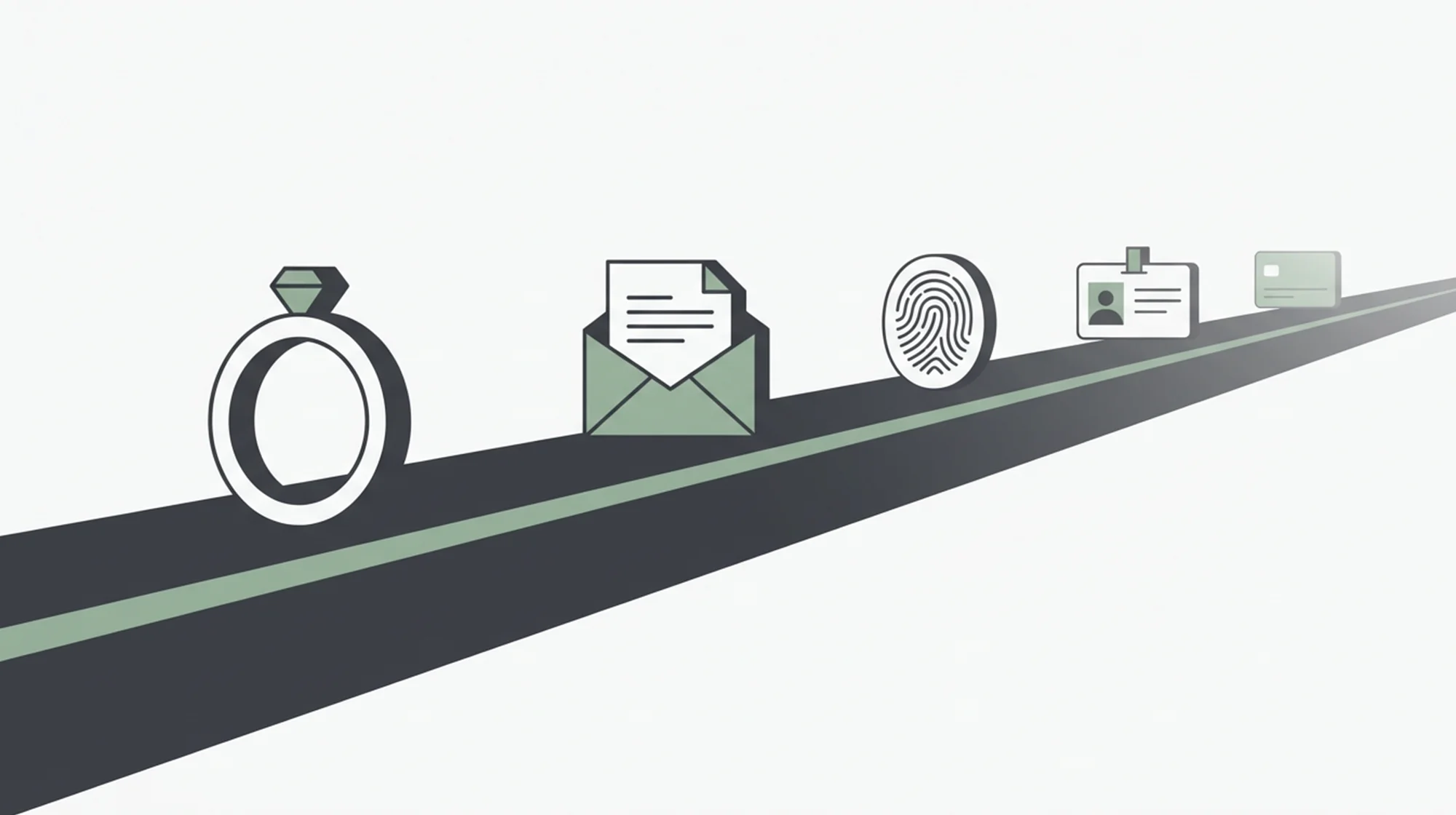
This article walks you through every stage of that journey — from the moment your fiancé lands at the airport to the day the green card arrives in the mail. I'll share the misconceptions I see most often, the mistakes that trigger delays, and what you need to know about navigating this process in 2026.

Let me address this upfront because it's the single most dangerous misconception I encounter.
Most couples understand that the K-1 visa comes with a 90-day rule: you must get married within 90 days of your fiancé's arrival in the United States. What they don't understand is that the 90-day marriage deadline and any kind of filing deadline are two completely different legal hurdles — and confusing them can leave your spouse in a genuinely precarious legal position.
Here's how it actually works:
Many couples treat the 90 days as a grace period for the entire process. They get married on day 45, breathe a sigh of relief, and assume they have months to figure out the paperwork. Legally, that's not how it works.
On day 91, your spouse's K-1 visa expires — full stop. Even if you're happily married and have a beautiful wedding album to prove it, your spouse technically has no valid immigration status in the United States until USCIS physically receives the Form I-485 (Adjustment of Status application). Being married to a U.S. citizen does not automatically grant "authorized stay." Only a pending I-485 does.
There's a legal protection that softens this somewhat: immediate relatives of U.S. citizens — which includes your spouse — are generally forgiven for brief periods of unlawful presence under INA § 245(c)(2), and USCIS can exercise favorable discretion at the green card interview even if there was a short gap. But "generally forgiven" is not the same as "zero consequences." A spouse with no pending application cannot legally obtain a Social Security Number, cannot get a driver's license in most states, and is technically vulnerable to enforcement action. The practical and legal risks of unnecessary delay are real.
My strong advice: file the I-485 packet as soon as reasonably possible after the wedding. Don't wait for the right moment. The right moment is now.
Once you're married, the Adjustment of Status process begins. This is the mechanism by which your foreign spouse — who entered the U.S. on a temporary visa — converts to Lawful Permanent Resident status without leaving the country. Understanding what you're actually filing, and why each piece matters, prevents the kind of technical errors that cause rejections.
A complete AOS packet for a K-1 entrant includes several interconnected forms:
Form I-485 is the core application — the formal request for permanent residence. Form I-864 (Affidavit of Support) is a legally binding financial contract in which you, as the U.S. citizen sponsor, demonstrate that your income meets or exceeds 125% of the Federal Poverty Guidelines for your household size. This isn't just a form — it's an enforceable obligation. If your income falls short, a qualified joint sponsor will need to sign their own I-864 as well.
Form I-765 (Employment Authorization) and Form I-131 (Advance Parole/Travel Document) are filed concurrently with the I-485 and are arguably the most urgently important documents for your spouse's day-to-day life. The I-765 results in an Employment Authorization Document (EAD) — without it, your spouse cannot legally work in the United States. The I-131 results in Advance Parole — without it, your spouse cannot leave the country and return without abandoning the entire green card application.
Form I-693 (Medical Examination) must be completed and sealed by a USCIS-designated civil surgeon — not just any physician. A medical exam completed by a non-designated doctor is summarily rejected.
The 2026 Fee Reality
One thing that genuinely surprises couples in 2026 is the cost. Historically, the fees for the I-765 and I-131 were bundled into the I-485 filing fee. That is no longer the case. USCIS has decoupled these fees entirely, meaning each form now carries its own separate cost.
Here's the current breakdown:
The minimum government filing fees for the AOS phase alone — I-485 plus the concurrent forms — will typically exceed $2,000 for an adult applicant before accounting for medical costs and legal fees. Budget accordingly and check the current USCIS fee schedule immediately before filing, as fees are subject to ongoing legislative adjustments.
For guidance on the green card process and what to expect at each stage, visit our Family-Based Green Cards page.
Here's something that catches many couples off guard: you already proved your relationship was genuine to get the K-1 visa approved. At the consular interview, you submitted photos, correspondence, and evidence of your meetings. You thought that chapter was closed.
It isn't. USCIS requires you to prove the marriage is genuine — at a higher evidentiary standard — during the Adjustment of Status phase. And a marriage certificate alone is woefully insufficient.
In my experience, the most common reason K-1 AOS applications receive a Request for Evidence (RFE) is a sparse bona fides package: a marriage certificate, a handful of wedding photos, and maybe some printed chat logs. USCIS sees this and raises a flag. They're not looking for proof that a wedding ceremony occurred — they're looking for proof that two people have built a genuinely shared life.
What High-Value Evidence Actually Looks Like
The evidence that carries the most weight with adjudicators demonstrates deep financial and residential integration. This includes:
Secondary evidence — photographs, travel records together, affidavits from friends and family — supports the narrative but does not substitute for the financial documentation above. If your packet is light on commingled finances and heavy on photographs, expect an RFE.
The practical lesson: start building this evidence immediately after the wedding. Open a joint bank account the week you return from the honeymoon. Add your spouse to your lease, your car insurance, your health insurance. Don't wait until it's time to file — by then, the paper trail will be thin, and USCIS will notice.
This is the question I hear most often, and I'll give you an honest answer: it depends, it varies, and 2026 processing times reflect a mixed picture. Here's what the current data shows for each stage after your fiancé's arrival:
The most important early milestone for most couples is the EAD. Until the Employment Authorization Document arrives, your spouse cannot legally work in the United States. This is often the most stressful waiting period — and it's why filing the I-765 concurrently with the I-485 from day one is so important.
Total timeline from arrival to green card approval: realistically, 12 to 24 months in most cases, depending on your local USCIS Field Office's workload and any RFEs or complications. Couples who file promptly, submit a complete and well-documented packet, and prepare thoroughly for the interview tend to come in at the lower end of that range.
For a complete breakdown of the pre-arrival K-1 stages and the petition timeline, see my earlier post on the K-1 Visa Processing Time and Timeline.
I've worked through enough of these cases to know where things go wrong. These are the three mistakes I see most consistently — and every one of them is avoidable.
I covered the legal mechanics of this above, but the practical consequences are worth spelling out. A spouse without a pending I-485 cannot get a Social Security Number. In most states, they cannot get a driver's license. They have no documentation to show an employer, a landlord, or a bank. They exist in a genuine legal limbo — married to a U.S. citizen, but without any of the rights or documentation that should come with that.
Beyond the day-to-day inconvenience, unnecessary delay can also complicate the future naturalization process, which requires demonstrating a clean and consistent immigration history. File as soon as you reasonably can after the wedding. There's no strategic advantage to waiting.
This is the mistake that causes the most acute crises in my practice. The K-1 visa is a single-entry visa. Once your fiancé has entered the United States, that visa is spent. If they leave the country before receiving Advance Parole — the travel document issued through Form I-131 — USCIS treats the departure as an abandonment of the pending I-485 application. The application is effectively terminated. Re-entry may be barred.
Emergencies happen. Family events happen. I understand that the impulse to travel home for a wedding or a sick relative's bedside is entirely human. But the legal consequence is severe and often irreversible. Do not leave the United States with a pending I-485 unless you have an approved Advance Parole document in hand. If a genuine emergency arises before AP is approved, contact an immigration attorney immediately — there are emergency options, but they require immediate action.
Many couples assume that remote work for a foreign employer — work performed for a company outside the U.S., paid in foreign currency — is legally permissible while the AOS is pending. It is not. Any work performed on U.S. soil, regardless of who the employer is or where the paycheck originates, constitutes employment under U.S. law. Without an EAD, it is unauthorized employment.
USCIS takes unauthorized employment seriously. It can trigger a mandatory interview, generate an RFE, and in some cases become a ground of inadmissibility that must be addressed before the green card can be approved. Wait for the EAD. It typically arrives well before the interview, and the wait — frustrating as it is — is far less costly than the alternative.
The interview is the final gatekeeping stage of the K-1 visa to green card timeline. It takes place at your local USCIS Field Office — in the Baltimore/Maryland region, that's the George H. Fallon Federal Building at 31 Hopkins Plaza in downtown Baltimore. The interview is a credibility examination: the officer is evaluating the genuine nature of your marriage and confirming that no grounds of inadmissibility have been overlooked.
In 2026, I've observed that officers are conducting increasingly detailed and at times aggressive questioning. The days of a quick 15-minute review are behind us. Officers are going deep into the specifics of daily life together — your morning routines, your household finances, your sleeping arrangements, the layout of your home. I've heard of officers asking questions as granular as what color each spouse's toothbrush is, or who takes out the trash.
A typical interview covers four broad areas:
Identity and biographic basics — confirming legal names, dates of birth, current shared address, and reviewing original civil documents in person.
Immigration and legal history — probing for prior visa violations, unauthorized stays, previous marriages, or any criminal history that could affect admissibility.
Relationship origins — testing the consistency of the couple's narrative. How did you meet? When did you decide to get engaged? How do you communicate with each other's families? Officers are skilled at identifying rehearsed answers versus genuine recollection.
Daily life and finances — the area where couples who haven't truly built a shared life are most exposed. Shared household expenses, bank accounts, grocery habits, who pays which bills — the officer wants to see that the marriage exists in practical reality, not just on paper.
If an officer has significant doubts, they may escalate to a "Stokes interview" — where the spouses are separated into different rooms and asked identical questions independently. Discrepancies between the answers become evidence of fraud. Couples who have genuinely commingled their lives rarely struggle here. The goal of thorough preparation is simply to make sure you can articulate the life you're already living.
If you want to go into your interview fully prepared — knowing what to bring, what to expect, and how to respond to the toughest questions — I work with couples throughout this entire process. Reach out to discuss your case.
When the interview goes well and the officer approves the case, your spouse receives a green card — but there's one more thing to understand before you truly exhale.
Because K-1 marriages are always less than two years old at the time of green card approval, the card is issued on a conditional basis. It is valid for only two years. Your spouse is a lawful permanent resident, but their status comes with an expiration date.
To remove those conditions and receive a full, 10-year permanent green card, you must file Form I-751, Petition to Remove Conditions on Residence, during the 90-day window immediately before the conditional green card expires. This filing requires — you guessed it — another round of bona fide marriage evidence. USCIS wants to see that the relationship is ongoing, genuine, and still intact.
Miss the I-751 filing window and the conditional green card expires, leaving your spouse without valid status. Mark the expiration date on your calendar the moment the card arrives, and start building your I-751 evidence package well in advance.
The I-751 is a topic that deserves its own article — and I'll cover it in depth separately. For now, the key takeaway is that getting the initial green card approved is a major milestone, but the work is not entirely over until the 10-year card is in hand.
The K-1 visa to green card timeline is a demanding, multi-stage process that extends long after the wedding day. In 2026, it comes with higher costs, more aggressive interviews, and a bureaucratic environment that penalizes incomplete applications and punishes unnecessary delays.
The couples who navigate it most successfully share a few things in common: they file promptly, they build a genuine and well-documented shared life from day one, they understand what they can and cannot do while the application is pending, and they go into the interview prepared rather than hopeful.
If you're at any stage of this process and you're not sure whether you're on the right track, I'm happy to take a look at your situation. Contact me at SG Legal Group to schedule a consultation — available in English, Russian, and Romanian.
Disclaimer: The information provided in this article is for general informational purposes only and does not constitute legal advice. Immigration laws and policies are subject to change, and individual circumstances vary. For advice specific to your situation, please consult with a qualified immigration attorney.
Oleg Gherasimov, Esq.
Stay informed with our latest articles and resources.