Immigration Law
You filed your immigration application. You have your receipt number. You've checked the USCIS website so many times the page practically loads itself. But the status hasn't changed, the processing timeline seems off, and you're not sure whether to worry.
This is something I walk clients through regularly. And in my practice, I often see cases delayed not because something went wrong, but because applicants are relying on incomplete or misleading information from the USCIS tools themselves. The tools exist — they just require you to know how to read them correctly.
This article explains exactly how USCIS case status and processing times actually work, where most applicants go wrong, and what your options are when a case genuinely stalls.

Before we get into mechanics, let me name the error I see most often:
Applicants select the wrong processing office when checking timeline estimates — specifically, selecting "Service Center Operations" for a case that will ultimately be decided at a field office, or vice versa. The result is a completely inaccurate baseline. You're measuring your wait time against the wrong yardstick, and everything that follows is off.
Understanding which office is handling your case — and why — is the prerequisite to reading anything else correctly.
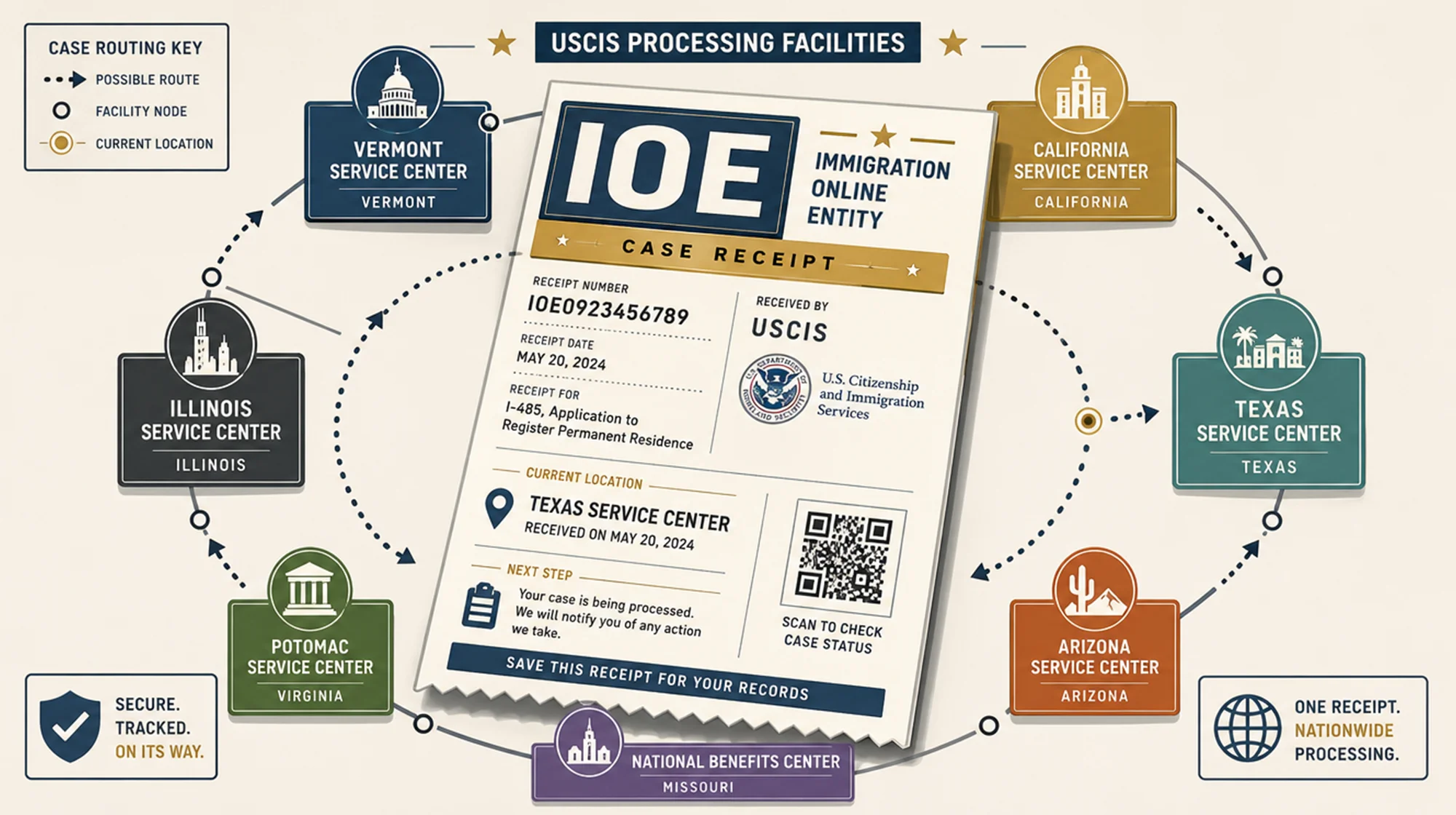
Most people think of USCIS as a single operation. It isn't. It's a network of different facilities with distinct roles, and your case may travel through more than one of them before a decision is made.
The three main players are service centers, the National Benefits Center (NBC), and field offices. Knowing which one has your file — and what role it plays — is essential to interpreting your case status accurately.
Service Centers
USCIS operates several service centers that handle initial adjudication for a wide range of petitions and applications — particularly employment-based cases, certain nonimmigrant petitions, and applications that don't require an in-person interview. If your case begins and ends at a service center, the processing time tool is relatively straightforward to use.
The National Benefits Center
The NBC, located in Lee's Summit, Missouri, is a centralized pre-processing hub. It doesn't hold final interviews or issue final decisions. Its job is to intake and prepare cases — running background checks, reviewing initial evidence, scheduling biometrics, and organizing files — before transferring them to the appropriate local field office for the interview and final adjudication.
If you filed an I-485 adjustment of status application, there's a strong chance the NBC touched your file first. That MSC or IOE receipt number you received? That's often a sign you're in the NBC pipeline.
Field Offices
USCIS operates field offices nationwide where interviews take place and many final decisions are made. The processing time at a field office is driven by local staffing, interview scheduling capacity, and caseload — none of which is reflected in service center processing data. If your case requires an interview, the field office timeline is the one that matters most to you.
The three-letter prefix on your USCIS receipt number tells you something about where your case entered the system. Common prefixes include EAC (Eastern Adjudication Center, i.e., Vermont Service Center), WAC (Western Adjudication Center, i.e., California), LIN (Nebraska), SRC (Texas), NBC (National Benefits Center), MSC (Missouri lockbox), and IOE.
IOE is the one that confuses people most. It doesn't stand for a geographic location — it stands for Integrated Operating Environment, and it simply means your application was filed or processed electronically. An IOE case can be assigned to any service center or the NBC depending on the form type and USCIS's internal workload distribution.
To find out which office currently has your IOE case, check your I-797C receipt notice — USCIS typically lists the assigned office on the notice itself, although the exact placement can vary. You can also check the USCIS Case Status Online tool, which often explicitly states the processing location.
USCIS publishes processing times at uscis.gov/processing-times. To get a meaningful number, you need to select two things correctly: the form type (and subcategory, if applicable) and the specific office handling your case. Getting either one wrong renders the estimate useless.
One thing I emphasize to clients is that the posted timeframe represents the 80th percentile — meaning 80% of cases of that type at that office are completed within that window. That's not the average, and it's not a guarantee. Twenty percent of cases take longer, for any number of reasons.
I also often see applicants compare their case to the wrong category entirely — for example, measuring a family-based I-485 against employment-based I-485 data, or comparing the service center timeline for a case that will ultimately be decided at a field office. These comparisons produce completely inaccurate expectations and unnecessary anxiety. Make sure you're looking at the right form, the right subcategory, and the right office before drawing any conclusions.
If USCIS issues a Request for Evidence on your case, your processing clock does not stop — it shifts. The clock pauses from USCIS's side while they wait for your response, and the response deadline is firm.
I advise treating RFEs seriously and ensuring the response fully addresses what USCIS is asking for within the deadline. An incomplete response almost always leads to a denial. A strong, well-documented response addressed by an attorney who understands what the officer is actually looking for gives you the best shot at approval without further delay.
Standard RFE response deadlines run approximately 87 days, though this can vary. Do not let that window close without a substantive, complete reply.
Case transfers happen. USCIS redistributes caseloads between service centers or moves a case from the NBC to a field office as part of normal processing. A transfer notice in your case history doesn't necessarily mean something went wrong.
What it does mean is that your processing timeline resets to the new office. A transfer can sometimes result in faster processing — but it can also extend your wait depending on the backlog at the receiving office. I've seen it go both ways. The important thing is to verify which office now has your case and re-check the processing time tool against the correct location.
USCIS considers its posted processing time ranges to be estimates, not commitments. Simply reaching the end of the window does not trigger automatic action on their part.
That said, if your case has exceeded the published processing timeframe, options do exist. USCIS allows you to submit a case inquiry once your case is outside normal processing times. You can also contact the USCIS Contact Center by phone or through the e-Request tool.
When a client's case falls into this territory, I evaluate whether the delay appears to be within normal variability or whether it raises concerns about administrative issues, background check delays, or file misplacement. The distinction matters because the appropriate response differs. A case that's three weeks outside the window is handled differently from one that's 18 months past it — and in the latter scenario, more formal options may be appropriate, including a congressional inquiry or, in some circumstances, a mandamus action in federal court.
If your case has stalled and you're unsure what your options are, I can assess where it stands and determine whether further action is appropriate. Most delays have a traceable cause — and knowing the cause is the first step toward knowing the remedy.
Call my office at 410-618-1288 or schedule a consultation online to discuss your situation. I work with clients nationwide on all stages of immigration case management, from initial filing to post-decision remedies.
Disclaimer: The information provided in this article is for general informational purposes only and does not constitute legal advice. Immigration laws and policies are subject to change, and individual circumstances vary. For advice specific to your situation, please consult with a qualified immigration attorney.
Oleg Gherasimov, Esq.
Stay informed with our latest articles and resources.