Personal Injury
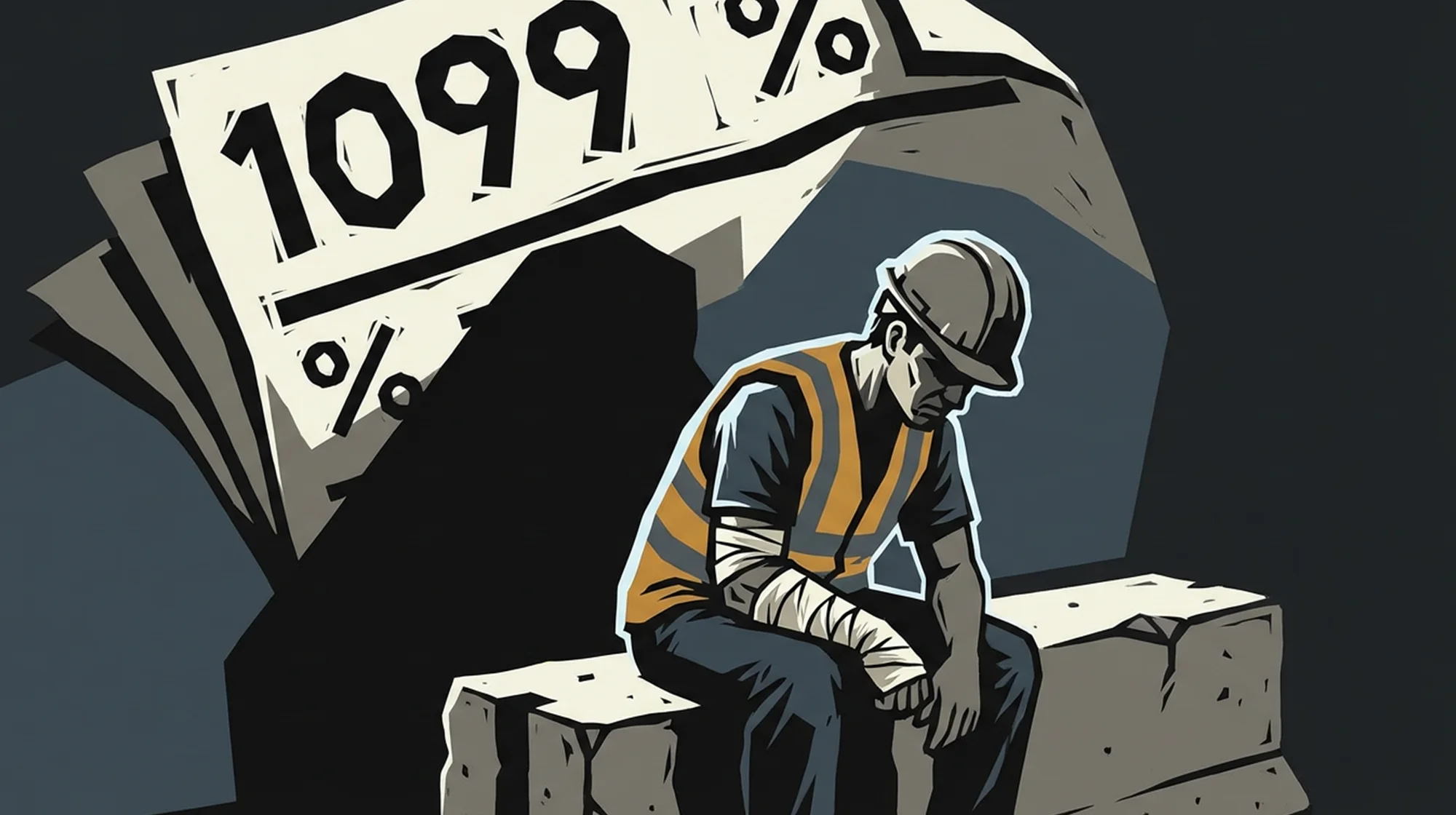
You get hurt at work. You report it. And then someone from the company—maybe your boss, maybe someone in HR—tells you: “You’re a 1099. We don’t have workers’ comp for you.”
Most people stop right there. They believe it. After all, they signed an independent contractor agreement. They get a 1099 at tax time instead of a W-2. HR told them that’s how it works. So they assume they’re on their own.
Here’s what I want you to understand: that piece of paper does not decide your rights under Maryland law. Not the 1099. Not the independent contractor agreement. Not what HR told you.
Maryland’s workers’ compensation statute looks past all of that. It examines the actual working relationship—how much control the company exercises over your day-to-day work—to determine whether you’re a covered employee. And in my experience handling these cases, the answer is often very different from what the employer claims.
I see this pattern constantly. A client calls me, convinced they have no options because they were “classified” as an independent contractor. But once I start asking the right questions—about their schedule, their supervision, their tools, their training—a very different picture emerges. In many cases, Maryland law treats them as employees entitled to full workers’ compensation benefits, regardless of what’s written on paper.
This article walks you through exactly how Maryland makes that determination, which industries are most affected, and why calling a workers’ compensation attorney as soon as possible after an injury can change the outcome of your case.
Maryland courts have been clear on this point for decades: what matters is the reality of your working relationship, not the labels attached to it. Judges call this the “substance over form” doctrine, and it has been applied consistently from the 1950s through the most recent Supreme Court of Maryland decisions.
Under this doctrine, the following documents and designations are not determinative of whether you are an independent contractor:
• A written independent contractor agreement
• A 1099 tax form
• The employer’s or HR department’s characterization of your role
• A business license you hold
• Workers’ compensation insurance you carry independently
• A separate business name or entity you operate under
In one landmark Maryland case, a worker operated under his own company name, held his own contractor’s license, and even carried his own workers’ compensation insurance. Despite all of that, the state’s highest court found him to be an employee because the company controlled how he performed his work—including providing detailed training, requiring branded clothing, scheduling his assignments, and evaluating his performance. The Workers’ Compensation Commission had initially ruled him an independent contractor. The Court of Appeals reversed that decision as a matter of law.
That case captures what I tell every client who calls me believing they’re “just a contractor.” The paperwork is not the end of the conversation. It’s barely the beginning.
One of the most common issues I encounter is injured workers who received their classification “advice” from the employer’s HR department. A lot of times, HR will tell a worker they are not eligible for workers’ compensation because they are an independent contractor. The worker trusts this because it comes from an authority figure within the company.
But here is the problem: HR representatives are generally not qualified to make legal determinations about worker classification. In some cases, they are simply repeating the company’s preferred position. In other cases, they may be actively trying to discourage workers from filing claims—because every successful workers’ comp claim costs the employer money through higher insurance premiums.
The only reliable way to know whether you are a covered employee under Maryland workers’ compensation law is to have an attorney evaluate the actual details of your working arrangement. That’s exactly what I do when someone calls me.
Maryland does not use a simple checklist or go by what’s written in your contract. Instead, the courts apply a five-factor common law test that focuses on the real dynamics of the working relationship. This test was established by the Court of Appeals of Maryland (now the Supreme Court of Maryland) and has been refined through decades of case law.
1. Who selected and hired you? Did the company recruit you, interview you, and decide to bring you on? If so, that looks more like an employment relationship than an independent business arrangement.
2. How are you paid? Are you paid by the hour or on a regular schedule, like an employee? Or do you invoice for completed projects at rates you set yourself? Regular, scheduled payments suggest employment.
3. Can the company fire you? If the company can terminate you at will—without having to buy out a contract or pay a penalty—that’s a strong indicator of an employment relationship. True independent contractors typically have contracts that protect both sides.
4. Does the company control how you do your work? This is the decisive factor—Maryland courts have said so explicitly. The question is whether the company has the right to direct not just what work you do, but how, when, and where you do it. Even if the company doesn’t exercise that control every day, the mere right to do so can be enough.
5. Is your work part of the company’s regular business? If you’re performing the same type of work that the company does as its core business—for example, you’re a nurse working for a home health agency, or a carpenter working for a construction firm—that weighs toward employee status.
Of these five factors, control over how the work is performed is by far the most important. Maryland’s highest court has stated that this factor alone can be decisive, even when the other factors are mixed or unclear.
And the standard is not as high as many people think. The court does not require the employer to be standing over your shoulder every minute. The test asks whether the employer has “some ability, should he care to exercise it,” to tell you what to do and how and when to do it. That’s a low bar.
This is exactly where my initial conversation with a new client becomes so important. When someone calls me after a workplace injury and tells me they’re classified as an independent contractor, the first thing I do is ask very specific questions about their day-to-day experience:
• Do you set your own schedule, or does the company tell you when to show up?
• Do you use your own tools and equipment, or the company’s?
• Did the company train you on how to do the work?
• Does a supervisor check or inspect your work?
• Do you wear a company uniform or display the company’s branding?
• Are you required to be available at specific times or locations?
A pattern almost always emerges. Workers who are told they’re independent contractors are often working set schedules, using company equipment, following company procedures, wearing company logos, and being supervised—all indicators of a covered employment relationship.
Here is something most injured workers do not know, and it may be the most important piece of information in this entire article: Maryland law presumes you are a covered employee.
Under Maryland Code, Labor and Employment § 9-202, any individual performing services for an employer under an express or implied contract is presumed to be a covered employee. This is not a minor technical point—it fundamentally shifts who has to prove what.
In practical terms, it means: you do not have to prove you are an employee. Your employer has to prove you are not. That is a significant legal advantage, and it’s one that most workers are completely unaware of.
When an employer or their insurance company disputes your workers’ compensation claim by arguing you are an independent contractor, they are raising what the law treats as an affirmative defense. The burden is on them to overcome the statutory presumption by demonstrating, under the common law right-to-control test, that you truly operate as an independent business—free from their direction and control in all details of the work.
Remember the case I described earlier—the licensed contractor with his own business name and insurance? Even with all of those independent-contractor trappings, the employer could not overcome the presumption because the evidence of actual control was too strong. The state’s highest court reversed the Commission’s decision and found the worker was an employee as a matter of law.
This presumption exists because Maryland’s legislature understood that employers have every financial incentive to classify workers as independent contractors. It saves them money on workers’ compensation insurance premiums, unemployment insurance, payroll taxes, and benefits. The presumption is designed to protect workers from bearing the consequences of their employer’s cost-saving decisions.
Worker misclassification is not evenly distributed across the economy. Certain industries have much higher rates of misclassification, and if you work in one of these fields, you should be especially alert to the possibility that your “independent contractor” label may not hold up under Maryland law.
In my practice, I see misclassification disputes most often in three sectors: construction, transportation, and healthcare.
Construction and Landscaping
Construction is the epicenter of worker misclassification in Maryland. State audits found a 15.6% misclassification rate in the construction industry in 2024, with over 1,000 workers found to be misclassified and more than $31 million in unreported wages. Independent estimates suggest approximately 23,000 Maryland construction workers—roughly 11% of the workforce—may be misclassified, resulting in tens of millions of dollars in avoided workers’ compensation premiums every year.
Maryland takes this so seriously that it enacted the Workplace Fraud Act, which currently applies specifically to the construction and landscaping industries. This law uses an even stricter standard than the general right-to-control test—called the “ABC test”—which requires employers to satisfy all three prongs to prove a worker is an independent contractor. It is very difficult for employers to meet this standard.
If you work in construction or landscaping in Maryland and you’ve been classified as an independent contractor, the legal deck is stacked in your favor.
Transportation and Trucking
Transportation workers, including truck drivers and delivery drivers, face some of the highest per-worker financial losses from misclassification of any occupation. Studies estimate that misclassified heavy truck drivers lose between $13,000 and $21,000 per year in wages and benefits compared to properly classified employees.
I see this regularly in my practice. A driver is brought on by a company, given a route, told where to pick up and deliver, follows the company’s schedule—and yet is classified as an independent contractor. The control indicators are often overwhelming, but the worker doesn’t realize it until an injury forces the question.
Healthcare: Nurses, CNAs, and Home Health Aides
This may surprise some readers, but the healthcare field has some of the highest misclassification rates of any industry tracked in Maryland. Home health care workers, in particular, show misclassification rates between 35% and 40%—meaning that roughly one in three workers in this sector may be improperly classified.
I’m seeing a growing number of cases involving nurses, Geriatric Nursing Assistants (GNAs), and certified nursing assistants who are told they are independent contractors by staffing agencies or home care companies. These workers are often assigned specific patients, given schedules, required to follow care protocols set by the agency, and supervised—all indicators of employment. If you work in this field and get hurt on the job, do not assume your 1099 status means you have no recourse.
If you’ve been injured on the job and you’re not sure whether you’re truly an independent contractor or a covered employee, here are the kinds of questions I ask when evaluating a case. Answer them honestly:
Your schedule: Do you decide when you work? Or does the company set your hours, shifts, or arrival times?
Your tools and equipment: Do you provide your own tools, vehicle, or equipment? Or does the company supply what you need to do the job?
Your training: Did the company train you on its methods, procedures, or standards? Or did you come in with your own established way of doing things?
Your supervision: Does someone check your work, give you feedback, evaluate your performance, or tell you how to do specific tasks?
Your availability: Can you work for other companies at the same time? Or are you expected to be exclusively available to this employer?
Your appearance: Do you wear a company uniform, use a company vehicle with branding, or display the company’s name or logo at job sites?
Your role: Is the work you do the same type of work the company does as its core business?
If you answered “yes” to several of these—particularly the questions about schedule, training, supervision, and branding—there is a strong possibility that Maryland law considers you a covered employee, regardless of what your paperwork says.
If you’re not sure where you fall, I can help you figure it out. A straightforward conversation is often all it takes. Contact me at SG Legal Group to discuss your situation.
If you file a workers’ compensation claim and your employer or their insurer argues that you are an independent contractor, here is a simplified overview of how the process works.
First, you file a claim with the Maryland Workers’ Compensation Commission (WCC). When the employer disputes your employee status, they raise it as a contested issue in their response filing.
A hearing is then scheduled before a Commissioner. These proceedings are relatively informal compared to a courtroom trial—there is no formal discovery process, and the evidentiary standards are relaxed. The standard of proof is preponderance of the evidence, which essentially means “more likely than not.”
Here is the critical point: because of the statutory presumption under § 9-202, your employer bears the burden of proof. They must demonstrate that you are an independent contractor under the common law right-to-control test. You do not have to prove you are an employee.
If the Commission rules against you, you have the right to appeal to the circuit court. Maryland provides two appeal pathways: an on-the-record review (if the facts are undisputed and the question is one of legal interpretation) or a de novo trial with a jury (if factual disputes exist about the working relationship). This means you get a second chance—and in the de novo trial pathway, you get a completely fresh hearing with full discovery and the right to present your case to a jury.
Having experienced legal representation during this process makes a significant difference. The employer will almost certainly have an attorney or insurance company representative arguing their side. You should have an advocate who understands the test, the case law, and the procedural strategy that gives you the best chance of a favorable outcome.
I want to address a point of confusion that comes up in nearly every misclassification case I handle: being a 1099 independent contractor for federal tax purposes does not mean you are an independent contractor under Maryland workers’ compensation law.
These are entirely separate legal frameworks with different tests. The IRS uses its own multi-factor analysis. The U.S. Department of Labor uses what’s called the “economic reality” test under the Fair Labor Standards Act. And Maryland uses its five-factor right-to-control test under state common law, combined with the statutory presumption of employment under § 9-202.
A worker can be classified as an independent contractor under the federal test and still be a covered employee under Maryland’s workers’ compensation law. The federal government has explicitly acknowledged that its classification rules do not affect state-law determinations.
So if an employer or insurer tells you, “You’re a 1099, so you’re not covered,” understand that this is not a legal conclusion—it’s a characterization that may or may not survive scrutiny under Maryland’s own framework. Do not let a tax form discourage you from pursuing the benefits you may be legally entitled to.
If there is one thing I hope you take away from this article, it is this: the sooner you call, the better your position. The more you wait, the more difficult it becomes to elucidate and streamline the matter.
Here is why timing matters so much in these cases:
Evidence can disappear. Witnesses move on, memories fade, and physical conditions at the worksite can change. Surveillance footage gets recorded over. Documentation gets lost or discarded. The sooner an attorney gets involved, the sooner we can preserve the evidence that supports your claim.
Medical records need to connect to the workplace. For a workers’ compensation claim to succeed, your medical treatment needs to be documented in relation to the workplace incident. Delays in seeking treatment—or gaps in the medical record—give the employer’s insurance company ammunition to argue that your injury is not work-related.
There are filing deadlines. Maryland generally requires that a workers’ compensation claim be filed within 60 days of the injury. Missing this window can jeopardize your entire claim.
Your employer is already working their side. The moment you report an injury, the employer’s insurance carrier begins its own investigation—gathering evidence, taking statements, looking for reasons to deny the claim. You need someone working just as diligently on your behalf.
Calling an attorney does not mean you are committing to a lawsuit. It means you are getting educated. When someone calls me after a workplace injury, the first thing I do is ask the right questions to assess whether they are truly an independent contractor or a covered employee under Maryland law. That initial assessment is the foundation of everything that follows.
If you’ve been hurt on the job and you’re being told you’re “just a contractor,” pick up the phone. The sooner we talk, the stronger your position. Contact me at SG Legal Group for a consultation, or learn more about my background and approach to these cases.
A label on a 1099 form does not determine your rights. A clause in a contract does not override decades of Maryland case law. And what someone in HR told you is not a legal opinion you should rely on when your health, your income, and your family’s stability are at stake.
Maryland’s workers’ compensation framework was built to protect people who work for others—and it does so by looking at the substance of the relationship, not the labels attached to it. The statutory presumption of employment, the right-to-control test, and the substance-over-form doctrine all exist because the legislature and the courts recognize that employers have powerful financial incentives to classify workers as independent contractors, even when the reality says otherwise.
If you’ve been injured on the job and you’re unsure of your status, you owe it to yourself to find out where you actually stand. Reach out to SG Legal Group today. I’ve helped many workers in your position discover that they had far more rights than they believed—and I’m ready to do the same for you.
Disclaimer: The information provided in this article is for general informational purposes only and does not constitute legal advice. Laws and regulations are subject to change, and individual circumstances vary. For advice specific to your situation, please consult with a qualified attorney.
Ioana David, Esq.
Stay informed with our latest articles and resources.