Immigration Law
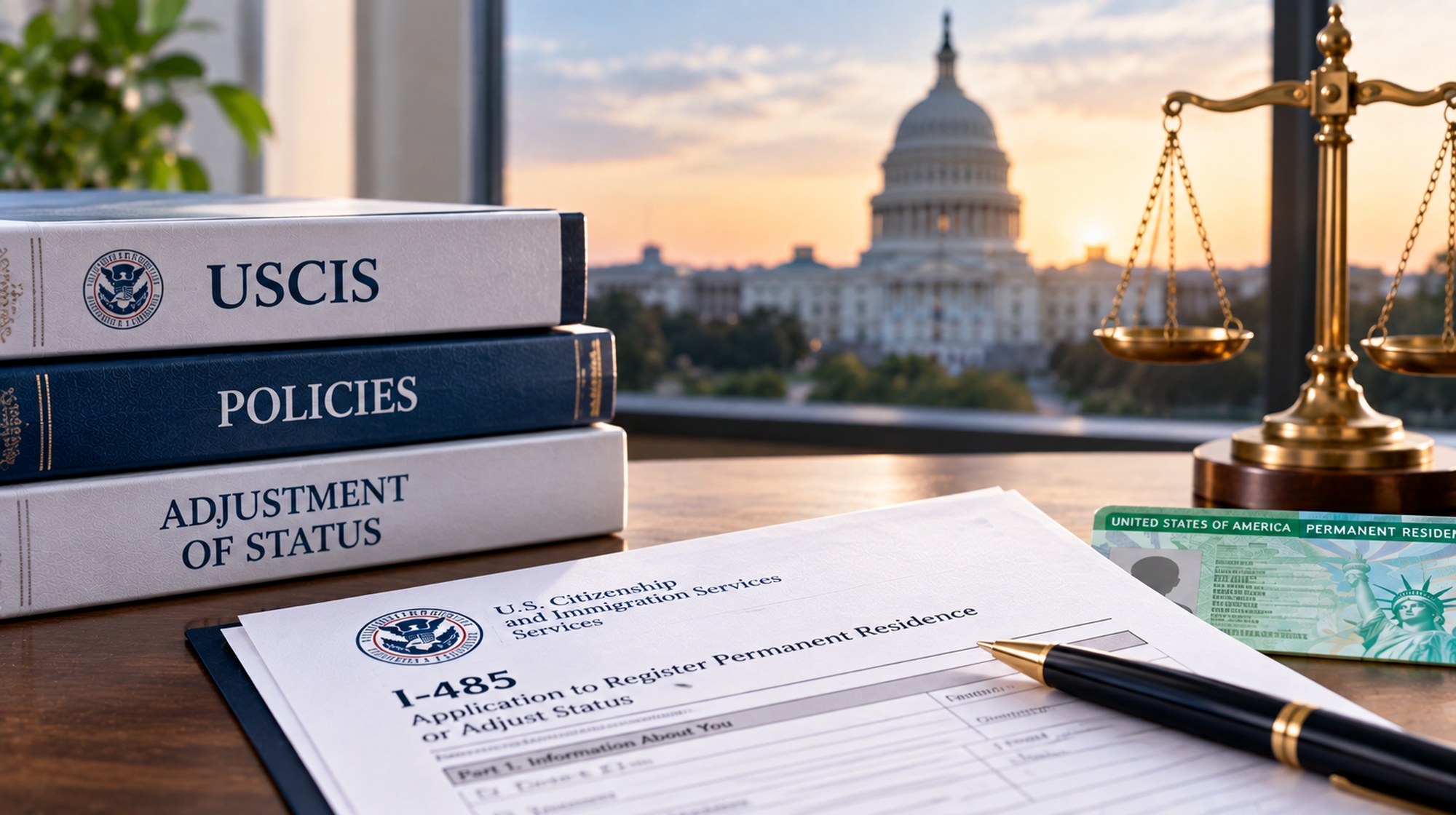
In 2026, USCIS changed how it decides green card applications filed inside the United States — and on October 5, 2026, a coalition of unions, universities, and immigrants sued to stop it. Two policies drive the change, and both are in effect right now.
Here is what each policy actually says — which is not always what the headlines suggest — and what it means if you are adjusting status or about to file.
USCIS Policy Memorandum PM-602-0199, issued May 21, 2026 and effective May 22, reframes adjustment of status — getting a green card without leaving the country — as extraordinary discretionary relief when consular processing is available. In its public announcement, USCIS said a person in the U.S. temporarily “must return to their home country to apply, except in extraordinary circumstances” (USCIS news release, May 22, 2026).
Discretion itself is not new. Adjustment under INA §245(a) has always required two things: statutory eligibility and a favorable exercise of discretion, because the statute says an eligible applicant's status “may be adjusted” at the government's discretion (8 U.S.C. §1255). For years, officers rarely denied an otherwise-eligible case on discretion alone absent serious negative factors.
It's worth separating what the memo says from how the lawsuit describes its effect. PM-602-0199 directs officers to treat failure to comply with the conditions of a nonimmigrant admission or parole, and failure to depart, as highly relevant — particularly when tied to an intention to live here permanently — and says certain adverse factors may need to be offset by “unusual or even outstanding equities.” The memo also expressly recognizes exceptions, including dual-intent classifications and categories where adjustment is the only route to permanent residence, and it requires a totality-of-the-circumstances analysis. The plaintiffs, by contrast, characterize the policy as treating the mere choice to adjust rather than consular process as a negative factor that compels denial.
The practical change is that USCIS has instructed officers to scrutinize the discretionary question much more aggressively, even where an applicant satisfies every statutory eligibility requirement.
USCIS Policy Alert PA-2026-05, issued August 5, 2026, restores officers' full discretion to deny a benefit request without first issuing a Request for Evidence (RFE) or Notice of Intent to Deny (NOID) where required initial evidence is missing or the record fails to establish eligibility. It applies to benefit requests pending or filed on or after August 5, 2026.
That timing matters. Because the alert reaches applications already pending when it issued, people who filed earlier — under the old expectations — can now be denied without the chance to supply a missing document first.
The RFE has long been the natural mechanism for curing missing or insufficient evidence; a NOID serves a different procedural role, typically where the officer is inclined to deny for reasons beyond a simple evidentiary gap. PA-2026-05 applies broadly to USCIS benefit requests, not only to adjustment of status — but its effect on adjustment cases is the focus here, because a no-RFE denial of an I-485 can send an applicant straight to consular processing abroad.
On October 5, 2026, a coalition of plaintiffs filed a federal lawsuit challenging both policies: American Association of University Professors, et al. v. Mullin, et al., No. 1:26-cv-14527, in the U.S. District Court for the District of Massachusetts. The case is currently pending.
The plaintiffs include labor unions, university faculty associations, a legal services provider, and individual green card applicants — among them spouses and parents of U.S. citizens who filed before the policies took effect. They are represented by Democracy Forward, the American Immigration Council, the American Immigration Lawyers Association, and Colombo & Hurd (American Immigration Council case page).
The lawsuit's core argument is that the executive branch cannot rewrite a process Congress created and then treat a person's lawful choice to use it as a reason to deny them. Plaintiffs ask the court to block and ultimately set aside both policies and to require USCIS to adjudicate affected applications consistent with prior law. These are the plaintiffs' allegations; the court has not ruled on them.
Filing a lawsuit does not suspend the policies it challenges. As of the date of this article, both PM-602-0199 and PA-2026-05 remain in effect, and no court has issued an order pausing them. USCIS officers can continue to apply both to pending and new adjustment of status applications.
That can change quickly. If the court grants a temporary restraining order or preliminary injunction, the policies could be paused — nationwide or for a defined group — while the case proceeds. Until that happens, plan around the rules as they are now, not as they might become.
The most important practical point for adjustment applicants in 2026 is this: being statutorily eligible to adjust and being granted adjustment as a matter of discretion are now two distinct hurdles, and PM-602-0199 sharpens the second one.
Immediate relatives of U.S. citizens — spouses, parents, and unmarried children under 21 — are generally exempt from the INA §245(c) bars that would otherwise block adjustment for someone who overstayed or worked without authorization. That statutory exemption still stands; the memo does not rewrite it. What changed is that the same overstay or unauthorized employment the statute excuses can now be weighed against you on the separate, discretionary question, because PM-602-0199 directs officers to consider immigration violations and compliance with the conditions of status when deciding whether to exercise discretion favorably.
The consequence one step ahead is serious. If an application is denied and the person is pushed to consular processing abroad, departing the U.S. can itself trigger a bar on returning: under INA §212(a)(9)(B), more than 180 days of prior unlawful presence followed by departure can trigger a three-year bar, and a year or more can trigger a ten-year bar (8 U.S.C. §1182). For someone who could have adjusted here, being forced abroad is not a change of venue — it can mean years of separation and a consular interview that is now the only path forward.
In my practice, I would no longer assume that an otherwise straightforward adjustment case will receive an RFE if USCIS believes something is missing. I recommend treating the initial filing as the applicant's opportunity to establish both statutory eligibility and why USCIS should exercise discretion favorably.
Concretely, I now advise applicants to prepare the initial filing as though USCIS will not issue an RFE before making a decision. That means building the discretionary record into the first submission: PM-602-0199 directs officers to weigh positive and negative factors, so document the favorable ones affirmatively — U.S. citizen family ties, length of residence, steady employment, tax compliance, good moral character, and the concrete hardship that consular processing would cause.
If you are considering any international travel or advance parole while your case is pending, get advice first; leaving at the wrong moment can carry serious consequences (see Leaving the U.S. Without Advance Parole During Adjustment of Status).
A denial is not necessarily the end, but the options are narrower than many people assume. There is generally no administrative appeal from a standard USCIS denial of an I-485 under §245. Depending on the facts, the available paths may include a motion to reopen or reconsider, refiling where permissible, renewing the adjustment application before an immigration judge if you are placed in removal proceedings, or judicial review — each with different requirements and risks (see My Green Card Application Was Denied — What Are My Options?).
Congress created adjustment of status, and the statutory eligibility rules in INA §245 remain on the books; eligible applicants may still file. What shifted in 2026 is how USCIS exercises discretion within that framework — and whether that shift is lawful is exactly what the court in AAUP v. Mullin will decide. The policies are in effect, the lawsuit is pending, and the next meaningful development could be a court order, new USCIS guidance, or neither for some time.
Talk to an immigration attorney before you file or travel. I'm Oleg Gherasimov, an immigration attorney with SG Legal Group. If you have an adjustment of status application pending — or you're deciding whether to file one now — I can help you build the strongest possible record and weigh your options under the current policies. We offer consultations in English, Russian, and Romanian. Contact SG Legal Group to discuss your specific situation.
Disclaimer: The information provided in this article is for general informational purposes only and does not constitute legal advice. Immigration laws and policies are subject to change, and individual circumstances vary. For advice specific to your situation, please consult with a qualified immigration attorney.
Oleg Gherasimov, Esq.
Stay informed with our latest articles and resources.