Immigration Law
Every week, I speak with people who have made one of two costly mistakes.
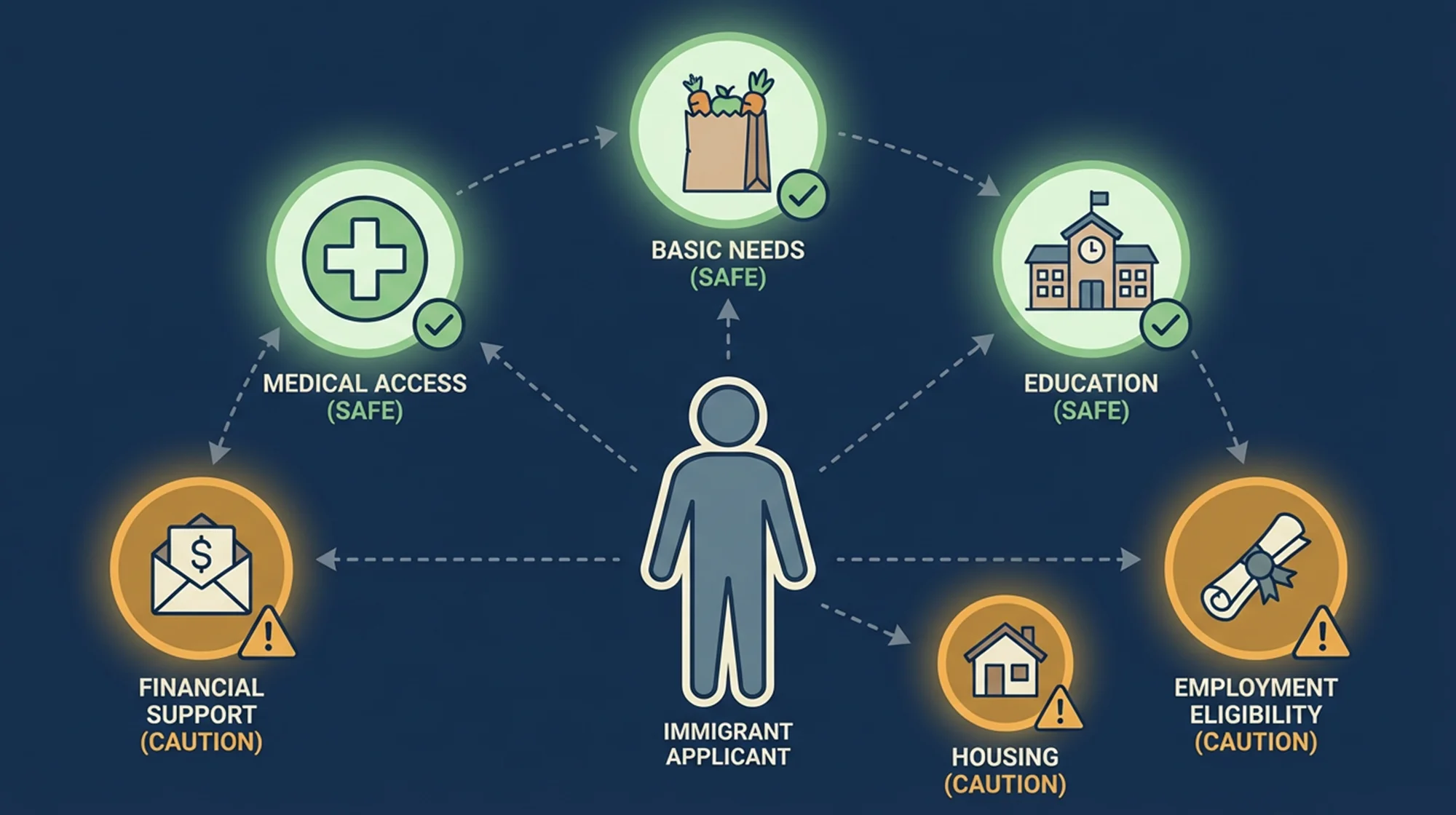
The first: they disenrolled from Medicaid, SNAP, or housing assistance out of fear — cutting off support they were legally entitled to — because someone told them it would ruin their own visa case. It usually wasn't true.
The second: they walked into a consular interview carrying real red flags they didn't know existed — unpaid hospital bills, a defaulted student loan, or a benefit they personally received years ago and never disclosed — and were blindsided by the consequences.
Neither outcome is acceptable. Both are preventable.
The rules around benefits and immigrant visa applications have shifted significantly in 2025 and 2026. The standard consular officers are now applying is stricter than what most people — and frankly, many online resources — still describe. This guide is designed to give you a clear, benefit-by-benefit picture of what actually matters at the U.S. consulate today, so you can walk into that interview prepared.
One important scope note before we begin: this article covers immigrant visa applicants applying through U.S. consulates abroad — that is, people seeking to come to the United States as lawful permanent residents through a family petition, a returning resident visa, or a similar immigrant pathway. If you are applying for a green card inside the United States through adjustment of status, the rules are different, and I will cover those in a separate article.

To understand the current environment, you need to know a little history.
From 2022 through most of 2025, the operative federal rule on public charge inadmissibility — the legal standard used to evaluate whether a visa applicant might become financially dependent on the government — was relatively narrow. Under the Biden-era 2022 Final Rule, only two categories of benefits could formally trigger inadmissibility: cash assistance for income maintenance (like SSI or TANF) and long-term government-funded institutionalization. Programs like Medicaid, SNAP, and Section 8 housing were explicitly excluded.
That framework remains operative for domestic adjustment of status applications at USCIS. At U.S. consulates abroad, however, the picture has changed materially.
In early November 2025, the Department of State issued internal guidance to consular officers directing them to assess visa applicants under a broader "self-sufficiency" standard — one that instructs officers to look "far into the future" and weigh the totality of an applicant's circumstances far more aggressively than the 2022 Rule contemplated. Then, on November 19, 2025, the Department of Homeland Security published a proposed rule signaling its intent to rescind the 2022 Rule altogether, potentially bringing USCIS in line with this stricter consular posture. That rule has not yet been finalized as of this writing, but the direction of travel is clear.
On January 21, 2026, the State Department also paused immigrant visa issuances for nationals residing in 75 countries while it reassesses its public charge vetting framework — a development I covered in detail [in a recent update on this site]. The practical effect is that consular officers today have broader discretion, less predictable standards, and explicit instructions to scrutinize financial health more intensely than ever before.
What follows is a benefit-by-benefit breakdown of where that scrutiny lands.
These are the benefit categories that, under current law, constitute the strongest grounds for a public charge finding. If you have received any of these — or are currently receiving them — that history will be directly relevant to the consular officer's decision.
Supplemental Security Income (SSI)
SSI is a federal cash assistance program for aged, blind, or disabled individuals with very limited income and resources. Receipt of SSI is one of the clearest indicators of primary government dependence in the public charge analysis. It is explicitly designated as "public cash assistance" under 8 C.F.R. § 212.21(b), and a history of SSI receipt — especially ongoing receipt — will raise serious concerns at the consular interview.
TANF (Temporary Assistance for Needy Families) Cash Payments
TANF provides ongoing cash assistance to low-income families with children. Like SSI, it falls squarely within the definition of "public cash assistance" that triggers formal public charge concerns. One nuance worth knowing: a single, one-time "diversionary" TANF payment — for example, a lump-sum emergency payment to help a family avoid needing ongoing assistance — is generally treated differently from recurring monthly cash benefits and is not typically treated as "public cash assistance" in a formal sense. But any ongoing TANF receipt is a serious red flag.
State and Local General Assistance Programs
These are programs funded entirely by individual states or municipalities to provide cash support to residents who don't qualify for federal programs. They go by different names in different states — "Emergency Assistance," "General Relief," or similar — but for immigration purposes, they are treated identically to federal cash assistance. If you received ongoing cash payments from any state or local assistance program, this will be reviewed under the same standard as TANF or SSI.
Long-Term Government-Funded Institutionalization
This refers to being placed in a nursing home, mental health facility, or similar institution for an indefinite period where the government covers the majority of the cost. Under 8 C.F.R. § 212.21(c), this is a separate formal basis for a public charge finding. It does not include short-term rehabilitation — for example, a few weeks in a skilled nursing facility following surgery. The trigger is long-term, ongoing institutional care paid by government funds.
If any of these apply to your case, the conversation with a consular officer will be difficult unless you can demonstrate a substantial change in circumstances — new employment, significant assets, a credible affidavit of support, or other evidence of financial stability.
This is the question I hear most often, and the one that causes the most unnecessary fear: if my U.S. citizen child received Medicaid, SNAP, or SSI, does that count as me having received those benefits for public charge purposes?
The legal answer, under current operative rules, is no.
Under 8 C.F.R. § 212.22(a)(3), the Department of Homeland Security does not consider public benefits received by family members who are U.S. citizens — including a U.S.-born child — when evaluating the immigrant parent's public charge inadmissibility. The rule applies to the applicant's own benefit receipt, not benefits received on behalf of a citizen child. The Immigrant Legal Resource Center even illustrates this with a direct example: if a U.S.-born child qualifies for and receives SSI, that does not hurt the immigrant parent's visa or green card application.
So if you disenrolled your child from Medicaid or CHIP out of fear of harming your own visa application, you almost certainly made an unnecessary sacrifice.
That said, there are two important exceptions to keep in mind.
First, if the child's benefit is effectively functioning as the sole source of income for the household — meaning the entire family is financially dependent on what the child receives — an officer may view that as relevant to the applicant's overall financial picture. This is an edge case, but it's one practitioners watch for.
Second, and far more seriously: the danger isn't usually the child's benefit itself. The danger is what happened on the benefit application. If you falsely claimed U.S. citizenship on a Medicaid, SNAP, or SSI application for your child — in order to avoid complications or to appear eligible — that false claim to citizenship can trigger one of the most severe grounds of inadmissibility in immigration law under INA § 212(a)(6)(C)(ii). Unlike many other grounds, a false claim to citizenship is generally non-waivable and creates a permanent bar. I've seen this situation arise in my practice, and it is devastating for families who had no idea that a checkbox on a state benefits form could have immigration consequences years later.
A critical warning about the proposed new rule
The November 2025 proposed rulemaking from DHS, if finalized, would eliminate the current regulatory language that explicitly exempts family member benefit receipt from the public charge analysis. The proposal specifically removes the current definition of "receipt of public benefits," which is currently limited to benefits received by the applicant personally. If the rule is finalized, officers could potentially consider the household's benefit picture more broadly. This rule is not law yet, but if you are in the middle of a multi-year visa process, you should understand the direction things are moving.
These programs are excluded under the current operative rules. However, given the 2025–2026 enforcement climate, I want to be honest about which ones are more stable and which are facing real pressure.
Non-institutional Medicaid
Routine Medicaid use — doctor visits, prescriptions, hospital stays — is not counted as a public benefit under the 2022 Final Rule. If you used Medicaid while living in the United States, you have not formally triggered a public charge concern under current rules. However, the proposed 2025 DHS rule would allow officers to consider any past Medicaid receipt as evidence of an inability to cover medical costs. Consular officers are already, in some cases, requesting proof of private health insurance valid in the United States from applicants with documented chronic conditions — even where Medicaid was technically excluded under current rules. The legal protection is real; the practical risk at the consulate window is growing.
SNAP (Food Stamps)
Under the 2022 Rule, SNAP receipt is not a public benefit for public charge purposes. It is currently safe to have received SNAP without it constituting a formal ground for inadmissibility. That said, the proposed 2025 rule explicitly signals a return to the 2019 standard, where SNAP could be weighted as a negative factor in the totality of circumstances. For now, SNAP is protected. The landscape could change.
WIC and School Lunches
These programs — the Special Supplemental Nutrition Program for Women, Infants, and Children (WIC) and the National School Lunch Program — are fully exempt from public charge analysis and face no proposed changes. WIC is classified as a public health intervention rather than income maintenance. Free and reduced-price school lunches for children are never a factor in any public charge determination. If you or your children received WIC or school nutrition benefits, there is no concern about these programs.
Section 8 Housing and Public Housing Assistance
Federally subsidized housing is not defined as a public benefit under the current rules. However, it is one of the programs the proposed 2025 rule explicitly seeks to reintroduce as a negative factor. Consular officers are already treating a history of housing assistance as an indicator of weak financial standing, sometimes requiring applicants to document significant liquid assets to offset the inference. Technically safe under today's rules; practically, something to be prepared to address.
ACA Premium Tax Credits
The Affordable Care Act's Premium Tax Credits are classified as a tax benefit under the tax code, not a public benefit under immigration law. Having received ACA marketplace subsidies does not affect a public charge determination. It is worth noting that the One Big Beautiful Bill Act, signed into law on July 4, 2025, restricted eligibility for these credits for certain immigrant categories — including refugees, asylees, and TPS holders — effective January 1, 2026. But this change affects who can access the credits, not their immigration law classification. Premium Tax Credits remain safe from a public charge standpoint.
COVID-19 Assistance
Federal stimulus payments (Economic Impact Payments), COVID-19 vaccines and testing, and pandemic-specific emergency rental assistance all carry explicit safe harbor protections. None of these trigger public charge concerns, and none need to be treated as derogatory factors regardless of how the proposed rule develops.
This is where I see the most surprises at the consular stage. These are not formal statutory bars in the traditional sense. They are "negative factors" in the totality of circumstances — and in today's stricter consular environment, negative factors carry real weight.
Unpaid U.S. Medical Bills
Unpaid medical debt from U.S. hospitals or providers is a significant derogatory factor in consular processing. In recent years, several states — including California, Massachusetts, and Connecticut — banned medical debt from appearing on consumer credit reports. That was a meaningful protection in many contexts.
Here is the problem: consular officers in 2026 are not relying on credit reports to find this information. They are going around the credit reporting system entirely, directly requesting "proof of payment" or "zero-balance letters" from hospitals for any prior medical treatment you received in the United States. The state-level credit reporting ban does not protect you at a U.S. consulate. If you had a hospitalization, a surgery, or an emergency room visit during a prior period in the United States and did not pay the bill in full, you need to address this before your immigrant visa interview — not after.
In my practice, I've worked with clients who were caught entirely off guard by this. The consular officer asked a seemingly routine question about health history, the applicant disclosed a past hospitalization, and the officer then requested billing documentation. An outstanding balance that had been effectively invisible on a credit report became a central issue in the interview.
Student Loan Default
The federal student loan landscape changed dramatically in 2025 and into 2026. The Biden-era SAVE income-driven repayment plan was effectively ended through a December 2025 settlement agreement, formally finalized by the U.S. Court of Appeals for the Eighth Circuit on March 9, 2026. A new Repayment Assistance Plan (RAP), created under the One Big Beautiful Bill Act, is scheduled to launch July 1, 2026. Borrowers who were relying on SAVE's favorable terms are now facing higher payments under alternative plans, and any prior or existing loan defaults remain a meaningful negative financial factor in a consular officer's totality-of-circumstances review.
For immigrant visa applicants, a federal student loan default signals financial unreliability and, by extension, a risk of future government dependence. It is not a formal bar, but it is the kind of derogatory financial factor that, in combination with other issues, can contribute to a denial. If you have a defaulted federal student loan, contact your loan servicer before your visa interview and document any steps taken toward resolution.
Unpaid Federal and State Taxes
Tax history is reviewed as part of the "assets and resources" factor in the public charge totality of circumstances. Unfiled returns, outstanding tax liens, or undisclosed tax obligations are treated as negative indicators of both financial stability and good moral character. For applicants who previously lived in the United States and were required to file returns, this is an area that deserves attention before the interview. Documented tax compliance — or a documented repayment plan with the IRS — goes a long way toward neutralizing this concern.
Chronic Medical Conditions and Health as a Proxy for Financial Risk
One of the most significant emerging trends in 2025–2026 is the use of medical conditions to support a public charge finding that has nothing to do with communicable diseases or traditional medical grounds of inadmissibility. Consular officers are now being directed to examine the immigration medical examination results for conditions that could generate "expensive long-term care" costs.
In practice, I have seen this applied to diabetes, heart disease, cancer history, and even conditions like obesity or sleep apnea. The officer is not medically barring the applicant — they are making a financial inference: this condition may require costly treatment, and the applicant may lack the resources to pay for it without government assistance. The principal remedy, under current DOS guidance, is demonstrating proof of private health insurance that is valid in the United States and covers the condition. If you have a significant health history, it is worth assembling that insurance documentation proactively rather than waiting to be asked.
This point deserves its own section because I see it confuse clients regularly.
Several states have enacted meaningful protections for immigrants around public benefits. California's Medi-Cal expansion covers all residents regardless of immigration status. California has banned medical debt from credit reports. Massachusetts, Connecticut, and others have similar credit protections. These state-level rules have genuine value in many contexts.
But U.S. consulates are federal institutions applying federal standards, and they operate largely beyond the reach of state law protections. A California attorney general's alert banning credit bureaus from reporting medical debt does not bind a consular officer in Warsaw, Manila, or Kyiv from asking you to produce a zero-balance letter from the hospital directly. California's Medi-Cal expansion means you could legally access healthcare as a California resident — but it does not prevent a consular officer from treating a history of chronic illness covered by Medi-Cal as evidence that you will need government-funded healthcare in the future.
State law protections matter most for adjustment of status, where USCIS applies the 2022 Final Rule's narrower definitions. They offer far less protection at the consulate window, where the 2025–2026 DOS guidance governs and where officer discretion is broad.
For those who lived in the United States for a period of time and are now processing an immigrant visa through a consulate abroad — a situation I see frequently with family-based petitions where the beneficiary had prior U.S. presence — there are additional considerations that deserve direct attention.
The disclosure imperative
Federal immigration authorities maintain records that can surface public benefit history through various channels during the visa review process. That means a benefit that is technically not a formal public charge trigger can still become a serious problem if it is not disclosed and the record reveals it. An officer who finds a discrepancy between what you disclosed on your application and what immigration records show may not focus on the benefit itself. They may focus on the discrepancy as evidence of willful misrepresentation under INA § 212(a)(6)(C)(i). Willful misrepresentation of a material fact is a separate, severe ground of inadmissibility — and it is one that is extremely difficult to overcome after the fact.
The practical lesson: disclose accurately and completely, and work with an immigration attorney to frame any benefit history in the proper context. Transparency, paired with strong supporting documentation, is almost always a better strategy than omission.
While this article focuses on your own benefit history, one closely related factor deserves mention: the Form I-864 Affidavit of Support. Most family-based immigrant visa cases require a U.S. citizen or permanent resident sponsor to file this form, agreeing to financially support you as the intending immigrant. The sponsor's income must be at least 125% of the Federal Poverty Guidelines for their household size.
A properly completed and sufficient I-864 is a strong positive factor in the public charge analysis. It does not, however, guarantee a visa. Consular officers in 2026 are scrutinizing affidavits of support more carefully than in recent years — examining whether the sponsor has a realistic ability to deliver on the financial commitment, not just whether the numbers technically meet the threshold. If your sponsor's income is close to the 125% threshold, or if they have any financial complications of their own, it is worth discussing with your attorney whether a joint sponsor might strengthen the application.
Here is a practical checklist to work through before your interview date arrives.
Understand your own U.S. benefit history. If you ever lived in the United States, be prepared to account for any public benefits you personally received. Know what is in your record before the officer asks.
Resolve any unpaid U.S. medical bills. Contact any hospital or provider where you had outstanding balances. Get zero-balance letters or payment documentation before the interview. Do not assume your credit report captures the full picture — it doesn't.
Address student loan defaults and tax issues. A defaulted federal loan or an outstanding tax lien is a solvable problem, but it needs to be addressed proactively. Entering the interview with a documented repayment plan is far better than disclosing a default with no resolution in progress.
Secure health insurance documentation. If you have any significant health history — especially a chronic condition — obtain proof of private health insurance that is valid in the United States and covers your condition. This is increasingly expected by consular officers under the 2025–2026 DOS guidance.
Disclose your benefit history accurately on all required forms. Do not assume a benefit "doesn't count" and skip disclosure — that assumption can create a misrepresentation problem that is far worse than the benefit itself.
Consult an immigration attorney if any of these factors apply. Public charge determinations are among the most fact-specific and discretionary decisions in the consular process. The wrong framing of a benefit history can create a problem where a properly presented record would not. If your case involves a history of SSI, TANF, unpaid medical debt, a chronic medical condition, or a complex benefit picture involving U.S.-born children, please do not navigate this alone.
My team and I work with families navigating exactly these issues every day. Consultations are available in English, Russian, and Romanian. Contact us here to schedule a consultation, or call 410-618-1288.
Disclaimer: The information provided in this article is for general informational purposes only and does not constitute legal advice. Immigration laws and policies are subject to change, and individual circumstances vary. For advice specific to your situation, please consult with a qualified immigration attorney.
Oleg Gherasimov, Esq.
Stay informed with our latest articles and resources.