Immigration Law
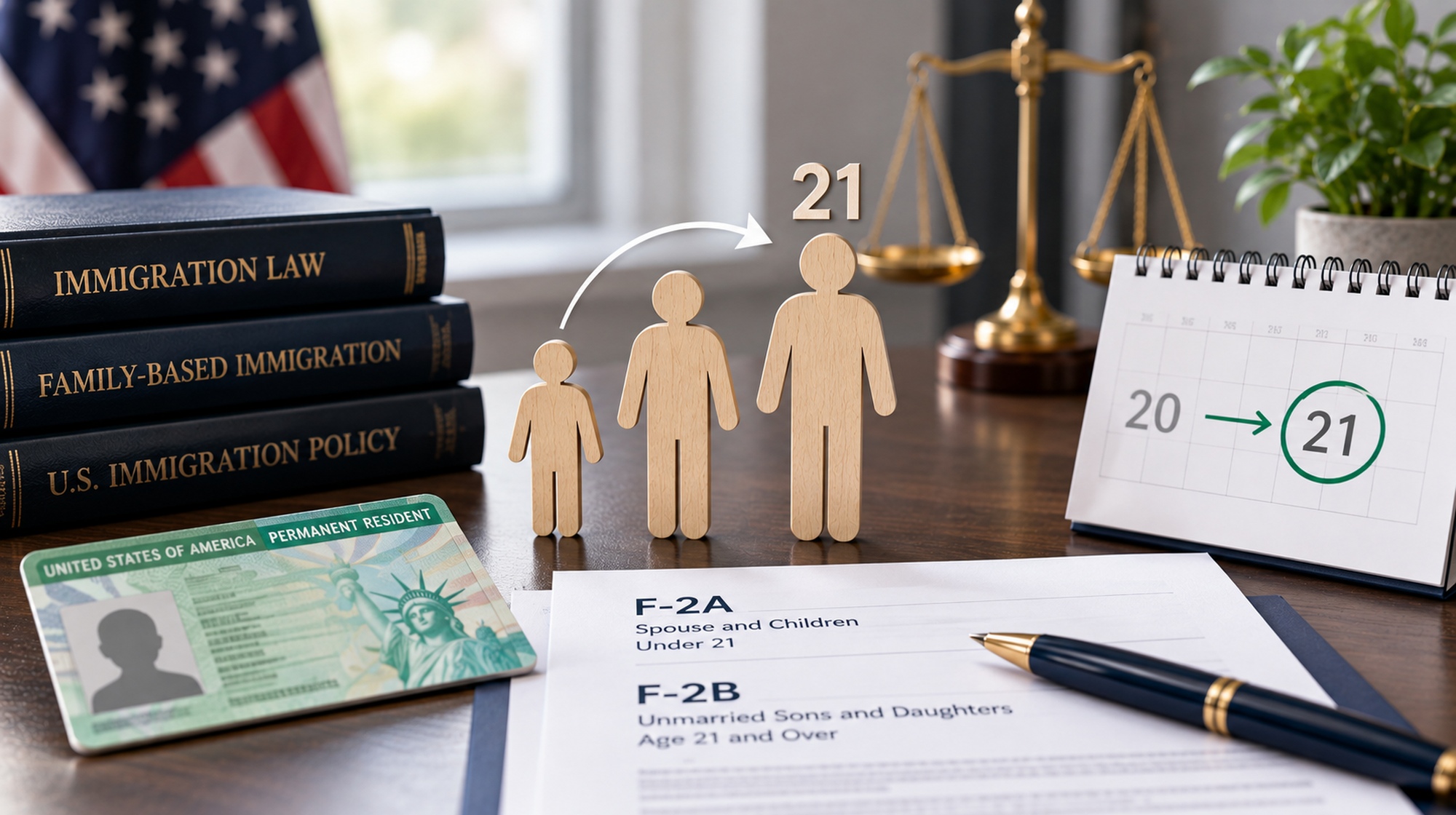
Short Answer: An unmarried child of a lawful permanent resident does not automatically age out of the F-2A category on turning 21. Under INA §203(h), the child subtracts the time Form I-130 was pending from their age when a visa becomes available under the Final Action Dates chart. If that CSPA age is under 21, F-2A classification holds. If the child ages out, the case generally converts to F-2B and keeps the original priority date, and a new Form I-130 is usually not required.
Parents often assume that filing Form I-130 before a child's 21st birthday permanently protects the child. For a lawful permanent resident parent, that is not how it works.
Filing early matters. But unlike the immediate-relative child of a U.S. citizen, whose age freezes on the filing date, the child of a permanent resident has an age that must be calculated — and calculated on a date that may be years away.
An unmarried child under 21 of a lawful permanent resident is classified in the F-2A preference category. Under the Child Status Protection Act, the time Form I-130 spends pending with USCIS is subtracted from the child's biological age:
Age when the visa becomes available − time Form I-130 was pending = CSPA age
Pending time runs from the date the petition was properly filed to the date USCIS approved it, and it includes periods of administrative review such as motions and appeals. If the resulting CSPA age is under 21, the child remains classified in F-2A even though their actual age is over 21.
Visa availability for an F-2A child is the later of two dates: when the F-2A priority date becomes current under Chart A, Final Action Dates, of the Department of State Visa Bulletin, or the date USCIS approves the Form I-130. This has always been the rule for consular processing, and it has applied to adjustment applications filed on or after August 15, 2025 under Policy Alert PA-2025-15.
That "whichever is later" language creates a gap that decides many cases. While the petition is pending, the child is effectively protected, because every day of that period is eventually subtracted. But if USCIS approves the petition while Chart A is not yet current, the protection stops accruing. The child starts aging again and keeps aging until the priority date arrives.
Suppose a lawful permanent resident files Form I-130 for his 19-year-old son. USCIS takes 14 months to approve it, and the F-2A priority date is not current under Chart A when the approval issues.
The son continues to age. When Chart A finally becomes current, he is 21 years and 9 months old. Subtracting the 14 months the petition was pending gives a CSPA age of 20 years and 7 months. He is under 21 for immigration purposes and remains in F-2A, provided he also satisfies the one-year requirement discussed below.
Now change one variable. If Chart A takes a further year to become current, he is 22 years and 9 months old on the controlling date. The same 14-month subtraction leaves a CSPA age of 21 years and 7 months. He has aged out of F-2A.
Nothing about the family's conduct differed between those two outcomes. The only difference was how fast the Visa Bulletin moved.
An F-2A child who ages out generally converts to the F-2B category for unmarried sons and daughters of lawful permanent residents, and the original priority date is preserved. The parent does not have to start over.
This is a genuine protection, and it is not available in most other family-preference categories. The wait in F-2B is typically years longer than F-2A, so the practical cost is real — but the case survives, and the child keeps their place in line.
The same conversion can apply where the child was never the principal beneficiary. If a permanent resident filed Form I-130 for a spouse in F-2A and the child was included as a derivative, an aged-out derivative can become the principal beneficiary in F-2B.
There is an important condition. In Scialabba v. Cuellar de Osorio, 573 U.S. 41 (2014), the Supreme Court's controlling opinion described this relief as available to a derivative child who is not only the spouse's child but also the petitioner's child. The conversion works because the same petitioner already has a qualifying relationship with the child on both sides of the 21st birthday.
That condition matters in blended families. A stepchild relationship under U.S. immigration law generally requires that the marriage creating it occurred before the child's 18th birthday. Where that relationship does not exist, the derivative may fall outside the conversion rule entirely, and the analysis changes.
An F-2A beneficiary who converts to F-2B does not generally need a new petition. USCIS policy allows the case to proceed on the existing approved petition once the F-2B priority date becomes current. If the permanent resident parent chooses to file a second Form I-130, the child can retain the original priority date either way.
This treatment matters because the Supreme Court read the automatic-conversion and priority-date-retention provisions of INA §203(h)(3) far more narrowly for derivatives who age out of the other family-preference categories. F-2A therefore deserves separate analysis from every other derivative age-out situation, which I cover in my article What Happens When a Derivative Child Ages Out?
Naturalization by the petitioning parent changes the analysis, and not always favorably. If the parent naturalizes while the unmarried child is biologically under 21, the child converts from F-2A to the immediate-relative category, and the age freezes on the naturalization date.
Where the child is already biologically over 21 when the parent naturalizes, the result depends on where the petitioner lives, and four federal circuits have now split from the Board of Immigration Appeals on the question. There is also a serious trap for children who were riding along as derivatives on a spousal petition: they lose derivative status entirely when the petitioner naturalizes and need their own Form I-130. Because the stakes are high and the rules are geographic, I address naturalization separately in my article, What Happens to a Child's Immigration Case When a Green Card Holder Parent Becomes a U.S. Citizen?
Both F-2A and F-2B require the son or daughter to remain unmarried, and the Child Status Protection Act does nothing about marriage. CSPA protects age in defined circumstances. It does not preserve a classification when the beneficiary stops meeting a separate requirement of that classification.
Timing controls if a marriage ends. Under 9 FAM 502.1-1(D)(4), a divorce after the 21st birthday and after the visa became available will not restore "child" status, because the applicant was married at the moment that mattered. A divorce before visa availability may restore it if the CSPA age is under 21.
For a green card holder's child, "when does my child turn 21?" is rarely the right question. The questions that decide the case are:
Those answers determine whether the child stays in F-2A, converts to F-2B, or faces a harder problem. A birthday alone tells you almost nothing.
If your child is approaching 21 while a Form I-130 is pending, contact SG Legal Group before assuming the birthday either ends the case or does not matter. We can run the calculation and tell you which category you are actually in.
Disclaimer: The information provided in this article is for general informational purposes only and does not constitute legal advice. Immigration laws and policies are subject to change, and individual circumstances vary. For advice specific to your situation, please consult with a qualified immigration attorney.
Oleg Gherasimov, Esq.
Stay informed with our latest articles and resources.