Immigration Law
You completed your exchange program. You built a life here. Maybe you married a U.S. citizen, got a job offer, or have a family petition waiting. And now someone — a friend, a coworker, maybe even another attorney — told you there's a "two-year rule" standing between you and your green card.
Here's what I tell every J-1 holder who walks into my office with that concern: the rule is real, it is serious, and it is widely misunderstood. But understanding exactly what it does — and does not — require is the first step toward figuring out your options.
This article explains the two-year home residency requirement under INA § 212(e), how it affects your ability to file for adjustment of status, what the 2024 Skills List update changed for nationals of certain countries, and what your legal options look like if the bar applies to you.

Not every J-1 holder is subject to the two-year home residency requirement. This is one of the most important things to establish before you do anything else — because plenty of people assume they're stuck when they are not.
Under INA § 212(e), the requirement is triggered by any one of three conditions.
Your program received government funding. If your exchange program was financed — directly or indirectly — by the U.S. government or the government of your home country, you are subject. The definition of "indirect" funding is broad enough to include grants channeled through universities or international organizations.
Your field appears on the Exchange Visitor Skills List for your country. The Department of State maintains a list of countries that "clearly require" the return of persons with specific skills or knowledge. If your field was on that list for your home country at the time you received J-1 status, you are subject.
You received graduate medical education or training. Foreign medical graduates who came to the U.S. for residency or fellowship programs are almost universally subject, regardless of funding.
One critical point: the notation on your DS-2019 form or your visa stamp is not legally conclusive. Immigration officers make errors. The DS-2019 may say "subject to § 212(e)" when a detailed analysis of your funding and program would show otherwise — or it may say nothing, when you actually are subject. If there is any genuine ambiguity about your status, the right tool is an Advisory Opinion from the Department of State's Visa Office. That opinion is binding on USCIS and resolves the question definitively.
If you're uncertain whether the requirement applies to you, that uncertainty alone is a reason to get a proper legal analysis before you take any action. To understand how J-1 status fits into the broader U.S. visa landscape, see my overview of U.S. visa types and adjustment of status.
If you are subject to the requirement, you need to understand what it actually requires, because the most common misconceptions here are genuinely dangerous.
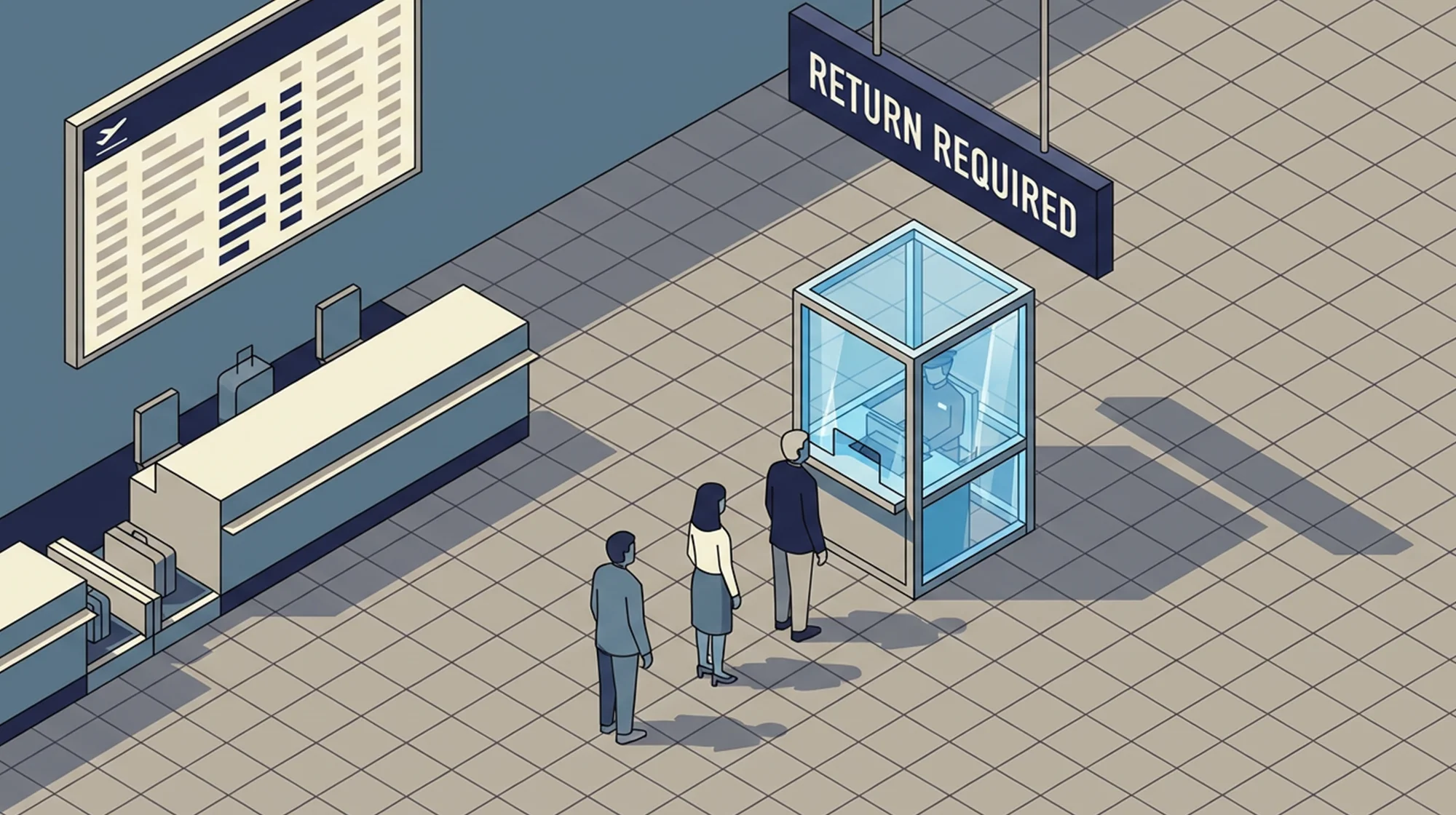
Staying in the U.S. does not count. The two years must be physical presence in your country of nationality or last legal permanent residence — not in the United States. Not in a third country. Not anywhere else. I regularly meet clients who have been in the U.S. for five, seven, even ten years and believe that time is somehow working in their favor. It is not. A person who has never returned home since their J-1 program ended has zero days credited toward the requirement.
The clock does not start when your J-1 visa expires. There is no countdown. The requirement does not accumulate passively. Time only accrues when you are physically present inside the borders of the designated country. Your visa expiring, your DS-2019 ending, your program concluding — none of those events start a timer.
The two years can be cumulative. This is actually the one clarification that works in people's favor. You do not need to spend two continuous years abroad. Multiple shorter stays in your home country can be added together, as long as the total reaches 730 aggregate days. Documentation matters enormously here — passport entry and exit stamps, travel history records, and similar evidence are what you will need to prove fulfillment if you go that route.
Brief trips do not "fix" anything. A two-week visit home does not reset the clock, resolve the bar, or satisfy any legal threshold. Only actual days physically present in the designated country count toward the requirement.
Here is where the stakes become real. INA § 212(e) is not simply a mark in your file that an officer weighs against other factors. It is a procedural bar to filing Form I-485 at all.
Under 8 CFR § 245.1(c)(2), any exchange visitor who is subject to the home residency requirement and has not fulfilled it or obtained a waiver is ineligible to apply for adjustment of status. That means USCIS will reject or deny your I-485 — and no amount of ties, equities, or eligibility on other grounds changes that outcome until the § 212(e) bar is resolved.
This is also why marriage to a U.S. citizen does not automatically solve the problem. Marriage is a powerful immigration tool in many contexts, but it does not eliminate the § 212(e) bar. Your spouse can file an I-130 petition on your behalf, and that petition can be approved. But you will not be able to file I-485 — and therefore cannot get your green card — until either the two-year requirement is fulfilled or a waiver is granted. The K-3 spousal visa is also blocked for those subject to § 212(e), which means the consular route offers no shortcut either.
The § 212(e) bar extends well beyond green card eligibility. Under the USCIS Policy Manual, a J-1 subject to § 212(e) can change status inside the United States only to A (diplomatic), G (international organization), T (trafficking victim), or U (crime victim) status. Every other practical category — H-1B, L-1, F-1, O-1 — is off the table for a change of status while the bar remains in place. An employer willing to sponsor an H-1B petition cannot work around this. The underlying § 212(e) bar must be resolved before the petition has any effect.
If you've already filed for a green card and received a denial related to this issue, my post on what to do when your green card application is denied walks through your options in that situation.
On December 9, 2024, the Department of State issued the first comprehensive revision to the Exchange Visitor Skills List since 2009. For practitioners and for J-1 holders from a significant number of countries, this is the most consequential development in this area of law in over a decade.
37 countries were removed from the Skills List entirely, including India, China, Brazil, South Korea, Saudi Arabia, the UAE, Turkey, South Africa, Malaysia, Indonesia, and Thailand. The 2009 list covered 82 countries; the 2024 list covers 45. The rationale was an updated assessment of economic development — countries that have surpassed certain GDP and development thresholds were decertified on the grounds that the original brain-drain concerns no longer apply at the same level.
The practical effect is significant and, critically, retroactive. Exchange visitors from any of the removed countries who were previously subject to § 212(e) solely because of the Skills List designation are no longer subject as of December 9, 2024. This applies even if your DS-2019 or visa foil still bears a "subject to 212(e)" notation from before the revision. That notation no longer controls if your only basis for subjectivity was the Skills List for one of the removed countries.
For many people with pending adjustment of status cases or who had previously been told they couldn't file, this change removed the legal barrier entirely — without the need to apply for a waiver, return home, or take any additional action.
However, the retroactivity has a precise scope that you must understand. It applies only to those who were subject solely on the basis of the Skills List. If you also received funding from the U.S. or your home government during your exchange program, that independent basis for subjectivity remains fully in effect. The 2024 revision does not help you on the funding prong — only the Skills List prong. If both prongs applied to your situation, you remain subject and still need a waiver.
This is exactly the type of scenario where individual analysis is essential. Do not assume that because your country was removed from the list, you are automatically clear. Verify whether government funding was also part of your program.
If you are subject to § 212(e) and the two-year requirement does not fit into your timeline or circumstances, a waiver is the other path. There are four main bases, and they are not equally accessible to everyone.
No Objection Statement (NOS). Your home government issues a diplomatic note to the U.S. Department of State stating it has no objection to you remaining in the U.S. permanently. This is the most commonly used waiver basis and is relatively streamlined when the home government cooperates. It is not available if your program was funded by the U.S. government.
Interested Government Agency (IGA). A U.S. federal agency — such as the Department of Defense, Department of Energy, or Department of Health and Human Services — requests a waiver because retaining you is in the public interest. These waivers exist for situations where the agency has a genuine, documented stake in your continued work in the U.S.
Exceptional Hardship. If your departure would cause exceptional hardship to a U.S. citizen or lawful permanent resident spouse or child, you may qualify. Note the specific language: "exceptional hardship" under § 212(e) is a higher bar than the "extreme hardship" standard used in other immigration waivers. The analysis looks at the totality of circumstances — medical needs, psychological impact, financial consequences, educational disruption.
Persecution. If you would face persecution in your home country based on race, religion, or political opinion, you may apply for a waiver on that basis. The standard here is notably more demanding than asylum: rather than a "well-founded fear" of persecution, you must establish a probability of persecution.
One misconception worth naming directly: receiving a favorable recommendation from the Department of State is not the end of the process. The DOS recommends; USCIS grants final approval. Your waiver is not approved until USCIS issues its decision. Acting on a DOS recommendation as though it resolves the bar — before USCIS has acted — can put you in a legally precarious position.
For more information on waivers in the immigration context, visit our waivers practice page.
If you have a pending adjustment of status application, you may be issued an Advance Parole document that allows you to travel and return to the U.S. without a visa. It is important to understand what Advance Parole does and does not do in the § 212(e) context.
Advance Parole does not cure the two-year home residency requirement. It is not a waiver. It does not satisfy any days toward the physical presence requirement. If you travel internationally while your waiver is pending — meaning DOS has made a recommendation but USCIS has not yet issued final approval — and a CBP officer at the port of entry determines you are still subject to § 212(e), you can be found inadmissible upon return.
The safe rule is straightforward: do not travel internationally until you have USCIS final approval of your waiver in hand — not just a DOS recommendation, and not just a pending I-485. If travel is truly necessary before that point, consult with an attorney first to assess the specific risks in your case.
Of all the misconceptions about § 212(e), the most consequential one is this: that you can set the issue aside and address it when it becomes directly relevant — when the job offer comes in, when the family petition is filed, when you're ready to pursue permanent residence.
By then, it is often too late to pursue the best available strategy.
Waiver options have deadlines and dependencies. Some avenues close as your circumstances change. If a job offer is already on the table and your employer is counting on an H-1B filing, discovering a § 212(e) bar at that moment creates an immediate crisis rather than a manageable legal issue. Family-based cases where the priority date is finally current can be derailed entirely by a bar that was always there but never addressed.
Early analysis also opens up options that simply don't exist when you wait. The choice of waiver basis — NOS, IGA, hardship — depends on your circumstances at the time you apply, and those circumstances change. Early strategy often means more options.
If you are a J-1 holder — or a former J-1 holder who is now in a different status — and you are thinking about adjustment of status at any point in the foreseeable future, the right time to evaluate your § 212(e) exposure is now, not later.
At SG Legal Group, I handle adjustment of status cases for clients navigating the § 212(e) bar, from the initial subjectivity analysis through waiver applications and the I-485 filing itself. I work with clients in English, Russian, and Romanian. If you want to understand exactly where you stand and what your path forward looks like, contact me to schedule a consultation.
Disclaimer: The information provided in this article is for general informational purposes only and does not constitute legal advice. Immigration laws and policies are subject to change, and individual circumstances vary. For advice specific to your situation, please consult with a qualified immigration attorney.
Oleg Gherasimov, Esq.
Stay informed with our latest articles and resources.