Immigration Law
Most couples who received a conditional green card through marriage are vaguely aware that they have to file "something" before the two-year card expires. What they are often not aware of is how long that process now takes, how much scrutiny it involves, or how consequential the mistakes are.
In 2026, Form I-751 — the Petition to Remove Conditions on Residence — is taking between 27 and 30 months to process at most service centers. That is nearly two and a half years of waiting after you file. During that wait, your status is protected by a receipt notice extension, but the petition is far from a formality. USCIS has significantly increased scrutiny on I-751 filings, interview rates are rising, and the standard of evidence that satisfies an officer in 2026 is meaningfully higher than it was a few years ago.
This guide covers what the I-751 process looks like from filing to approval, what the current timeline means practically for your status and your plans, and — most importantly — where cases go wrong and what you can do to make sure yours does not.

When a foreign national receives a green card through marriage to a U.S. citizen or lawful permanent resident, and the marriage was less than two years old at the time the green card was approved, USCIS issues a conditional permanent resident card rather than a standard ten-year card. This conditional card is valid for only two years.
The condition exists because USCIS treats newer marriages as statistically more likely to have been entered into for immigration purposes rather than genuine commitment. The two-year window is designed to give the marriage time to demonstrate its legitimacy — and the I-751 is the mechanism by which you prove it.
Filing Form I-751 is how a conditional resident says to USCIS: our marriage was real, it has continued in good faith, and I am entitled to full permanent residency. If USCIS agrees, they remove the conditions and issue a standard ten-year green card. If they do not — if the petition is denied — the conditional resident's status is terminated and removal proceedings begin.
That is the stakes. This is not a renewal. It is a second evaluation of your marriage.
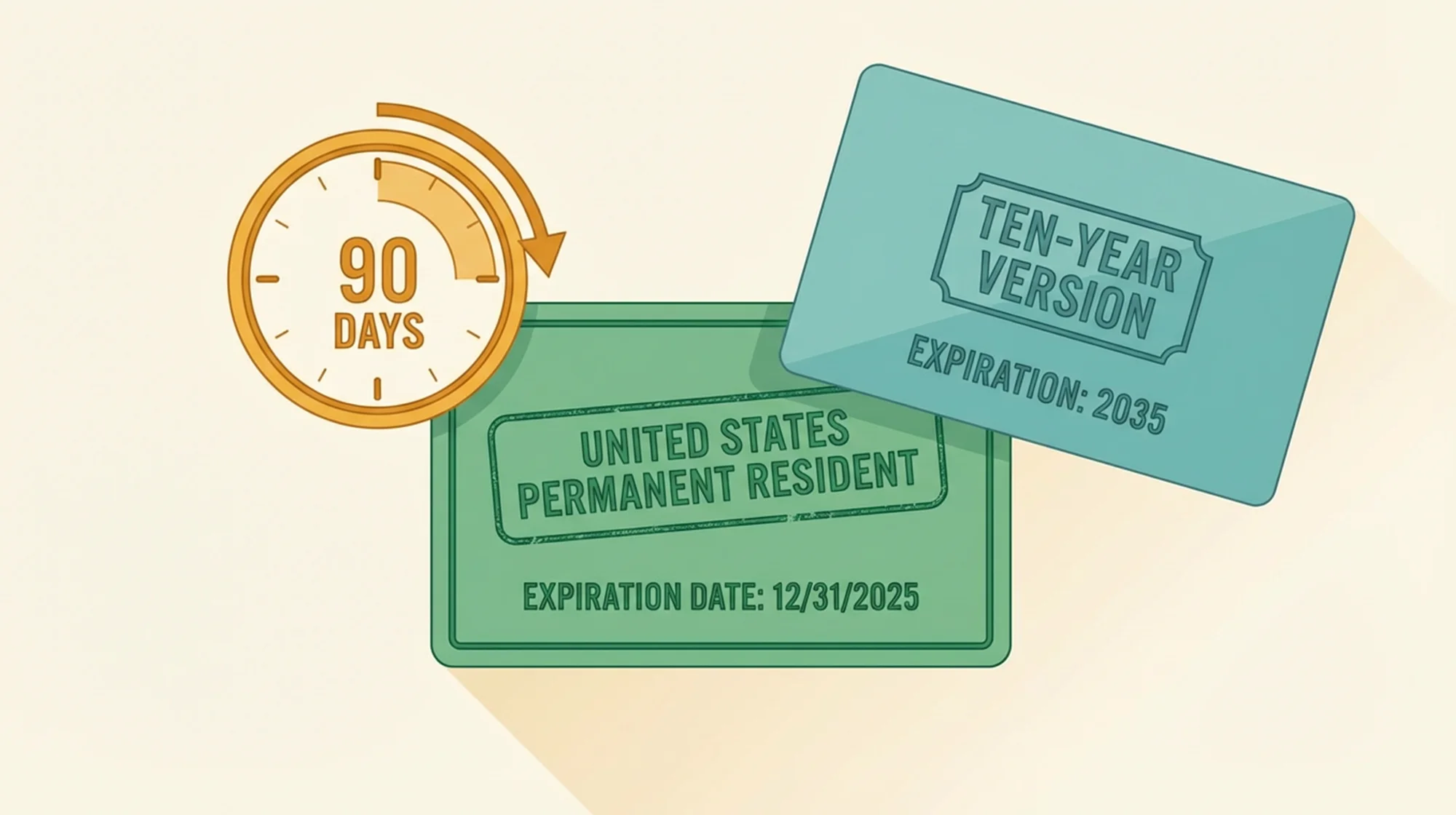
The I-751 must be filed during the 90-day period immediately before your conditional green card expires. Not before that window. Not after it. During it.
Your conditional card has an expiration date printed on it. Count back 90 days from that date — that is the first day you can file. Filing before the window opens will result in rejection. Filing after the expiration date without a strong documented explanation for the delay can result in termination of your conditional status and initiation of removal proceedings.
This deadline is the one I emphasize most forcefully with clients who have a conditional green card. Put it in your calendar the day you receive the card. Set multiple reminders. The 90-day window exists, and it does not move.
One important nuance: if you are filing a waiver petition — because the marriage ended in divorce, your spouse died, or you experienced abuse — you are not bound by the 90-day window. Waiver petitions can be filed at any time before removal proceedings are completed. I cover the waiver scenarios in detail below.
Once USCIS receives a properly filed I-751, they send a receipt notice — Form I-797C — confirming that your petition is pending. This receipt notice is one of the most practically important documents you will receive in the entire process, and many conditional residents do not fully understand what it does.
The receipt notice automatically extends your conditional permanent resident status for 48 months beyond your card's printed expiration date. This means that even though your physical green card says it expires on a certain date, your legal status as a permanent resident continues while USCIS processes your petition. You can work, travel internationally, and live as a lawful permanent resident during this entire period.
In practice, this means you should carry your expired conditional green card together with your receipt notice whenever you travel or present immigration documents to an employer. The two documents together — expired card plus receipt notice — serve as proof of your continuing status. Airlines, employers, and CBP officers at the port of entry are all required to accept this combination.
Given that I-751 processing is currently running 27 to 30 months, and the extension is 48 months, most applicants will receive their ten-year green card well before the extension expires. But if for any reason your case approaches the 48-month mark without resolution, consult an immigration attorney immediately — there are specific steps to take to address that situation.
The numbers are significant, and they matter for planning purposes.
As of early 2026, USCIS is taking 27 to 30 months to process 80% of jointly filed I-751 petitions. This means the typical wait from filing to receiving a ten-year green card is between two and two and a half years. Some cases at certain service centers move faster — processing ranges from roughly 10 months at the fastest end to over 30 months at the slowest. The USCIS processing time tool, available at egov.uscis.gov, shows estimates by service center and is the most reliable source for current data.
Waiver petitions — filed without a joint-filing spouse, due to divorce, death, abuse, or extreme hardship — take longer on average. USCIS reviews waiver cases more closely because the absence of a joint-filing spouse means the bona fide marriage determination rests entirely on the documentary record and the petitioner's own account. Waiver processing in 2026 is averaging 22 to 26 months, though complex cases can run longer.
There is no premium processing available for Form I-751. There is no way to pay an additional fee and move your case to the front of the line. The only meaningful levers you control are the completeness and quality of your initial filing, and the speed with which you respond to any requests USCIS sends during processing.
The I-751 is fundamentally a second look at the bona fides of your marriage. USCIS officers reviewing your petition are asking the same core question they asked when you first applied for the green card: did this couple genuinely intend to build a life together when they married?
The evidence framework they use — and that you should build your petition around — focuses on:
Shared financial life. Joint bank accounts, joint tax returns, joint credit cards, and shared insurance policies all demonstrate financial commingling. The more thoroughly your finances are intertwined, the stronger this part of your record. Couples who have kept finances entirely separate for personal or cultural reasons need to explain that context explicitly — an unexplained absence of joint finances is a red flag, even if the separation was entirely innocent.
Shared residence. A lease or mortgage in both names, utility bills at a shared address, and correspondence arriving at the same address all document that you live together. If you have lived separately at any point for legitimate reasons — a work assignment in another city, a family emergency that kept one spouse elsewhere — document those circumstances in your petition rather than leaving the gap unexplained.
Children and family integration. Birth certificates of children born to the marriage are among the strongest possible evidence. Evidence of integration into each other's families — photos at family gatherings, correspondence from in-laws, records of shared holidays — also carries significant weight.
Third-party affidavits. Letters from people who know you as a couple — friends, family members, colleagues who have observed your relationship over time — are underused by most petitioners. A well-written letter from someone who has witnessed your marriage firsthand can be more persuasive than another bank statement.
Continuity of the relationship. The I-751 covers the period from your initial green card approval through the filing date. USCIS wants to see evidence from throughout that period, not just a snapshot from around the filing date. A packet of documents all dated within the month before filing raises questions about whether the evidence was manufactured. A record spanning the full two years tells a more credible story.
USCIS has always had the authority to schedule I-751 interviews, but in practice many petitions were approved without one. That is changing. Interview rates for I-751 petitions have increased in 2026, particularly for cases involving:
If you are scheduled for an interview, both spouses must attend unless a waiver of that requirement has been granted. The interview covers the history of the relationship, the couple's current living situation, daily routines, finances, and family. Officers in 2026 are approaching these interviews with more probing questions and less willingness to accept vague or general answers than in prior years.
The most important preparation principle for an I-751 interview is consistency — not scripted answers, but genuine familiarity with your own life together. Couples who have reviewed their submitted evidence together, understand the timeline of their own relationship, and can speak naturally and confidently about their shared life move through these interviews without difficulty. Couples who have not prepared — who give inconsistent answers about when they moved in together, who cannot recall basic details of their finances, or who appear coached rather than knowledgeable — create problems for themselves.
(Placeholder: If you have a brief observation about what your clients are most commonly unprepared for at I-751 interviews — even one sentence — this section is the right place for it.)
For related guidance on what USCIS marriage interviews look like and how to prepare, see my article on decoding the green card marriage interview.
Generic advice to "submit strong evidence" is accurate but not particularly useful. Here is what actually goes wrong in I-751 cases, based on what generates RFEs and what creates problems at interview.
Filing too early. The 90-day window is strict in both directions. If you file before the window opens — even by a day — USCIS will reject the petition and return it. You will then need to refile, which costs time and potentially creates a gap in your documented status. Know your exact expiration date and calculate the window carefully.
Filing too late — or not at all. Failing to file before the card expires, without a documented extraordinary circumstance, is one of the most serious errors a conditional resident can make. USCIS can initiate removal proceedings against someone who simply forgot to file. If you have missed the window, do not wait and hope the issue resolves itself. File immediately with a written explanation of the circumstances and consult an attorney about how to present the late filing as compellingly as possible.
Evidence that covers only the present, not the full two-year period. Submitting a joint bank statement from last month and a tax return from last year tells USCIS something about where your marriage is now. It tells them very little about whether it was genuine from the beginning. Build an evidence timeline that spans the full period from your initial green card approval to the filing date.
Unexplained gaps. If anything in your circumstances looks unusual on paper — a period without a shared address, a gap in joint tax returns, limited financial documentation from a particular year — explain it. Officers are not looking for perfect marriages. They are looking for honest ones. A brief explanatory statement accompanying an otherwise thin section of evidence is far more persuasive than silence.
Weak or generic third-party letters. A letter that says "I have known John and Maria for several years and believe their marriage is genuine" adds almost nothing. A letter that describes specific events — attending their wedding, visiting their home, observing their relationship over time — carries real weight. If you are asking people to write letters in support of your petition, give them guidance on what to include.
Ignoring an RFE deadline. If USCIS sends a Request for Evidence, the deadline on that notice is real. Missing it — or submitting an incomplete response — can result in denial based on the record as it stands. If you receive an RFE and are not sure how to respond, consult an attorney before the deadline, not after.
(Placeholder: Your single most commonly seen filing mistake — even one sentence — transforms this section from a general list into a practitioner's firsthand observation.)
Not every couple filing an I-751 is still together. Life happens during the two-year conditional period — marriages end, spouses die, and in some cases the U.S. citizen spouse was never the partner they appeared to be. USCIS recognizes four grounds for waiving the joint filing requirement:
Divorce or annulment. If your marriage ended before you filed the I-751, or ends during the processing period, you can file a waiver petition demonstrating that the marriage was entered into in good faith. The critical detail: the divorce must be finalized before you file the waiver. USCIS will not accept a pending divorce as the basis for a waiver. If your divorce proceedings are ongoing, the filing timeline becomes a strategic question — file jointly now and amend later, or wait for finalization and file the waiver? The right answer depends on the specific circumstances of your case.
If you are in a difficult marriage and uncertain whether it will survive the two-year period, the worst thing you can do is avoid thinking about the I-751 until a crisis forces the issue. The 90-day window does not pause while you work through marital difficulties. Knowing your options in advance — including what a waiver requires and what evidence you would need — puts you in a far stronger position than discovering those options under deadline pressure.
Death of the U.S. citizen spouse. If your spouse dies during the conditional period, you can file an individual petition demonstrating that the marriage was genuine. This situation also removes the 90-day filing requirement — you can file at any time before removal proceedings are completed. Grief is already difficult; having your immigration status become an urgent crisis on top of it is not something anyone should navigate without legal counsel.
Battery or extreme cruelty. Conditional residents who experienced domestic violence, abuse, or extreme cruelty from their U.S. citizen or permanent resident spouse can file a VAWA-based waiver petition. This waiver is filed individually, requires a fee waiver (VAWA petitioners are exempt from the filing fee), and requires documentation of the abuse — police records, medical records, protective orders, personal declarations, and supporting statements from people who observed the relationship. These cases require careful preparation and, in almost every instance, the involvement of an experienced immigration attorney.
Extreme hardship. The extreme hardship waiver applies when the conditional resident can demonstrate that removal from the United States would cause hardship significantly beyond what is typical in a deportation case. The standard is high — courts and USCIS have consistently held that ordinary disruption of life does not meet it. This waiver is the most difficult of the four to obtain and the most fact-intensive to build.
For all waiver scenarios, the underlying requirement remains constant: you must show that the marriage was genuine when it was entered into, even if it has since ended. A marriage that failed does not automatically mean it was fraudulent. The I-751 waiver process exists precisely because USCIS recognizes that genuine marriages sometimes end — and that a conditional resident who married in good faith should not lose their status because the marriage did not survive.
For the legal framework governing marriage fraud findings and how they interact with the I-751 process, see my article on immigration marriage fraud.
One practical consequence of I-751 processing times that many conditional residents do not anticipate: the wait affects when you can apply for naturalization.
For conditional residents on the three-year track — those who obtained their green card through marriage to a U.S. citizen and remained married throughout — naturalization eligibility is calculated from the date of initial green card approval, not from the date the I-751 is approved. This means it is theoretically possible to become eligible to file Form N-400 while your I-751 is still pending. In some cases, USCIS will adjudicate both the I-751 and the N-400 together, issuing a ten-year green card and scheduling a naturalization interview simultaneously.
If you are approaching three years of conditional residence and believe you may be on the three-year track, consult an attorney about whether filing the N-400 concurrently with or shortly after the I-751 makes sense for your specific situation. For clients whose primary goal is U.S. citizenship, the sequence and timing of these filings matters more than most people realize. For a full overview of the naturalization process and what it involves, see the SG Legal Group naturalization services page.
The framing I use with every client who has a conditional green card is this: the I-751 is not a renewal. It is a second evaluation of your marriage, conducted by officers who are trained to be skeptical and who in 2026 are more aggressive than they have been in recent years.
Couples who treat it as a formality — who file at the last minute with minimal evidence and hope for the best — are the couples who generate RFEs, schedule interviews unprepared, and in the worst cases face denials. Couples who build a thorough, chronological, well-organized record of a genuine shared life, who understand what the officer is looking for and why, and who prepare for the possibility of an interview with the same seriousness they brought to the original green card application — those couples move through the process efficiently and without crisis.
The processing time is long. You cannot change that. What you can change is the quality of the case you put in front of USCIS.
If you are approaching your I-751 filing window — or if you have already filed and have questions about an RFE, a scheduled interview, or a waiver situation — I am here to help. Schedule a consultation with SG Legal Group. Consultations are available in English, Russian, and Romanian.
Disclaimer: The information provided in this article is for general informational purposes only and does not constitute legal advice. Immigration laws and policies are subject to change, and individual circumstances vary. For advice specific to your situation, please consult with a qualified immigration attorney.
Oleg Gherasimov, Esq.
Stay informed with our latest articles and resources.