Immigration Law
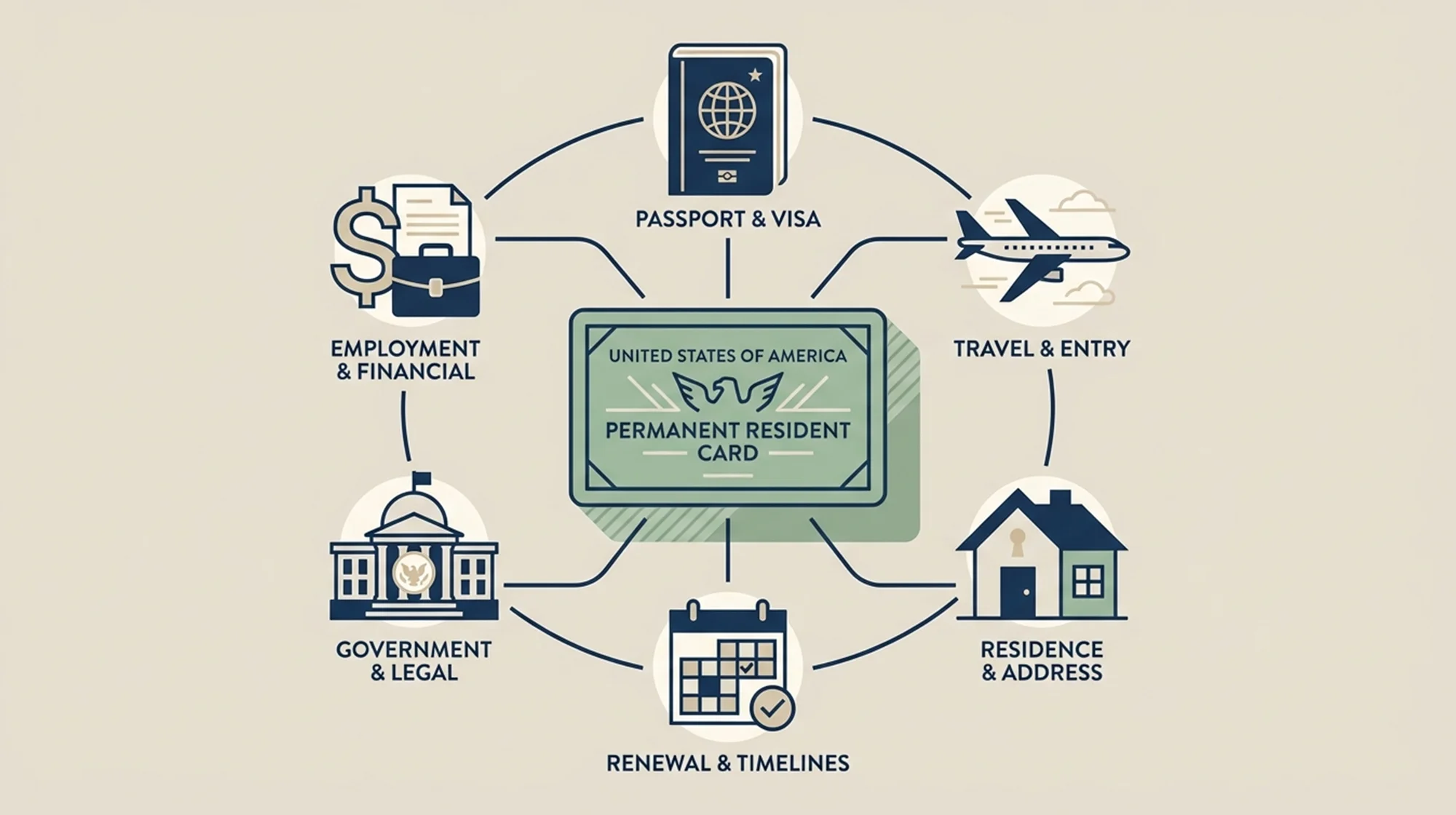
One of the first questions I hear from newly approved green card holders is: "Can I travel now?" The answer is yes — but traveling as a lawful permanent resident comes with a set of rules that are easy to misunderstand, and the consequences of getting them wrong range from a difficult conversation at the port of entry to losing your permanent resident status entirely.
In 2026, with CBP officers operating under heightened scrutiny instructions and border enforcement more aggressive than at any point in recent memory, the margin for error on travel-related mistakes has shrunk. This article is a complete guide to green card travel rules — what documents you need, what the legal thresholds actually mean, what a reentry permit does and does not protect, and what your options are if you cannot obtain a passport from your home country.

The green card — Form I-551, your Permanent Resident Card — is your proof that you have the right to live and work in the United States. It is not, by itself, a travel document in the full sense of that phrase. Here is how it actually functions at different points in your journey.
Leaving the United States. No special permission is required for a green card holder to depart the United States. You simply leave. Your green card does not need to be presented on the way out, though airlines may check it as part of routine document verification at check-in.
Entering a foreign country. To enter another country, you will generally need a valid passport from your country of citizenship. Your green card proves your U.S. residency status — it does not establish your identity or nationality for the purposes of foreign governments. Even countries that grant visa-free access to U.S. green card holders — including Mexico, Canada, and a number of Caribbean and Central American destinations — still require a valid national passport alongside the green card for entry. The green card reduces or eliminates the need for a separate visa in those countries; it does not substitute for the passport itself.
Returning to the United States. This is where your green card carries its primary weight. To re-enter the U.S. after a trip abroad, you must present a valid, unexpired green card. A CBP officer will review your card and any other documents — passport, national ID, U.S. driver's license — and determine whether to admit you. The green card is what establishes your right to return.
Domestic travel within the United States. For flights within the U.S., your green card functions as a valid government-issued photo ID under the REAL ID Act. You do not need a passport for domestic travel.
The practical implication: for international travel, you need both your green card and a valid passport. If your passport has expired or you are unable to obtain one, you are not necessarily without options — but the alternatives require advance planning. I cover those options in a dedicated section below.
Most green card holders have heard that staying outside the U.S. for more than six months is a problem, and that being outside for more than one year is worse. What is less well understood is exactly what each threshold triggers — and why the distinction matters.
Under six months. A trip of less than six months is generally treated as a temporary absence. CBP officers are unlikely to question your intent to maintain permanent residence, and there is no legal presumption of abandonment. "Generally safe" is accurate for this window, though it is not an absolute guarantee — a CBP officer can always ask questions about your ties to the United States, and if your answers suggest your life has shifted primarily abroad, the length of your trip is only one factor.
Six months to one year. Once a continuous absence exceeds six months, you are treated as someone seeking re-admission rather than simply returning from a trip. Under INA § 101(a)(13)(C)(ii), this means you become subject to the full grounds of inadmissibility at the port of entry. A CBP officer can now examine not just how long you were gone, but whether your ties to the United States — your home, your employment, your family, your tax filings, your bank accounts — remain the center of your life. An absence in this range does not automatically mean abandonment, but it creates a presumption that the green card holder must actively overcome with evidence.
One year or more. An absence of one continuous year or longer without a reentry permit generally renders your green card invalid for re-entry. Airlines may refuse to board you. CBP may deny your entry and initiate removal proceedings. The legal pathway back at this point is an SB-1 Returning Resident Visa, applied for at a U.S. embassy abroad — and these applications carry a high denial rate, requiring proof that the extended absence was caused by circumstances beyond your control and that you always intended to return.
The factors CBP considers in evaluating possible abandonment go beyond the length of the absence. Officers look at: whether you maintained a U.S. address, whether you continued filing U.S. taxes, whether you have a U.S. job or business, whether your family remains in the U.S., whether you retained U.S. bank accounts and memberships, and whether you disposed of your U.S. property before leaving. Filing taxes as a nonresident alien while abroad is treated by courts as effectively an admission of abandonment — a detail that surprises many clients.
If you plan to be outside the United States for more than six months — or certainly more than one year — you should apply for a reentry permit before you leave. Understanding exactly what this document does, and what it does not do, is critical.
What a reentry permit does. A reentry permit, applied for using Form I-131, is issued by USCIS and is valid for two years from the date of issuance. Its core function is to establish that you did not intend to abandon your permanent resident status during your absence. Possessing a valid reentry permit means that CBP cannot find abandonment based solely on the duration of your time abroad — as long as you return within the permit's validity period. It also allows you to apply for re-entry to the U.S. without needing to obtain a Returning Resident Visa from a U.S. embassy abroad.
A reentry permit can also serve as a travel document in countries that do not require a national passport — many countries will accept the permit in place of a passport for entry, placing visa stamps and entry records directly in the permit. Before relying on this, however, you must verify with each country of destination that they accept reentry permits in this way. This is not universal.
What a reentry permit does not do. This is the point that catches people off guard, and it is one of the most important distinctions in this entire article.
A reentry permit protects your green card status. It does not protect your eligibility for naturalization.
Naturalization requires five continuous years of residence in the United States (three years if you obtained your green card through marriage to a U.S. citizen), with physical presence in the U.S. for at least half of that period. A single trip abroad of more than six months creates a presumption that your continuous residence was broken — regardless of whether you held a reentry permit. A trip of more than one year automatically breaks continuous residence for naturalization purposes under the law, again regardless of the permit.
In other words: you can hold a valid reentry permit, travel for 18 months, return to the U.S. without any problem at the port of entry — and then find that your five-year naturalization clock has effectively restarted. Green card holders who plan to naturalize and are contemplating extended travel need to think carefully about the downstream effect on their citizenship timeline, not just their immediate ability to return.
If you intend to remain outside the United States for more than one year and want to protect your naturalization eligibility, Form N-470 (Application to Preserve Residence for Naturalization Purposes) may be an option in limited circumstances — primarily for U.S. government employees and certain other categories. For most green card holders, the most reliable way to protect the naturalization timeline is to avoid single trips beyond 180 days whenever possible.
How to apply for a reentry permit. You must apply for a reentry permit while you are physically present in the United States. You cannot apply from abroad. You must also attend a biometrics appointment at a USCIS Application Support Center before you leave — if you depart before completing biometrics, your Form I-131 will be denied.
Current processing times for Form I-131 reentry permits are running 14 to 17 months in 2026. This creates a critical planning problem: if you file 30 to 60 days before departure, as many people do, you will almost certainly be outside the U.S. for more than a year before the permit arrives. USCIS can send an approved reentry permit to a U.S. embassy or consulate abroad — which allows you to pick it up without returning to the U.S. — but the window between departure and permit arrival is a period of legal vulnerability. Plan and file as far in advance of your travel as possible.
A pending reentry permit does not provide the same protection as an approved one. If you are approaching one year outside the U.S. and your permit is still pending, CBP officers can still question your intent at the port of entry.
Not every green card holder has easy access to a valid national passport. Russian nationals currently cannot obtain passports through most normal channels due to the closure of Russian consular services across much of Europe and the restrictions on Russian embassy operations. Ukrainian nationals displaced by the conflict may face practical difficulties. Nationals of sanctioned or politically unstable countries may be unable — or unwilling, for safety reasons — to interact with their home government's consular offices abroad.
If you are a lawful permanent resident who cannot obtain a passport from your country of citizenship, here are the realistic options:
Reentry permit as a travel document. As discussed above, a reentry permit can serve as your primary travel document to and from the United States in some circumstances, and as a passport substitute for entry into countries that accept it. This is the most common solution for green card holders who cannot access their home country's consular services. The critical limitations are: you must apply while in the U.S., processing takes over a year right now, and you must verify destination country acceptance before relying on it.
Refugee travel document. If you were admitted to the United States as a refugee or have been granted asylum, you may be eligible for a refugee travel document rather than a reentry permit. A refugee travel document is also applied for using Form I-131 and is valid for one year. Importantly, refugees and asylees generally should not return to the country from which they fled — doing so can be used as evidence that the fear of persecution no longer exists, which can have severe consequences for your status.
Applying for U.S. citizenship. If you are approaching eligibility for naturalization, your most permanent solution to international travel complications is a U.S. passport. U.S. citizens travel on one of the most powerful passports in the world, with no green card abandonment concerns and no restrictions on travel duration. For many of my clients who are eligible and delay naturalization for cultural or emotional reasons, the practical travel benefits of citizenship are often the most compelling argument for filing the N-400 promptly. I cover the naturalization process in detail on the SG Legal Group naturalization services page.
Green card travel rules are not new. The 6-month and 1-year thresholds have existed for years. What has changed in 2026 is how aggressively they are being applied at ports of entry.
CBP officers are currently operating under expanded vetting mandates that direct heightened scrutiny toward lawful permanent residents returning from extended travel, particularly those from countries identified as high-risk under current executive orders. Secondary inspection — where you are taken to a separate area for detailed questioning — is significantly more common for returning green card holders than it was two or three years ago.
At secondary inspection, officers can ask detailed questions about your U.S. ties: where you live, where you work, whether you have filed taxes, what your bank accounts look like, why you were abroad for as long as you were. They may present you with Form I-407, a Record of Abandonment of Lawful Permanent Resident Status, and ask you to sign it voluntarily. This is the most important thing to know about that form: do not sign Form I-407 without first speaking to an immigration attorney. Signing it means voluntarily surrendering your green card. CBP cannot revoke your green card on the spot without a legal process — you have the right to a hearing before an immigration judge. A signature on I-407 waives that right.
For a full breakdown of your rights if you are detained or questioned at a U.S. port of entry, see my article on what to do if you are detained at a U.S. port of entry.
The following is not a substitute for legal advice specific to your situation — but it reflects what I walk through with clients before any international trip of significance:
Confirm your green card is valid and not expiring. A ten-year green card shows an expiration date on the card itself, but your status as a permanent resident does not expire with the card. However, airlines may refuse to board you with an expired card, and CBP may ask additional questions. Renew any card expiring within six months before traveling.
Know your absence history. If you have taken multiple trips abroad in recent years, total up the cumulative days outside the U.S. over the past five years. Even without a single long trip, repeated absences can cumulatively affect your naturalization eligibility and can raise CBP questions about your true center of life.
File for a reentry permit well in advance if you are planning to be outside the U.S. for more than six months. Given current processing times of 14 to 17 months, "well in advance" means more than a year before your planned departure if possible.
Maintain your U.S. ties on paper. Continue filing U.S. tax returns. Keep your U.S. bank accounts active. Maintain your U.S. address. If you own property in the U.S., do not dispose of it before traveling. These are the factors CBP and USCIS evaluate when assessing whether you intended to maintain your residence.
Carry documentation of why you were abroad. If your trip extended beyond six months for legitimate reasons — a family illness, a work assignment, circumstances beyond your control — carry documentation of those reasons when you return. A letter from a doctor, an employer, or other contemporaneous evidence of the circumstances is far more persuasive than a verbal explanation at the border.
Consult an attorney before any trip of significant length or complexity. If your trip will be long, if your home country is one of those under a travel ban or advisory, if you have a complicated immigration history, or if you are approaching naturalization eligibility and want to understand the impact of travel on your timeline — the consultation is far less expensive than the alternative.
If you have questions about your specific travel situation as a green card holder, or if you are returning from abroad and are concerned about your status, contact SG Legal Group for a consultation. Consultations are available in English, Russian, and Romanian.
Disclaimer: The information provided in this article is for general informational purposes only and does not constitute legal advice. Immigration laws and policies are subject to change, and individual circumstances vary. For advice specific to your situation, please consult with a qualified immigration attorney.
Oleg Gherasimov, Esq.
Stay informed with our latest articles and resources.